Green Night, a Dark Green Liberation and Solidarity Depicted by Female Queer Noir
Every human being encounters moments of confinement within a solitary room where they cannot prove their own existence. Days of alienation, spent holding one’s breath under the domination of another, until even one’s identity is forgotten.
The film Green Night follows two women cast into the very center of such blacked-out lives—a destructive yet beautiful journey wherein they finally locate their own names through the presence of one another. Their struggle to smash the walls of self-confinement and deviate from the orbits prescribed by the world violently awakens a long-buried longing for liberation within the audience.
🌿 Moments This Film Deeply Penetrates
- Those suffocating within a prison disguised as a socially prescribed safety net
- Those longing for the presence of a single individual who truly recognizes them amidst a thorny reality
- Those wishing to experience a destructive sense of liberation and a dense vortex of emotion triggered by merging with another
- Those who wish to witness the precarious yet beautiful solidarity of two women racing forward as they shatter the shackles of oppression
The reason to read until the end is that this review transcends the framework of a simple crime thriller to offer an in-depth interpretation of the narrative essence and emotional fluctuations through which two women reclaim their life sovereignty via each other’s existence.
🎞 Notes Prior to Viewing
- This work chronicles the survival struggle of two characters exposed to a violent and harsh reality.
- While raw and precarious scenes emerge during the depiction of physical and psychological oppression, these do not function merely as sensationalist direction, but rather serve as a narrative device that tightly binds the emotions and relationship of the two individuals.
🎬 Film Information
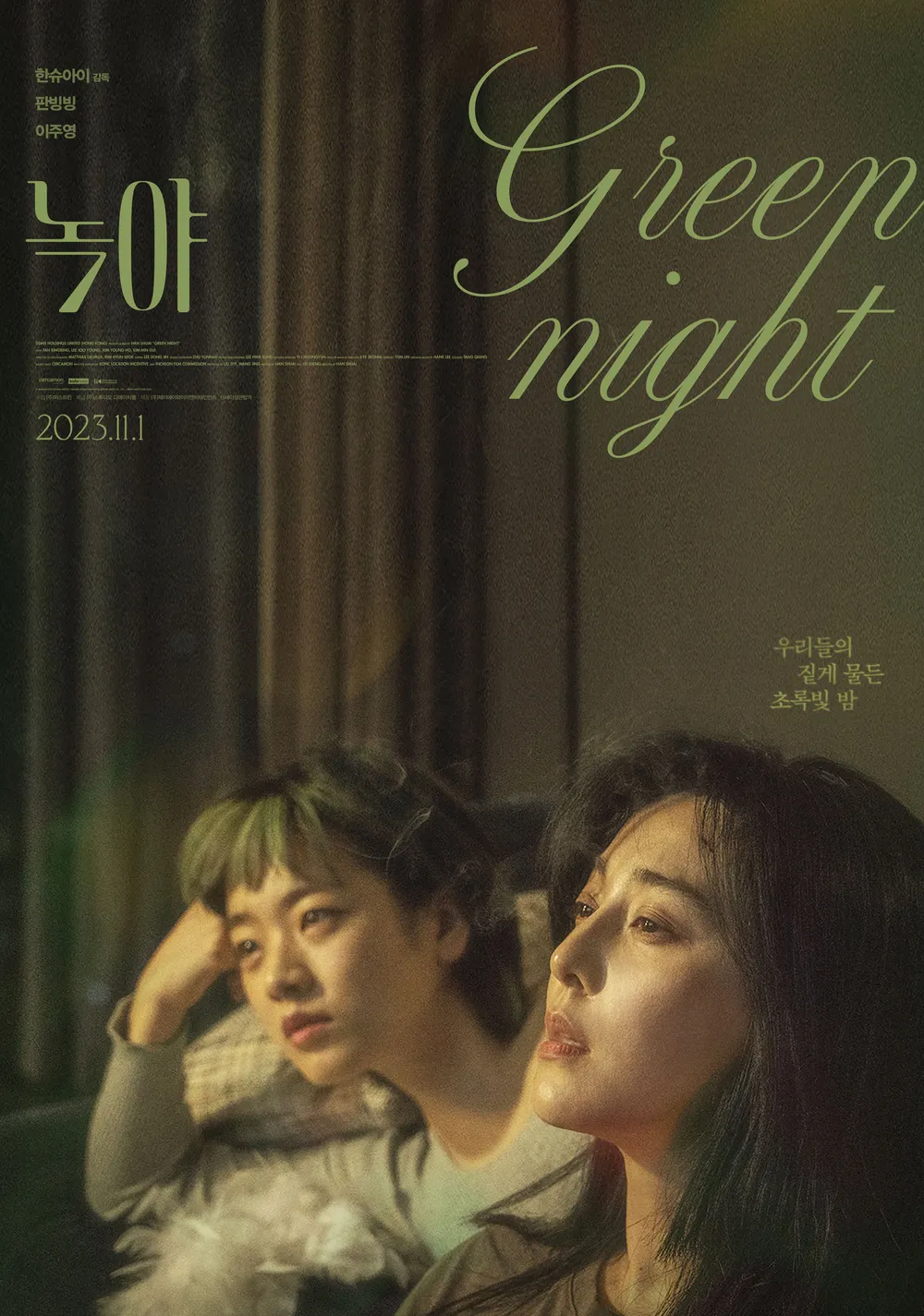
- Title: Green Night (2023)
- Director: Han Shuai
- Screenplay: Han Shuai
- Country: Hong Kong, China, South Korea
- Genre: Drama, Thriller, Queer
- Running Time: 92 minutes
- Platform: Wavve, Watcha, Naver Series On
- Cast: Fan Bingbing, Lee Joo-young
📖 Green Night, The Night of Two Women Racing Away from Oppression [Spoiler-Free]
Jin Xia (played by Fan Bingbing), a Chinese immigrant working at the security checkpoint of the Incheon Passenger Terminal, endures a helpless daily existence under her husband’s violence and control.
One day, a free-spirited, secretive woman with green hair passes through the checkpoint, fracturing her dry routine. Accidentally accompanied by the green-haired woman (played by Lee Joo-young), who is embroiled in a drug smuggling incident, Jin Xia is swept into an unpredictable vortex of events.
Seeking to escape a harsh, male-dominated world, Jin Xia and the hunted green-haired woman recognize each other’s deficiencies, commencing a dangerous solidarity for survival as they hurtle into the dead of night.
🟢 Analysis of Green Mise-en-scène and Character Structure Against Oppression
The green light dominating the interior of the film transcends a simple visual device, serving as a core symbol that represents the psychology of the characters. Green, which commonly signifies peace and safety, is modulated within this work into cold neon signs and uncanny lighting on night streets, constructing a precarious space of liberation.
If the monochromatic uniform worn by the protagonist Jin Xia signifies the conformity enforced by society, the vivid hair color of the green-haired woman reveals a heterogeneous presence that disrupts the system.
The two characters, who had been living in entirely different orbits, are drawn together like magnets under the shared tyranny of patriarchal violence, reaching a psychological resonance aimed at subverting an oppressive reality.
🏍 Velocity and Stasis: Emotional Curve Shifts Revealed via Spatial Contrast
While Jin Xia’s life was confined to the closed spaces of the Incheon airport and a dilapidated apartment, the green-haired woman is a fluid entity, constantly moving on a motorcycle.
The sequence in the middle of the film, where the two ride a motorcycle through the night streets of Seoul, constitutes the peak of emotional liberation depicted in this movie.
The process by which Jin Xia, who was forced into silence within controlled spaces, absorbs the speed and the wind with her entire body cleverly visualizes the internal shift wherein an oppressed ego awakens into an autonomous being.
🔎 Reinterpretation of the Ending: Traces of Dignity Left Behind After the Dense Night
In the final stages of the film, after the storm of the massive ordeal they had to endure passes, the camera fixedly captures the face of Jin Xia left alone.
The ending of this film thoroughly rejects naive romanticism—such as the notion that the relationship of the two has reached an eternal sanctuary—and instead coldly stares at the solitude and disconnection that must be borne by those who broke the rules of the world.
However, the fracture left by this ending is not ruin; rather, it functions as a structural milestone declaring a complete break from a past spent under the control of another.
Through the intense mirror of the green-haired woman, Jin Xia acquires internal dignity and complete growth, taking responsibility for and choosing her own life, even if she has lost something precious. The dawn air confronted by Jin Xia, unlike her previous silence, is an entirely independent space achieved through her own volition.
❓ Interpretations on the Achievement and Narrative Ambiguity of as a Female Queer Noir
Q. Some critics point out that the queer coding in the film is somewhat ambiguous and fails to develop into a conventional romance, leaving a sense of regret. How should this be interpreted?
From a critical perspective, disappointment is often expressed regarding the point where the sexual tension between the two protagonists halts without yielding the fruits of an explicit queer romance. However, this must be understood within the structural context that the film’s objective lies not in the completion of mere ‘love,’ but in ‘liberation’ and survival.
For them, physical intimacy was not a sentimental romance, but the only safe sanctuary protecting each other from a violent external world, and a confirmation of solidarity. The ambiguity of the romance functions instead as an aesthetic device that emphasizes the urgency of the reality faced by the two women.
Q. How should we view the criticism that the plot development and plausibility as a crime thriller in the latter half are insufficient?
The criticism that plausibility drops because the causal relationships of events or the resolution of conflicts with drug syndicates do not faithfully follow the grammar of genre films is valid. However, Green Night is a work that focuses on the psychological mutation curve of the two women confronting the events, rather than the meticulousness of the events themselves.
The loose narrative structure can be seen as an intentional omission to highlight the contradictions of the patriarchal social system and to convey the anxiety and chaos felt by the characters directly across the screen, leaving the final judgment to the audience.
✨ Green Night, Facing the Countenance of Dawn After Smashing the World That Confined Me
The conclusion of Green Night does not stop at merely showing the process of two women escaping crime, but poses a heavy question toward the invisible walls of oppression faced by women in modern society.
The cries of “I want to be born as a dog in the next life” or “I want to be a bad bitch” are akin to a declaration of war, flatly refusing the virtues of obedience and sacrifice that patriarchal society has imposed upon women. The film reveals the raw desires of women who plot survival even if it means crossing moral boundaries to occupy the position of perpetrators, opening a new horizon for queer and female solidarity.
True politics of liberation begin only when the moral innocence demanded of women is demolished.
💬 What Color Is Your Night?
We sometimes encounter moments when we must personally dismantle the blindfolds and handcuffs we believed kept us safe. Does the courage to deviate from the safe life orbit dictated by others and meet your own dawn hide within you as well?
At the boundary of that precarious race, one wonders if you would willingly hold an unfamiliar hand and plunge into the center of the night.
💜 Violet Screen’s Recommended Curation
- Reason for Recommendation: This work centers on the life of ‘Manok,’ a middle-aged woman who has operated a lesbian bar in a corner of Seoul for twenty years. Instead of the ‘beginning of love’ frequently covered in queer cinema, it delves deeply into the highly realistic and heavy themes of ‘generational conflict and survival within the queer community.’
The Little Sister / La Petite Dernière (2025)
- Reason for Recommendation: A masterpiece that shook critics, winning the Queer Palm at the 2025 Cannes Film Festival. It depicts the process of Fatima, a 17-year-old girl raised in a French-Algerian immigrant family, moving to Paris to study philosophy and awakening to her identity. Unlike universal queer films, it directs the taut psychological tension between religious values, responsibility toward family, and an undeniable identity with a cool tone akin to noir.
TODAY'S QUESTION
What's your favorite line from a WLW movie or show?
Your answer isn't saved. Feel free to share it in the comments below.


You May Also Like

A Perfect Ending: The Liberation of Repressed Desire and the Eternal Flight Left by Love
Same But Different (2019): Discovering Radical Hospitality and Love Beyond the Chaos of Identity