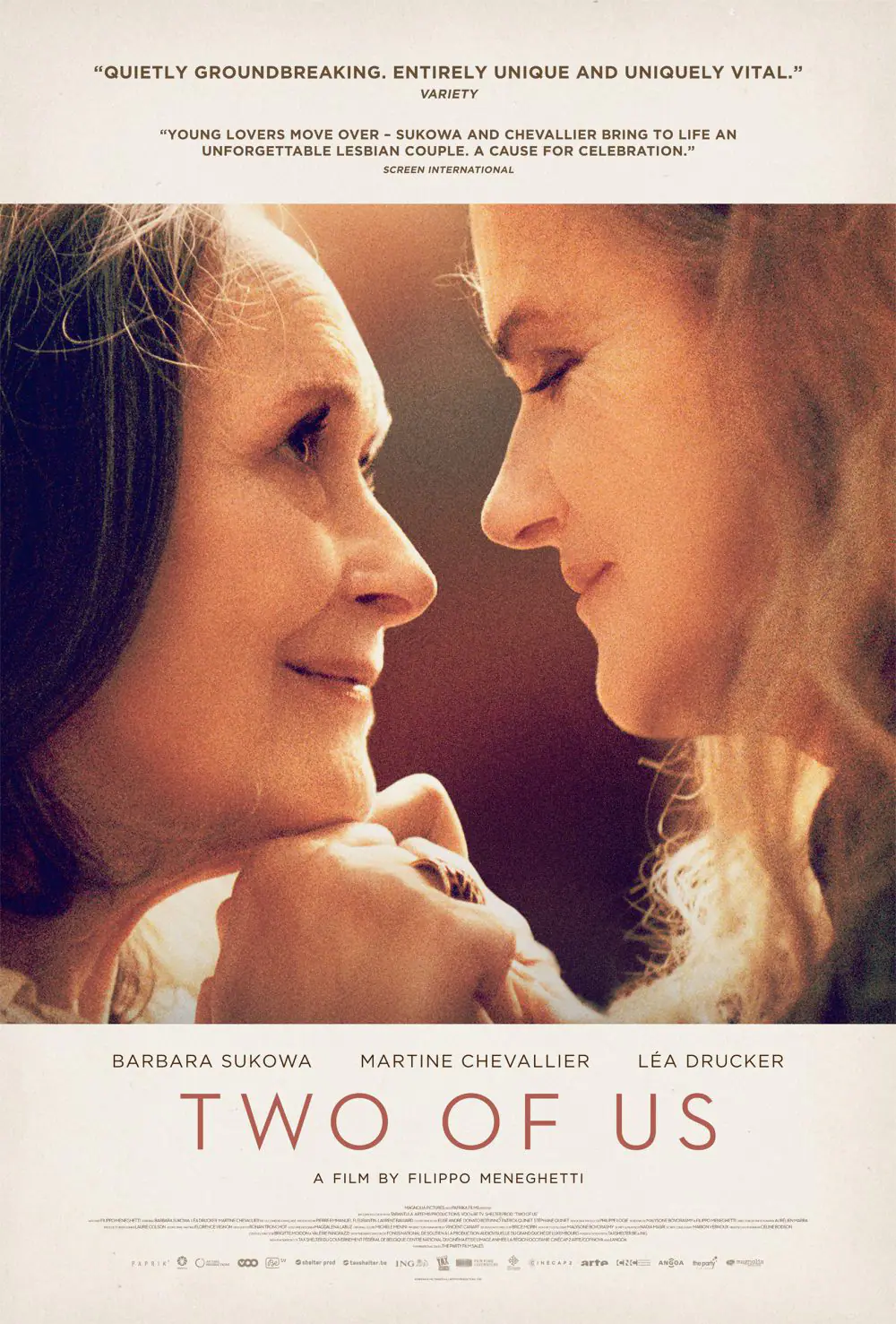
Two of Us: The Moment an Elderly Women’s Secret Queer Romance Becomes a Thriller
To love another human being completely is akin to a declaration that you will shoulder even the darkest secrets of the life they have built. The film Two of Us relentlessly digs into the solidarity between two elderly women who have spent their lives indulging in one another behind the refined mask of being mere neighbors, and the isolation that strikes when that secret crumbles.
This work does not simply linger as a beautiful twilight romance; rather, it uses a chilling grammar to demonstrate how societal perspectives and familial ignorance become the iron bars that imprison love.
🌿 The Moments This Film Deeply Permeates
- When the pretext of being ‘friendly neighbors’—the only relationship permitted by the world—ironically turns into a massive, insurmountable wall between each other.
- When facing the utter helplessness of a lifelong secret transforming into an eternal prison due to a single moment of silence.
- When witnessing the agonizing paradox where well-intentioned familial care systematically erases the individual’s autonomy and yearning.
- Therefore, you must read until the very end to discover the final door these two choices lead to at the edge of this suffocating emotional isolation.
🎞 Note Before Viewing
This work is an in-depth romantic drama that focuses on the depth of emotion and relationship rather than the explicit level of physical contact. It portrays late-life sexuality and love without distortion. Because it unfolds around psychological tension and emotional bonds between characters rather than violent or sensational stimuli, you may watch with peace of mind.
🎬 Film Information
- Title: Two of Us (2019, Original Title: Deux)
- Director: Filippo Meneghetti
- Screenplay: Filippo Meneghetti, Malysone Bovorasmy
- Country: France, Belgium, Luxembourg
- Genre: Drama, Romance, Thriller
- Running Time: 99 minutes
- Platform: Naver SeriesOn, CatchOn
- Cast: Barbara Sukowa, Martine Chevallier, Léa Drucker
📖 Two of Us: A Secret Fracture Between Neighbors Sharing a Single Hallway and a 20-Year Partnership [No Spoilers]
On the top floor of an apartment building in Montpellier, France, Nina and Madeleine live in apartments facing each other across the hall. To outward appearances, they are merely fond neighbors, but in reality, they are secret lovers who have spent over twenty years opening their doors daily to share their lives and emotions.
Unlike the free-spirited Nina, Madeleine lives hiding this truth from her children, whom she raised with her late husband. While the two agree to settle their apartments and move to Rome for true liberation, Madeleine continuously postpones coming out to her family.
Immediately following a minor argument triggered by this delay, Madeleine suddenly suffers a stroke that leaves her mute. Swiftly reduced to an outsider—a mere “kind neighbor”—Nina begins to slip into the apartment past the family’s watchful eyes to stay by Madeleine’s side, steering their relationship into an entirely new dimension.
🚪 The Grammar of a Domestic Thriller Built on the Gaze of the Peephole and Secrecy
As Two of Us enters its second half, it sheds the outer skin of a romance and adopts the form of a thriller utilizing spatial oppression. Director Filippo Meneghetti transforms the top-floor hallway the two women once shared from a simple corridor into a psychological battlefield of power and exclusion.
In particular, the small peephole in the apartment front door recurs as a core element of mise-en-scène, symbolizing Nina’s isolation and the gaze of the outside world. This mechanism, which rigidly separates the inside from the outside, visually amplifies the heteronormative defensive line established by Madeleine’s daughter, Anne, and the profound deficiency driving Nina to puncture it. The lies and unauthorized entry Nina resorts to should not be interpreted as mere obsession; rather, they represent a suspense-filled struggle by those erased from institutional relationship networks to reclaim their rightful place.
🧠 Physical Confinement via Aphasia and the Analytical Structure of the Bond of Gazes
The narrative choice to strip Madeleine of her speech through a stroke functions as the film’s most tragic yet sophisticated relational device. The severance of language permanently deprives Madeleine of the opportunity to voluntarily disclose her identity to her children, yet it yields the paradox of restricting her communication with the outside world strictly to her sensory connection with Nina.
The children present a cat as a gift or hire a caregiver under the guise of doing what is best for their mother, but this amounts to a well-intentioned violence carried out while completely ignoring Madeleine’s internal desires. Only Nina detects the subtle shifts in Madeleine’s gaze and gestures, a point that sharply indicts how easily patriarchal society erases an elderly woman’s sexual identity and agency as the mere ‘caprice of a sick elderly person.’
🔎 Reinterpretation of the Ending: Absolute Solidarity of the Dance Melody Resonating Beyond the Closed Door
Rather than simply illustrating whether the pair succeeds in escaping, the film’s ending illuminates the essence of a bond that refuses to fade even in the face of a social death sentence. Endangered by isolation from her children and threatened with relocation to a care facility, Madeleine ultimately faces Nina once again inside the disheveled apartment. The order of the outside world and legal relationship networks thoroughly attempted to destroy and isolate them, but the moment the two feel each other’s warmth and step in time to the background music, all societal constraints lose their power.
Without concealing the realistic limitations the two will face, this ending declares that the territory of love they have constructed remains an unassailable sanctuary. Amid physical decline and social severance, what they have acquired is an absolute certainty toward each other’s existence, and what they have lost is only the fear that once craved the approval of others.
Their final dance fractures the prison of normalcy defined by external gazes, standing as a transcendent victory of a love that becomes whole solely through the existence of one another.
❓ Interpreting the Narrative of Two of Us
Q. Why does the care provided by Madeleine’s children feel violent?
Anne and the other children do not control Madeleine out of malice. Rather, they care for their mother with deep filial piety and concern, but their ignorance stems from an inability to conceive that their mother has lived a ‘hidden life’ concealed for decades.
The history of the sweet mother that the children believe in is merely a script imposed by heteronormative familialism, and the act of excluding Nina to maintain that script becomes, inherently, a structural violence that annihilates the subject’s autonomy.
Q. What is the aesthetic distinction of this film as an elderly queer narrative?
While many conventional queer films replicate the identity struggles of the younger generation or clichés of tragic deaths, Two of Us unreservedly reveals that a passionately pulsing sexual desire and a yearning for life still exist within the elderly.
The film directly confronts the social prejudice that dismisses aging as the extinction of desire, showcasing a mature form of love where decades of layered comfort and sharp tension coexist. Critically speaking, preferences may vary as some might argue the characters’ choices are consumed by extreme thriller devices, but this can be viewed as an inevitable directorial choice to express the desperation of the marginalized.
✨ Two of Us, A Twilight Bond of Dignity Breaking the Prison of Secrecy
The conclusion of Two of Us hurls a heavy question at those of us living in the present regarding the essence of family and the qualification to love. Through the characters’ emotional trajectory, the film meticulously tracks whether the mere sharing of blood grants the right to control a human being’s deepest longings, or whether decades of solidarity can be erased simply because it stands outside institutional systems.
Identity and emotional solidarity are not proven by the permission of others or by social documentation. This work concludes with a declarative sentence showing that true union does not stem from the validation of a system, but solely from an unrelenting gaze and mutual dignity.
🪟 Lingering Impression & Discussion Question
A gaze that recognizes each other even within silence possesses a strength far more resilient than any rigid institution of the world.
Between the ‘tranquil old age’ defined by children and the ‘perilous love’ yearned for by Madeleine, which door would you choose to leave open in the final moments of your life if you were Madeleine? Please share your deep thoughts in the comments.
🍇 Violet Screen’s Curated Recommendations
- Life Unrehearsed (2025): A work that honestly captures through a documentary lens the twilight reality faced by Madeleine and Nina in Two of Us. It depicts the daily lives of two women who met forty years ago in Germany as an expatriate nurse and a hospice leader, serving as each other’s haven for the remainder of their days as first-generation immigrants, migrant workers, and lesbians. In place of fictional dramatic suspense, the dignity and steadfast solidarity of elderly women proven by life itself leave a heavy, resonant wave deep in the heart.
- Who’ll Stop the Rain (2023): A Taiwanese independent film that shares the emotional wavelength of Two of Us in that the characters defy structural orders oppressing class or identity to become each other’s liberation. Set against the backdrop of the 1994 campus student strikes in Taiwan following the lifting of martial law, it charts the emotional maelstrom experienced by Wei-ching, a freshman fine arts student, upon meeting the free-spirited upperclassman Ching. Amid the harsh storms of the era and the patriarchal power structures within the university, the process of two young women finally discovering their own art and identity through their longing for each other unfolds via sensory mise-en-scène.
TODAY'S QUESTION
Is there a hidden gem you always recommend to friends?
Your answer isn't saved. Feel free to share it in the comments below.


You May Also Like
Homeward Bound (2025) Analysis: The Aesthetic of Cracks Created by Isolated Truths and the Desire for Solidarity
La Graine (2023) Review: Love and the Conditions of Family Beyond the Boundaries of Normativity