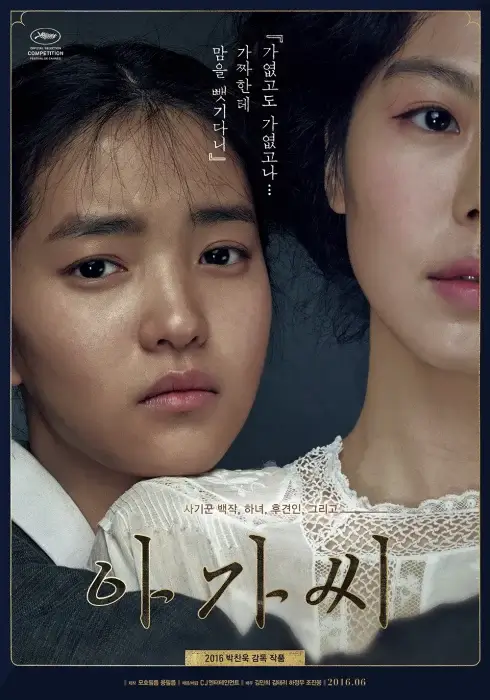
The Handmaiden (2016) Analysis: Park Chan-wook’s Aesthetic Liberation and the Solidarity of Destructive Desire
Love sometimes blooms atop the most sophisticated deception. In a garden designed to destroy others, a twisted salvation wrought by two women who recognized each other’s deficiencies poses a question: do you have the courage to break the fences that imprison someone in order to fully possess them?
The film The Handmaiden depicts the burning solidarity of two women who tear down a fortress-like library built upon the bloated desires of men, set against the cold landscape of colonial Korea. This article is a record of how they transformed from each other’s “destroyers” into “saviors.”
🌿 The moments when this film especially seeps in
- When you feel a desperate longing for someone’s touch amidst a suffocating sense of isolation, as if all the world’s doors have closed.
- When a desire for liberation wells up, urging you to cast off the social status and masks that define you.
- When you wish to witness that dizzying sensation of the moment a relationship born of lies transforms into truth.
- Therefore, you must read this to tear down your own internal walls through the catharsis found in the destruction of the “library,” the symbol of oppression.
🎞 Note Before Viewing
While this work features high levels of physical violence and sexual depiction, these are essential devices used to express the transference of senses and the subversion of power structures. We recommend approaching it as an adult dark fairy tale centered on mise-en-scène, meticulously designed to portray psychological distance and a sense of liberation beyond mere provocation.
🎬 Film Information
- Title: The Handmaiden (아가씨, 2016)
- Director: Park Chan-wook
- Screenplay: Chung Seo-kyung, Park Chan-wook
- Original Work: Sarah Waters’ novel Fingersmith
- Country: South Korea
- Genre: Thriller, Drama, Romance
- Running Time: 144 min (Extended: 167 min)
- Platform: Netflix, TVING, Watcha, etc.
- Cast: KIM Min-hee, KIM Tae-ri, HA Jung-woo, CHO Jin-woong
📖 The Handmaiden Synopsis: Three Perspectives Where Deception and Truth Intersect [No Spoilers]
In 1930s colonial Korea, a swindler calling himself a Count approaches Lady Hideko, the noble heiress to a vast fortune. His goal is to win Hideko’s heart, marry her, and then institutionalize her in a psychiatric hospital to seize her inheritance. Sook-hee, a handmaid recruited as an accomplice for this plan, begins monitoring Hideko’s every move and brainwashing her to admire the Count.
However, Hideko—who has lived her entire life in isolation under the strict surveillance of her uncle Kouzuki within a massive manor—feels a strange curiosity and affinity toward the poor but vibrant Sook-hee. Sook-hee also wavers precariously between guilt and compassion as she witnesses the loneliness of the seemingly naive lady. Within the manor where fraud and sincerity, surveillance and seduction intertwine, the desires of the three characters begin to spiral in different directions.
🚪 The Library as a Prison: Deconstructing the Male Gaze and Fetishistic Collectivism
Kouzuki’s library in the film is not merely a place to store books. It is a massive prison where the perverse desires of men are taxidermied, grotesquely combining Western architecture and Japanese gardens. Hideko is reduced to a “living tool” for the visual pleasure of men, forced to perform readings there.
Director Park Chan-wook maximizes Hideko’s isolation by staging this space with highly symmetrical and overwhelming compositions. However, a crack forms when Sook-hee enters this space. Sook-hee does not recognize the value of the library; rather, she ridicules its symbols. Sook-hee’s ignorance is a direct disregard for established power, serving as the catalyst for liberation that demotes the world Hideko has feared all her life to mere scraps of paper.
🦢 When the Fake Saves the Real: Interpreting the Dual Relationship Structure of The Handmaiden
The core engine of The Handmaiden lies in the process of “fakes” finding “real” emotions. Sook-hee and the Count enter the manor under false identities, and Hideko has spent her life reading novels in a fake voice. Within this play-like existence, the physical and psychological communion shared between Sook-hee and Hideko becomes the only reality.
Specifically, Sook-hee’s acts of filing Hideko’s tooth or helping her bathe demonstrate a primordial aesthetic of care. This stands in stark contrast to the calculated seduction displayed by the Count. Sook-hee’s raw sincerity breaks down the defensive mechanisms Hideko has worn; as a result, the two choose a grand collusion to deceive the world rather than continuing the play of deceiving each other. Their interpretation converges on the sentence: “My savior who came to ruin my life.”
🔎 Reinterpreting the Ending: A Solidarity of Severing the Snake’s Head and Crossing the Wall
In the film’s finale, the two women damage the books—symbols of the sadistic narratives constructed by men—and escape by smashing the head of the snake statue. This ending is not a mere flight; it signifies a complete severance from the masculine language and gaze that once defined them.
The scene of Sook-hee and Hideko running through the fields provides a visually vast sense of liberation. While the men in the manor they left behind meet their ruin, consumed by their own desires, the two women move toward a new world transcending borders and status. The sound of the bells in the ending is no longer an instrument of oppression but is transmuted into a symbol of their own play and freedom. Sook-hee and Hideko’s escape is a subjective birth achieved by slaying their past selves. By destroying the very frame that imprisoned them, they declare a life as partners to one another, belonging to no one else.
💬 The Handmaiden FAQ: Interpreting Content Rating and the Essence of Women’s Narrative
Q1. How do you view the criticism that the explicit sexual depictions are a product of an excessive “male gaze”?
Certainly, the erotic scenes in this film are aestheticized and direct. Some critics point out that these ultimately satisfy the voyeurism of male audiences. However, from a structural perspective, these scenes represent the process of Hideko overwriting the “fake sexuality” she was forced into in the library with “real play” with Sook-hee. It is important to note that the two women mock that authority by practicing as subjective pleasure the fantasies that men only enjoyed as text.
Q2. Compared to the original Fingersmith, has the ambiguity of the cinematic ending been resolved?
While the original focused more on class conflict and plot twists, Park Chan-wook’s interpretation prioritizes aesthetic perfection and emotional catharsis. Unlike the somewhat cynical atmosphere of the original, the film clearly declares the victory of the two women. This clarity, combined with the historical background (colonial Korea), reinforces the double meaning of the escape of the oppressed (Hideko/Korea/Woman) from the oppressor (Kouzuki/Japan/Man).
✨ What The Handmaiden Left Behind: A Destructive Love Crossing an Era of Oppression
The Handmaiden is a film that shows how love can become a political weapon. The relationship between Hideko and Sook-hee goes beyond simple romance; it is a rejection of all structural violence that sought to imprison and define them. Before the invisible glass walls and social gazes that still exist in 2026, this film whispers to us: the only thing capable of breaking the walls that confine you is absolute trust in another who will take your hand.
True liberation begins not with turning away from the world that oppresses me, but with the courage to destroy the heart of that world and walk out of it.
🔔 “My savior who came to ruin my life, my Tamako, my Sook-hee.”
When betrayed by the one you trusted most, do you dream of revenge, or do you find the courage to face the truth behind it? If you were in Hideko’s position, could you have taken the hand of Sook-hee—who intended to deceive you—and crossed that wall? Please share your thoughts in the comments.
📽 Violet Screen Curation: Chronicles of Other Women’s Solidarity
- Bottoms (2023): If The Handmaiden is an elegant and desperate drama of liberation, this film is a story of girls overturning high school power structures with a cheeky, quirky B-movie sensibility. Experience a playful variation that reveals teenage women’s desires without filter.
- Green Night (2023): Depicts two women meeting in a foreign land and relying on each other to break through desperate circumstances. You can feel a strange yet intense bond blooming within an oppressive environment, much like in The Handmaiden.
To provide a more stable publishing environment, multilingual content, and better communication with our readers, we have moved our official publication to Substack.
All new film reviews and critical essays will be published on our new platform. This website will be closing down soon, so we would greatly appreciate it if you subscribed to our new space.
TODAY'S QUESTION
What's your favorite line from a WLW movie or show?
Your answer isn't saved. Feel free to share it in the comments below.


You May Also Like

when night is falling: Gliding Freely to Break the Ice of Oppression, a Classic Reinterpretation of Female-Centric Romance

The Feels (2017): Fissures Between Ennui and Truth, the Raw Face of Obsession-Driven Relationships