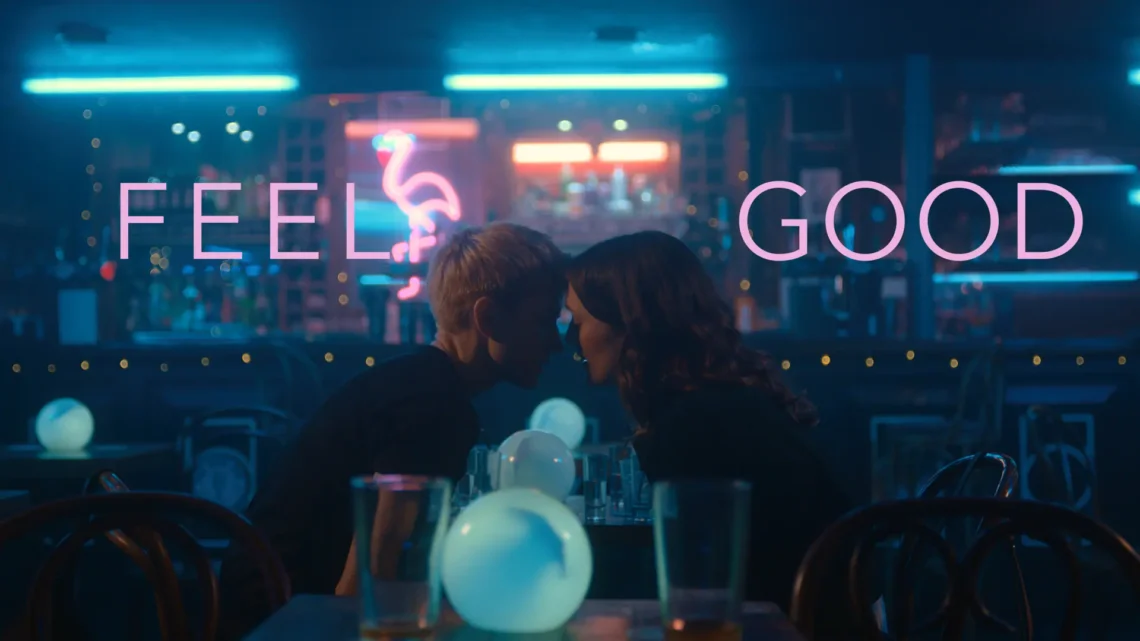
Feel Good Review: A Record of Complete Deconstruction and Dignity Beyond Addiction and Codependency
The emotion we call love is often packaged as another name for salvation, but sometimes it becomes the sweetest form of anesthetic. We constantly strive to cover the vast, unfilled voids within ourselves with the presence of another, often mistaking this desperate act for genuine solidarity.
The drama Feel Good (2020–2021) is a work that tears open the gift-wrapping of this splendid illusion with the most harmless face, yet through the sharpest lens imaginable.
🌿 Moments When This Drama Deeply Permeates
- For those who have ever clung to someone like a cure to mask their own deficiencies
- For those who want to confront the suffocating trajectory carved out by codependency masquerading as love
- For those who wish to exist entirely as themselves, shedding the restrictive frameworks of identity imposed by society
- And why you must read to the end of this painful yet brilliant journey of healing to face your true self
🎞 Note Before Watching the Drama
This work directly addresses drug addiction and trauma (PTSD) stemming from past emotional and sexual exploitation. Although the focus remains on the psychological shifts and personal growth of the characters rather than gratuitous depiction, please be advised that certain episodes may leave a powerful and emotionally heavy lingering impression.
🎬 Drama Information
- Title: Feel Good (2020–2021)
- Director: Ally Pankiw, et al.
- Screenplay: Mae Martin, Joe Hampson
- Country: United Kingdom 🇬🇧
- Genre: Comedy-drama / Romance / LGBTQ+
- Running Time: Seasons 1–2 (12 episodes total, approx. 30 minutes per episode)
- Platform: Netflix
- Cast: Mae Martin (as Mae), Charlotte Ritchie (as George), Lisa Kudrow (as Linda)
📖 Feel Good, A Road Map of Healing to Break the Cycle of Addiction and Reach One Another [No Spoilers]
Mae, a Canadian stand-up comedian living in London, is navigating a precarious day-to-day recovery after escaping a history of severe drug addiction. One night, she meets George in the audience of her show and falls intensely in love at first sight. George, a primary school teacher who has only ever dated men, is drawn to Mae’s unfiltered charm, and the two rapidly become a couple.
However, Mae’s deep-seated anxiety and George’s identity confusion soon create fractures in their relationship. Instead of substances, Mae begins to rely on and obsess over George’s presence with frightening intensity, while George, paralyzed by social expectations, attempts to hide Mae from her world. The void felt by Mae as she becomes a hidden partner, paired with George’s fear of losing her own identity, quickly propels the two toward a massive psychological turning point.
🧠 Mirror Therapy Penetrating the Mechanism of Addiction: The Narratology of Dependency
💊 From Substance to Person: Mae’s Love as a Substitute
What makes Feel Good stand out most is its relentless capture of the human instinct to heal one addiction with another. For Mae, George is not merely a partner, but a replacement drug capable of instantly filling her internal emptiness.
In the series, Mae’s obsession exhibits a classic anxious attachment style, whereas George adopts an avoidant stance, refusing to step out of her comfort zone. Within this structural imbalance, Mae is wounded by the stigma of being a “hidden partner,” while George feels overwhelmed by Mae’s crushing emotional weight. Through this precarious dynamic, the work persuasively demonstrates that the desperate craving for another ultimately stems from a fundamental discord with oneself.
🚪 The Comfort of the Closet and the Chill of the Outside: George’s Liminal Identity
George is a character who has spent her entire life within the safety net provided by the heteronormative order. She loves Mae, but she knows that the moment she declares this love, the perfect world surrounding her will crack.
Her compromise—introducing Mae to her friends as just a “good friend”—inflicts a deep wound of existential denial on Mae. The series depicts George’s journey out of the closet not as a heroic struggle, but as an intensely realistic and painful growing pain where she must confront her own hypocrisy and accept her personal limitations.
⛓ Asymmetry of Power and the Reconstruction of Trauma: The Ghost of the Past
In Season 2, the core axis deepening the narrative is Mae’s teenage trauma. The asymmetric relationship she had with a much older figure in her youth was a clear case of emotional exploitation disguised as romance.
Mae experiences severe PTSD in the process of admitting she was a victim, which serves as the key to explaining why she was so obsessively terrified of abandonment in her current relationship with George. Tracking the origin of this wound lends three-dimensional depth to the characters, securing an intellectual and psychological weight that transcends simple queer romance.
🔎 Reinterpreting the Ending — Independent Solidarity Born of Complete Deconstruction
The two eventually hold hands once more, but this path strictly avoids the conventions of a “fairytale happy ending.” The shared breath between Mae and George in the final moments is not the union of mutual saviors patching up each other’s holes, but a mature declaration of companionship—an agreement to walk side-by-side while fully embracing their respective wounds and anxieties.
Mae has reconciled with her own helplessness by confronting her past abuser, and George has accepted her own unstable emotions instead of conforming to society’s standardized identities. The true healing attained by the two begins only when they abandon the helplessness of mutual dependency and stand face-to-face as whole individuals. The ending they present leaves us with the solemn truth that love is not a panacea for life, and that only those who have saved themselves can maintain a healthy distance and form true solidarity with another.
❓ Deep Dive FAQ: Feel Good’s Ending and Narrative Structure
Q. How does Mae’s exploration of non-binary identity function within the narrative?
The series does not weaponize Mae’s gender identity as a dramatic plot twist or a tool for conflict. By Season 2, Mae quietly realizes they do not fit neatly into the narrow box of being a “woman,” which is portrayed as a natural part of self-discovery rather than a grand manifesto. This depiction—reflecting the real-life identity of actor Mae Martin—offers viewers a sense of ease by refusing to force rigid labels onto the character.
Q. How should we interpret the selfish aspects of George’s behavior toward Mae?
The defensive and avoidant attitude George displays in the early stages undoubtedly inflicts emotional violence upon Mae. However, the work refuses to frame George as a villain. By bringing three-dimensional nuance to the identity-related terror experienced by someone who has lived as part of the heteronormative mainstream her entire life, it shows how anyone can become cowardly to protect their own peace of mind. By acknowledging this limitation and eventually dismantling her own closet, George transcends the role of a mere observer to stand as an active subject of the narrative.
✨ Feel Good: On the Dignity of Loving Another Without Losing Oneself
Feel Good flatly denies the romantic fantasy that love can cure all pain, asking instead how wounded individuals can coexist without destroying one another. The essence of a relationship is not to become interlocking cogs that plug each other’s deficiencies, but to become a binary star system—each orbiting its own path while illuminating the other. True love is completed only when one preserves the solitary dignity of refusing to use another person as an escape hatch for one’s own life.
💬 What kind of distance does your universe maintain?
We often choose a love in which we lose ourselves because we cannot bear our own loneliness. Are you showing your whole, authentic self to the person beside you right now, or are you holding them close as an anesthetic to hide your own emptiness? We pose this question to your precarious heart.
🗺 Violet Screen’s Curated Path: Other Relational Trajectories
- If you want to see the delicate calibration of two people walking at different paces:
- 《Fragrance of the First Flower》 (2024–2025): Depicts the psychological whirlpool experienced by two women who were intensely drawn to each other in their school days but parted due to social pressures, only to cross paths again as adults.
- If you want an emotional register that quietly gazes into bruised inner worlds:
- 《Unlock Your Love》 (2024): Breaking away from the cliché-ridden mainstream school dramas, this Thai GL series portrays the healing process of two women, each carrying deep inner wounds and deficiencies, as they meet and unlock the heavy latches of their hearts.
To provide a more stable publishing environment, multilingual content, and better communication with our readers, we have moved our official publication to Substack.
All new film reviews and critical essays will be published on our new platform. This website will be closing down soon, so we would greatly appreciate it if you subscribed to our new space.
TODAY'S QUESTION
What's your favorite line from a WLW movie or show?
Your answer isn't saved. Feel free to share it in the comments below.


You May Also Like
Harlem: A Journey of Self-Discovery Born from the Chaos of Sexual Fluidity

An In-Depth Analysis of Kick (2007): The Fencing Match of Gender & Sexual Identity, and the Courage to Shed Social Masks