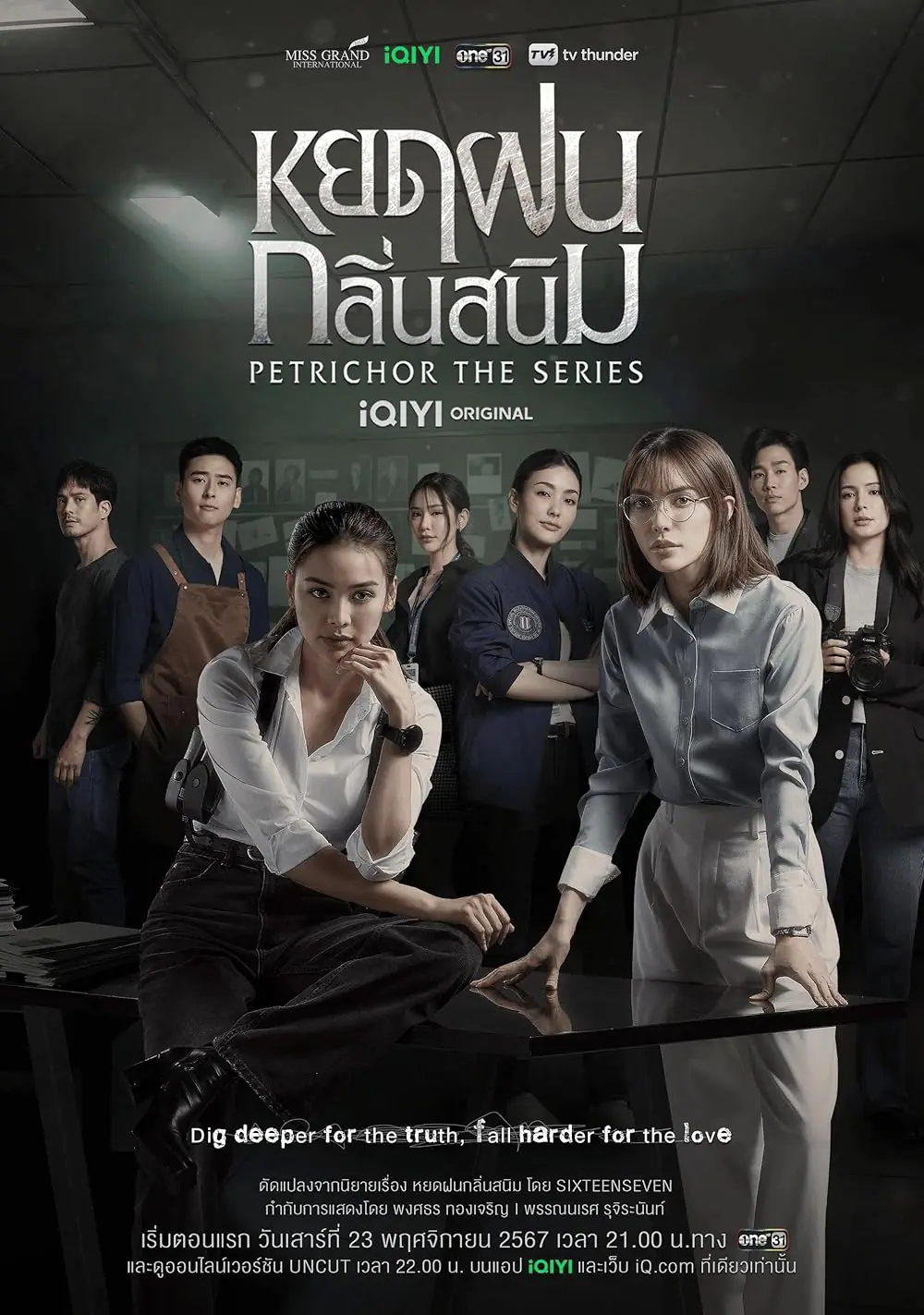
Petrichor The Series: Raindrops Falling on a Cold Corpse, A Fierce Solidarity of Two Women Proving Loss
The scent of loss is usually at its most potent after the rain has fallen. The meeting between a forensic pathologist who faces the coldest moments of others, and a detective who tracks down their hottest rage, is in itself a massive fissure and an inevitable gravitational pull. Moving beyond the conventional grammar of a crime thriller, <The (หยดฝนกลิ่นสนิม) Petrichor Series> meticulously traces a journey of salvation where two women, each harboring her own hell, sense and heal each other’s scars.
While we all yearn to be fully understood by another, we simultaneously fear exposing our deepest deficiencies. Piercing through the fissures of these contradictory emotions, this drama speaks of the miracle of finding the one person with whom to share warmth in a cruel world of freezing rain.
🌿 Moments When This Drama Deeply Permeates
- On a night when you have grown accustomed to shutting the door to your heart and maintaining distance from others due to past wounds.
- When you wish to witness the peculiar tension and the birth of trust that arise when rational logic and heated emotions collide.
- When you crave a mature female narrative that refuses to avert its gaze from the other, even in the face of a cruel world’s absurdities.
- Therefore, the reason to read until the very end is to verify the true essence of a relationship—how two women became each other’s psychological anchors and averted ruin amidst the catastrophe left by a massive plot twist.
🎞 Notes Before Watching the Drama
Due to the nature of the crime thriller genre dealing with serial murder cases, this work presents a somewhat heavy and suspenseful atmosphere during investigation and forensic analysis scenes. However, it eschews provocative direction that relies solely on visual stimulation or sensationalism; it is a densely packed, relationship-driven work focusing on the deepening emotional bond and spiritual partnership between the two protagonists as they resolve the case.
🎬 Drama Information
- Title: Petrichor The Series (Original Title: หยดฝนกลิ่นสนิม) (2024~2025)
- Director: David Bigander
- Screenplay: Kanokphan Oratree, Rangsima Atiprayoon
- Original Work: Amabass web novel of the same name
- Country: Thailand
- Genre: Crime Thriller, Procedural, Romance
- Running Time: Approximately 45 minutes per episode (10 episodes total)
- Platform: iQIYI, One 31
- Cast: Engfa Waraha, Charlotte Austin
📖 The First Step of Two Women Tracking the Cruel Truth Hidden in the Raindrops [No Spoilers]
Tul, a passionate rookie detective newly assigned to the Criminal Investigation Department (CID), encounters Ran, a cold and rational forensic pathologist, at her first major crime scene. Tul, the hot-headed woman of action, and Ran, the cold woman of logic, clash at every turn due to their differing investigative styles, establishing a tense confrontation.
However, when a copycat crime bearing the signature of the “Raindrop Killer”—the serial murderer who took Ran’s mother 18 years ago—occurs, their relationship enters a new phase. Intertwining personal trauma with professional duty, Tul and Ran begin to recognize each other’s brilliance and sincerity, gradually transforming into an unparalleled partnership. Unaware that the shadow of a massive conspiracy is closing in on them, they step forward together toward the cruel truth hidden within the rain-soaked puddles.
🌧 The Perfect Intersection of Emotion and Reason Charted by Petrichor, and an Interpretation of Narrative Completeness
👥 From Animosity to Adoration: A Professional Venture into the ‘Enemies to Lovers’ Framework
The core appeal of Petrichor lies in how the two polarized characters, Tul and Ran, permeate one another. Tul’s reckless sense of justice acts as a hammer striking Ran’s closed interiority, while Ran’s precise logic serves as a buffer to cool Tul’s overheated emotions.
The relationship between the two does not follow the typical romance formula that begins with personal attraction and develops hastily. It is constructed entirely on professional partnership and mutual respect, demonstrating a sophisticated psychological narrative where the trust accumulated with each case resolution transitions directly into romantic tension.
🩸 A Past Stained with Blood and Rainwater: The Aesthetics of Shared Trauma
The drama utilizes an intelligent directorial choice that transmodes rain from a symbol of death into a medium of healing. For Ran, rain is the scent of pain (Petrichor) reminiscent of her mother’s death, but the moment she is drenched in the rain with Tul, that space is redefined as a sanctuary.
This curve of emotional transition reaches its peak during the suspect pursuit in the mid-section of the series. The moment they realize they are the only existence to whom they can entrust their respective backs, their communion transcends mere romantic feelings and escalates into an absolute solidarity for survival.
🔎 Reinterpretation of the Ending — Dignity and a Solidarity of Salvation Blooming Upon a Ruined World
The truth Tul confronts in the final episode, “No Rain, No Flower,” was harsh. The fact that her older brother Tin, who had been her perfect moral anchor, was the actual perpetrator behind the “Raindrop Killer” who murdered Ran’s mother, completely shatters Tul’s world. Pointing a gun at her brother while shedding tears in the enclosed space of an abandoned gymnasium, Tul’s internal conflict serves as the most catastrophic climax this drama achieves.
Here, the ending does not merely rest on poetic justice through the arrest of the criminal; it focuses on the choice Tul makes amidst the blind shackles of blood relations and systemic corruption. By shooting her brother, Tul chooses public justice over private revenge or family concealment, but loses the greatest part of her soul as the price.
Ran exists within this space of acute sorrow. Even in the face of the tragedy where the target of vengeance is Tul’s family, Ran does not resent or push Tul away; instead, she becomes a massive pillar supporting her collapsed world.
Tul lost the safety net of family but gained the absolute salvation of Ran, and their bond is evidence of mature growth—bearing the scars together rather than erasing the wound.
The bittersweet lingering impression that the case is resolved but the rotten roots of the system have not been entirely extirpated paradoxically hardens the solidarity of the life the two women will live together moving forward, leaving behind a profound aesthetic of salvation.
💬 Regarding the Narrative Structure and Ending Interpretation of Petrichor The Series
Q. How should we interpret the criticism that Tin’s criminal motive and the shift toward family drama in the latter half diminish the suspense of the thriller?
Some viewers express regret, stating that the revelation of the genius serial killer’s identity as Tul’s brother and his motive being childhood abuse trauma feels somewhat like a repetition of a conventional narrative.
However, this structural shift must be understood as a device to test the moral identity of the protagonist, Tul, rather than a simple resolution of the mystery. The drama does not grant absolution to the killer’s narrative; rather, it concentrates on depicting the acute dilemma Tul experiences through him. This can be viewed as a directorial intent that places more weight on the psychological collapse and reassembly of the character than on genre-specific pleasure.
Q. What is the contemporary significance of the mode of female representation and the absence of homophobic conflict within the work?
Petrichor The Series wastes no time depicting identity crises or social prejudices regarding sexual minorities. The two women are first described as autonomous individuals exerting peak capabilities within their professional fields.
Such a setting helps focus on the universal wounds and healing experienced by two human beings rather than the specificity inherent in queer narratives. Refusing to leave female characters as victims or assistants, and instead placing them at the forefront as pursuers, problem solvers, and each other’s saviors, represents a highly contemporary and progressive approach to female representation. We invite you, the readers, to judge for yourselves whether this direction heightened immersion as a genre piece or if it lacked realism.
✨ The Name of the Scar That Finally Becomes Clear After the Rain Stops
The ending of this work poses a question to us. It is an answer to how humans can survive while preserving dignity when the world they trusted most is proven to be a lie. Through the two women who do not sink even in the face of systemic corruption and private tragedy, the drama proves that love is not about opposing each other’s perfection, but a process of reading through each other’s missing text together.
While it is a massive evil that destroys humanity, that which raises humans up again from the debris of destruction is, ultimately, the gaze of the single person who recognizes one’s suffering.
☔ When your world collapses, who is the one person you will keep by your side?
We sometimes isolate ourselves out of a desire not to become a burden to others, or out of fear of being hurt. True solidarity might begin with the courage to willingly expose even our ugliest and most painful secrets.
If you were placed in a catastrophic situation like Tul’s, would you choose the pain of condemning a loved one with your own hands to reveal the truth, or would you choose stability through silence?
🎬 Another Narrative of Salvation Chosen Through the Eyes of Violet Screen
- The Drama 《The Loyal Pin》 (2024) Reason for Recommendation: A period drama depicting the lifelong love and solidarity of two women (Anin and Pin) blooming amidst the strict caste system and patriarchal rules of the Thai royal court. They autonomously reject the limitations imposed on women by the era, maintaining their faith and loyalty toward each other until the end to pioneer their own lives.
- The Drama 《Apple My Love》 (2024) Reason for Recommendation: A narrative of salvation where characters possessing deep-seated past wounds and deficiencies from loss heal each other’s lives through an accidental reunion. The development process, wherein they recover their autonomy through the other party amidst the tension of inevitably intertwined relationships, is compelling, and the work stands out for its quiet yet taut modulation of emotional pacing.
To provide a more stable publishing environment, multilingual content, and better communication with our readers, we have moved our official publication to Substack.
All new film reviews and critical essays will be published on our new platform. This website will be closing down soon, so we would greatly appreciate it if you subscribed to our new space.
TODAY'S QUESTION
What's your favorite line from a WLW movie or show?
Your answer isn't saved. Feel free to share it in the comments below.


You May Also Like

Reverse 4 You Analysis: Temporal Obsession and Sublime Sacrifice Mending the Cracks of Fate
4 Estrellas: Luznhoa’s Journey of Identity and the Ultimate Destination of Love
