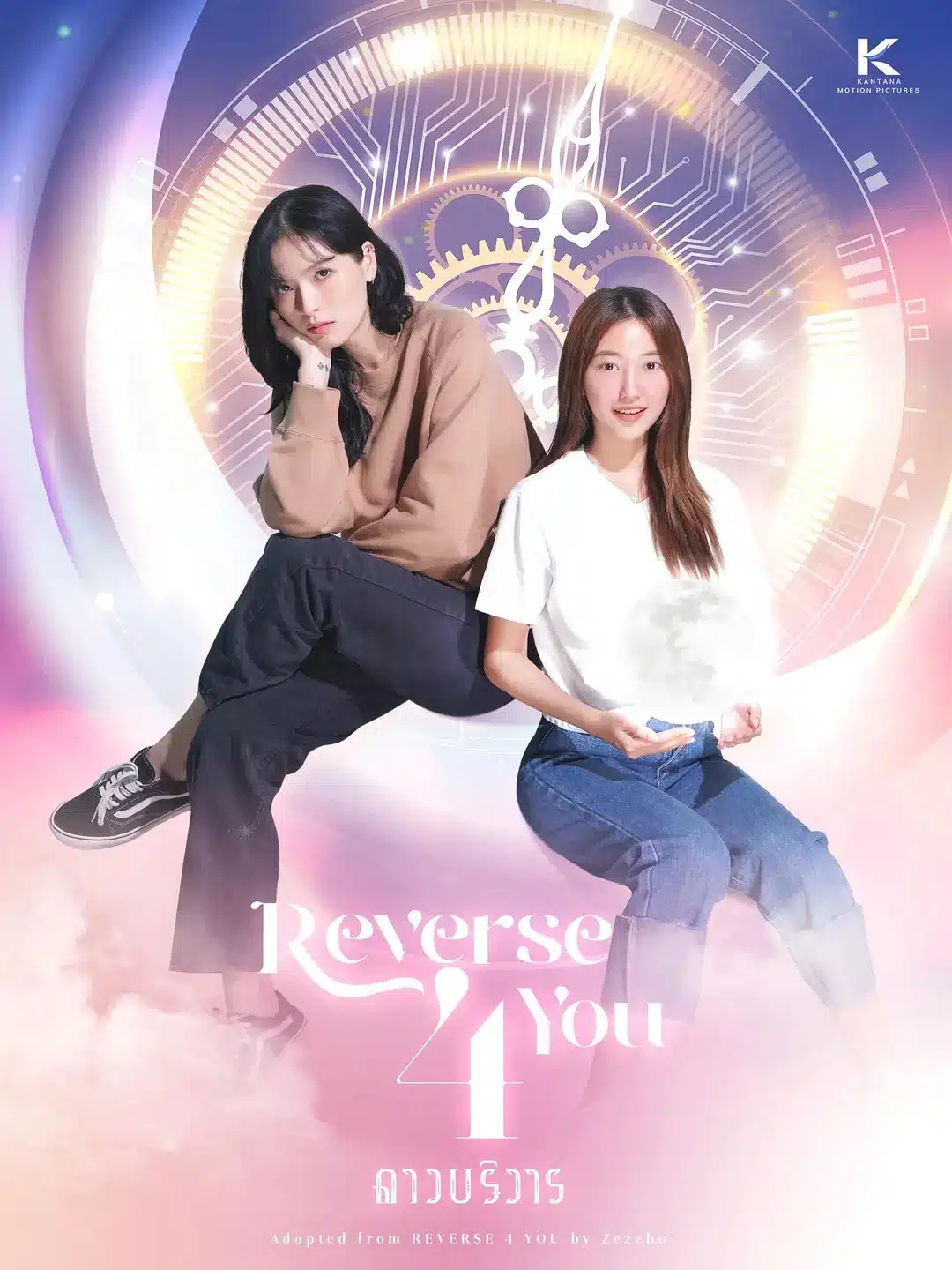
Reverse 4 You Analysis: Temporal Obsession and Sublime Sacrifice Mending the Cracks of Fate
Love often begins with the selfish desire to make time stand still. However, when that desire is actually realized, we are forced to confront the price we must pay to protect the things we love. The dissonance that occurs when the human will to hold on clashes with a destiny threatening to veer off course creates a tragedy that is, at times, cruelly beautiful.
🌿 Moments When This Drama Deeply Permeates the Soul
- When you are crushed by the primal fear that your choices might bring about the misfortune of a loved one.
- When you discover a child-like vulnerability hidden behind the cold, seemingly impenetrable walls of another.
- When you need the desperation to not let go of a hand even while feeling powerless before the massive waves of fate.
- The reason to read this piece to the end is to witness, beyond a simple fantasy romance, the ‘weight of time’ one must endure to save another’s life and the form of true love found at its conclusion.
🎞️ Notes Before Viewing
Using a fantasy setting as a medium, this work explores the deep emotional bonds and fateful opposition between two women. It is a relationship-centered narrative that focuses on the thematic consciousness of sacrifice and psychological tension between characters rather than physical explicitness.
🎬 Drama Information
- Title: Reverse 4 You (Original Title: ดาวบริวาร, 2024)
- Director: Oat Vathanyu Ingkavivat
- Screenplay: Zezeho (Based on the Original Novel)
- Original Work: The novel of the same name by Zezeho
- Country: 🇹🇭 Thailand
- Genre: Queer Romance, Fantasy, Drama
- Running Time: 8 Episodes (Approx. 45–50 minutes per episode)
- Platform: Global streaming services including Netflix
- Cast: Methakarn Anektanasuwan (as Jattawa), Christine Gulasatree Michalsky (as Four), Natnicha Polsombat (as Vivi)
📖 Reverse 4 You: The Trajectory of a Fateful Love Reached Even by Turning Back Time [No Spoilers]
Jattawa, a law student, possesses the extraordinary ability to stop or rewind time by about ten minutes. Rather than using this supernatural power for grand ambitions, she lives her life using it to protect her small daily routines and her precious younger sister, Vivi, whom she cares for alone. One day, Vivi, who has the ability to see the future, leaves a prophecy that the cold and arrogant business major senior, Four, will become Jattawa’s ‘soulmate.’
Jattawa and Four, who seemed to have no common ground, become entangled through a series of accidental events. Jattawa finds herself gradually drawn to Four as she discovers the profound isolation and domestic trauma hidden behind Four’s cynical mask. However, an ominous sign appears as Vivi can no longer see her own future, and the cruel threads of fate begin to reveal that Vivi’s tragic death is connected to Four. Jattawa begins a desperate struggle against time, caught between the irreconcilable values of her sister’s life and her love for her partner.
⏳ Reverse 4 You Analysis: A Function of Salvation and Obsession Born from Temporal Asymmetry
Jattawa’s ability to manipulate time is not merely a ‘convenient device’ in this narrative; it functions as a shackle in the name of responsibility. Because she can turn back time, she ends up blaming herself for the outcome of every misfortune. Conversely, Four is a character living in ‘frozen time,’ trapped within family coldness and the betrayal of others despite her wealthy environment.
The meeting of these two is the union of one who seeks to change the physical flow of time and one who seeks to restart the flow of psychologically stopped time. From an analytical perspective, Jattawa’s process of healing Four’s wounds is achieved not through the unrealistic power of a supernatural ability, but through the power of human empathy—of fully gazing into another’s pain. This serves as a core emotional line that secures reality even within the fantasy genre.
🎡 The Form of Human Dignity Discovered Within the Cycle of Recurring Tragedy
The drama illustrates a process where, the more Jattawa exercises her power, the outcome of Vivi’s death repeats itself, subtly changing only in form. This poses a heavy question regarding fatalism: “Can the human will truly defer a predetermined end?” Jattawa despairs in the face of this question.
In particular, the setting where Vivi’s death and Four’s existence are bound by a causal relationship creates a cruel dilemma. The psychological collapse Jattawa experiences within the tragedy of parallel universes—where gaining love means losing family, and saving family means love cannot exist—elevates the tension of the play to its peak. The point we must note here is the transference of sacrifice, where Jattawa goes beyond simply correcting the past and stakes her entire life as collateral.
🔎 The ‘Best Possible Universe’ Created by Paternal Love and Jattawa’s Choice
The ending of this work is not a simple happy ending that avoids tragedy. The truth revealed through the appearance of Jattawa’s father suggests that a sacrifice already existed behind all these timelines. The father creates a new trajectory by choosing self-extinction for his daughters’ futures.
Ultimately, the final timeline Jattawa reaches was not obtained for free; it is a ‘cleft of miracles’ created by the union of a previous generation’s sacrifice and her own desperate will. The moment the two protagonists face each other again in the finale signifies a cosmic reconciliation—a gear that finally meshes after tens of thousands of misalignments, rather than a mere reunion of lovers. Jattawa truly grows into an adult as she learns to fully accept the ‘present,’ even if it means losing her powers or paying a price.
The final timeline Jattawa reaches is not a result of defeating fate, but the only sanctuary permitted after the acceptance of sacrifice.
💬 Aesthetic Perspectives Filling the Gaps in Reverse 4 You’s Probability
Q: Did the short length of 8 episodes result in a lack of explanation regarding the laws of time travel?
A: From a critical viewpoint, logical flaws (plot holes) may exist in the complex timelines. However, this work places more weight on ’emotional inevitability’ than ‘sci-fi perfection.’ The unexplained voids actually emphasize the uncontrollable nature of fate and allow the audience to assimilate into Jattawa’s chaotic psychology. By leaving areas to be understood through sense rather than logic, the work maximizes the poignancy of romantic fantasy.
Q: How does the power structure change in the relationship between Jattawa and Four?
A: Initially, Four, with her economic power and social status, seems to hold the upper hand, but the actual initiative of the narrative and the ‘power over life and death’ belong to Jattawa, who holds time. However, as Jattawa falls truly in love with Four, this power is reversed. Jattawa exhausting her abilities to save Four suggests that anyone can become the most vulnerable underdog in the face of true love.
✨ Reverse 4 You: A Record of Dogged Devotion Vowing to Choose You Even if Time is Rewound
Reverse 4 You is a work that expands the narrative horizon of the Thai GL genre. It does not stop at the flutters of a campus romance but weaves the macroscopic themes of life and death into the relationship between two women. While everyone wishes to correct past mistakes, the work tells us that true salvation is not about changing the past, but enduring the weight of the ‘present moment’ shared with a loved one.
Love is not a superpower that defies time, but a steadfast promise to remain by one’s side regardless of the future that arrives.
🔮 What Choice Would You Make at the End of a Relationship?
“If you were given a single chance to turn everything back, would you change someone’s fate even at the cost of sacrificing your own future?”
If you had to choose a timeline where your own existence is forgotten in order to save the person you love, what decision do you think you would make? Please share your thoughts in the comments.
👩💻 Violet Screen Curation: Women’s Narratives Exploring the Depth of Relationships
- Gap: The Series (2022): A foundational work of the Thai GL craze, it deals with the fierce love and solidarity of two women blooming amidst social class differences and workplace power dynamics.
- 23.5 (2024): This work captures concerns about identity and the sincerity of relationships within a fresh campus romance. It is an excellent choice if you prefer the warm solidarity of daily life over fantasy elements.
To provide a more stable publishing environment, multilingual content, and better communication with our readers, we have moved our official publication to Substack.
All new film reviews and critical essays will be published on our new platform. This website will be closing down soon, so we would greatly appreciate it if you subscribed to our new space.
TODAY'S QUESTION
Which ending has stayed with you the longest?
Your answer isn't saved. Feel free to share it in the comments below.


You May Also Like

New Amsterdam: Lauren and Leyla—The Ruins of Love Left by the Empowerment of Desire

《Transit Girls》 Review: An In-Depth Interpretation of Two Worlds Settling Into Each Other Beyond Taboo