The Story of Us (2025) Analysis: A Record of Salvation and Obsession Stripped of Revenge
We often assemble our lives atop the fragments of wounds left by others. For some, an inheritance is a blessing; for others, it becomes an indelible debt. The drama <Us> depicts the precarious yet beautiful trajectory of two women attempting to sever the chains of that debt.
When those who have lived like isolated islands discover each other’s deficiencies—and face the tragic reality that these voids originate from the same root—we finally witness the “raw face” of love. This work goes beyond simple romance to deeply explore the arrogance inherent in forgiveness and the salvation found in the name of love.
🌿 Moments When This Drama Truly Penetrates the Soul
- When the shackles of “family” become suffocating and you long to escape.
- When you wish to experience the chilling thrill of your sincerity colliding with another’s thirst for revenge.
- When you empathize with the agonizing dilemma of falling for the child of the person you can never forgive.
- When you want to witness the pinnacle of a powerful female narrative that chooses “surviving together” over vengeance.
🎞 Notes Before Viewing
This work is an emotion-centered narrative set against a backdrop of familial conflict and past tragedies. It is a piece where the psychological tension between characters and the emotional immersion during the unveiling of secrets take precedence over physical stimulation.
🎬 Drama Information
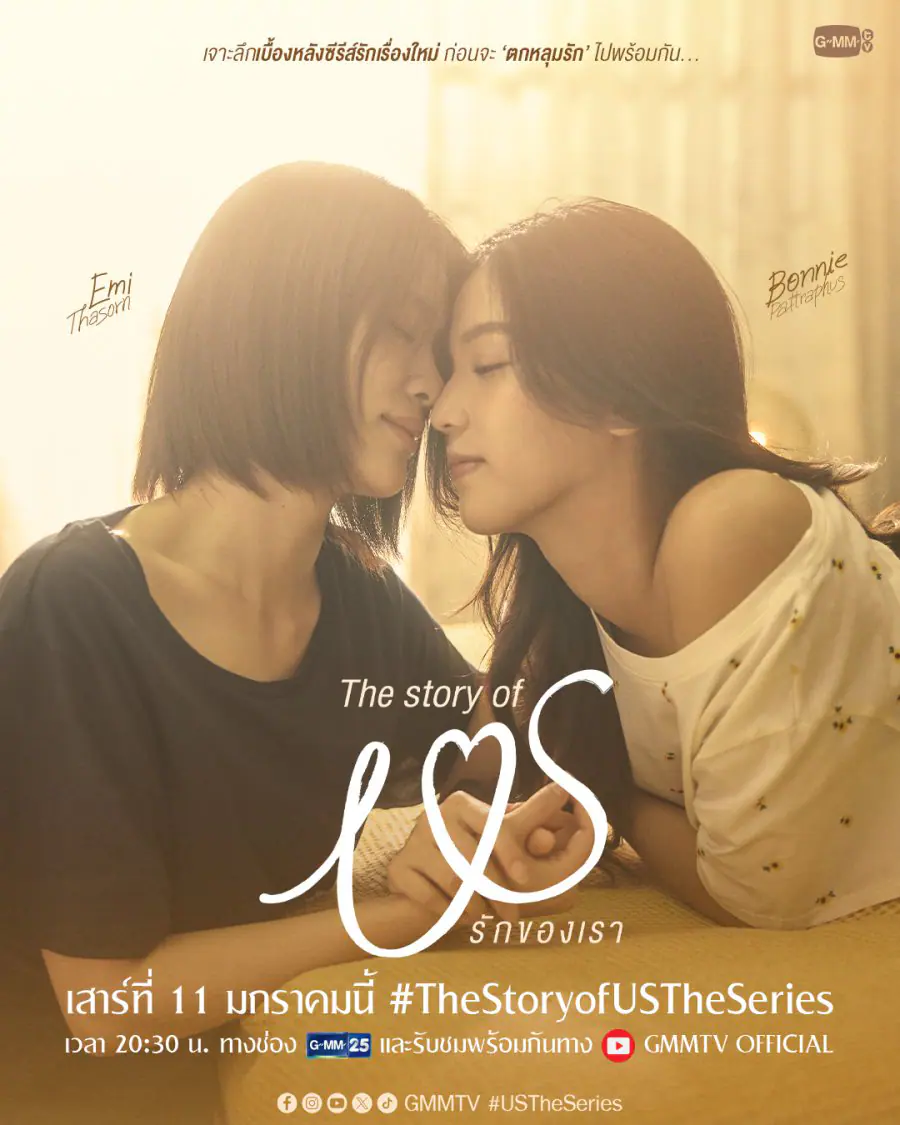
- Title: The Story of Us (Us รักของเรา) (2025)
- Screenplay: (Based on the novel by Chao Planoy)
- Original Work: Novel Us – by Chao Planoy
- Country: Thailand
- Genre: Romance, Drama, GL (Girls’ Love)
- Running Time: 12 Episodes (Approx. 45–50 minutes per episode)
- Platform: GMMTV, YouTube, Viu
- Cast: Emi Thasorn Klinnium, Bonnie Pattraphus Borattasuwan
📖 Us Synopsis: A Precarious Coexistence Built on Walls of Lies [No Spoilers]
Dokrak, who has been carving out her own life alone since graduating high school, works part-time at a cafe. One day, she meets Pam, a dental student she encounters at a clinic, and falls in love at first sight. However, in a cruel twist of fate, Dokrak’s brother, Kawi, is also captivated by Pam and asks his younger sister for help in winning her heart.
Caught between her love for her brother and her own hidden feelings, Dokrak suppresses her emotions for the sake of Kawi’s happiness and takes on the role of “Cupid.” While doing so, Rak becomes rapidly close to Pam, but a massive secret—of which Dokrak is entirely unaware—lurks between them.
Rak discovers the deep internal wounds Pam carries and the trauma resulting from the accidental death of Pam’s parents. As their secret consolations repeat, the boundaries between them collapse. Crossing social taboos and the fence of family, their longing for one another grows uncontrollably.
🎨 False Projections and True Longing: The Aesthetics of Relationship in <Us>
🔗 The Deceptive Truth and Interpretation of Painting as a Medium
The most striking element of this work is the visual language constructed by director Fon Kanittha Kwunyoo. Instead of becoming buried in provocative conflict structures, the drama utilizes spaces like the “Art & Us” gallery and cafes to project the characters’ inner worlds.
The paintings Dokrak creates on behalf of her brother serve as the most symbolic device in the series. While Dokrak paints Pam under her brother’s name, the emotions carried by the tip of the brush belong entirely to Dokrak herself. This exposes the invisibility of relationships.
🩸 The Value of “Chosen Family” Beyond the Shackles of Blood
Through Dokrak’s household, Us poignantly depicts how patriarchal violence and bystander apathy can destroy an individual. Her father’s infidelity and irresponsibility, coupled with her mother’s silent acquiescence, suggest that for Dokrak, home is not a sanctuary but a prison from which she must escape.
Conversely, her relationship with Pam—though it may have begun with motives of revenge—becomes the sole channel through which they understand each other’s wounds. The drama proves that “intentional solidarity”—confronting pain together and healing as one—is a far more powerful survival mechanism than biological family. This poses a heavy question regarding how the meaning of family should be redefined in modern society.
🔎 Reinterpretation of the Ending: Forgiveness as a New Beginning, Not a Destination
The happiness the two encounter at the end of the work is not possible because they have completely forgotten the past. Rather, Pam is clearly aware of the sins committed by Dokrak’s father, and Dokrak accepts that guilt with her whole being.
The “Post-marriage life” presented at the conclusion transcends the typical happy ending, showcasing a beauty akin to Kintsugi—the art of joining broken pieces back together. Their union does not hide the fractures of the past; it is a victory of dignity that acknowledges those very cracks as part of their history.
Love is not an eraser that wipes away past victimization, but an existential choice to draw tomorrow together despite it.
💬 Questions Regarding the Narrative and Ending of Us
Q. Did Pam’s desire for revenge subside too easily?
From a critical perspective, the process of Pam falling in love with the daughter of her parents’ enemy might feel overly sentimental. However, a close look at the narrative structure reveals that Pam did not simply forgive Dokrak; rather, she discovered the inherent integrity of Dokrak as an individual. Based on the humanistic premise that “the sins of the parent should not be visited upon the child,” the work convincingly portrays Pam realizing the futility of revenge and reclaiming her own life.
Q. Does Dokrak’s self-sacrificing attitude align with modern female archetypes?
Dokrak’s early actions may feel frustrating. However, her sacrifice is not a passive surrender but an active defense mechanism to protect those she loves. In particular, the way she condemns her father and builds her own household in the finale symbolizes her growth from a girl conforming to her environment into a proactive woman who determines her own destiny. This signifies independence as a human being, not merely remaining as someone’s “partner.”
✨ Us: Until the Sanctuary of “We” is Complete
The drama Us demonstrates the heavy responsibility accompanied by the word “we.” Revenge keeps one mired in the past, but love allows one to live in the present. Through a narrative of healing where the child of a perpetrator and the child of a victim meet to soothe each other’s wounds, this work makes us reconsider the essence of the relationships we form with others.
Ultimately, life is a process of finding the one person you can choose amidst the pains you did not choose. Us is a warm consolation to those who have arrived at the end of that arduous journey and a milestone reminding us that understanding is ultimately more powerful than hatred.
Love is not a coat that covers each other’s wounds, but the courage to press wounded skin together and share warmth.
🌊 Where does your heart linger?
If someone’s sincere tears could instantly melt away years of hatred, would you trust those tears, or would you continue to guard your wounds?
💜 Violet Screen’s Recommendations: Other Deep Female Narratives
- <Pluto> (2024): A mystery-melo following a woman who meets her twin sister’s blind lover while pretending to be her sister. The psychological depiction of a relationship starting with a lie and evolving into true love mirrors the themes in Us.
- <Reverse 4 You> (2024): The story of a protagonist with the power to turn back time, struggling to prevent the death of the woman she loves. It deals with the strong solidarity and sacrifice of women facing the massive wall of fate.
To provide a more stable publishing environment, multilingual content, and better communication with our readers, we have moved our official publication to Substack.
All new film reviews and critical essays will be published on our new platform. This website will be closing down soon, so we would greatly appreciate it if you subscribed to our new space.
TODAY'S QUESTION
When did you first feel fully accepted for who you are?
Your answer isn't saved. Feel free to share it in the comments below.


You May Also Like
Valeria: Erasing the Perfect Checklist to Reach an Chronicle of Imperfect Love
Amar es para siempre (2013~): An In-Depth Analysis of the Brilliant Female Narrative Within an Era of Oppression