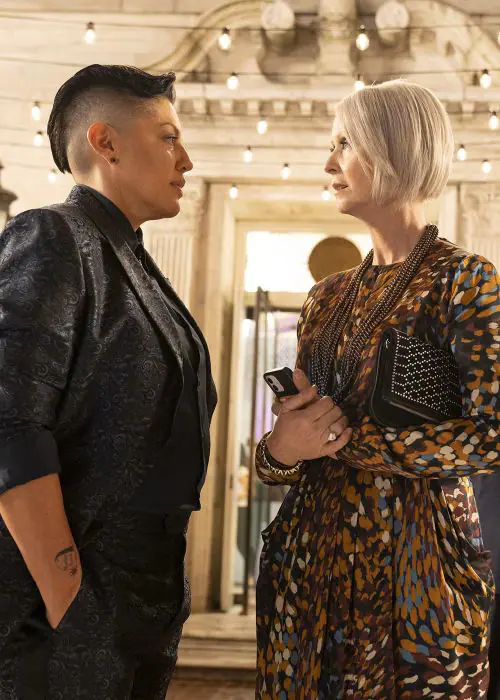
And Just Like That… An Analysis of Miranda Hobbes: Reconstructing Desire and the Fissures of Relationship
We often believe that once we reach the pinnacle of life, we will no longer waver. Mistaking stability for achievement and familiarity for happiness, we cross the threshold of middle age. However, for certain souls, stability is merely another name for a slowly tightening suffocation.
The trajectory of Miranda Hobbes poses a question to us all: Is a desire intense enough to shatter a self-identity built over decades a sin, or is it a long-overdue salvation? This article is a record tracing the path of the fissures she chose.
🌿 Moments When This Drama Deeply Permeates
- When silence feels more comfortable than conversation with a familiar partner, and a sudden sorrow takes hold.
- When the version of yourself you thought you knew feels like a performance staged for the expectations of others.
- When you dream of plunging into an unknown world to fill the emptiness left by societal achievement.
- The reason to read to the end: To confront the “truth” that lies between the points where Miranda’s choices are condemned and where they are celebrated.
🎞️ Note Before Viewing
This work candidly addresses the sexuality, love, and identity of adult women, depicting dynamic shifts in relationships. It is a psychological adult drama where the emotional density and the shock of relational subversion carry more weight than physical exposure.
🎬 Drama Information
- Title: And Just Like That… (2021–2025)
- Director: Michael Patrick King, Nisha Ganatra, et al.
- Screenplay: Michael Patrick King, Elisa Zuritsky, et al.
- Country: USA
- Genre: Drama, Comedy, Social Drama
- Running Time: Approx. 30–60 minutes per episode (Seasons 1–3)
- Platform: HBO Max (Wavve in South Korea, etc.)
- Cast: Cynthia Nixon, Sara Ramirez, Suzanne M. Willis, David Eigenberg
📖 And Just Like That… Miranda’s Wandering and the Search for Self [No Spoilers]
Miranda Hobbes, once the symbol of the cold-headed New York lawyer, has now become a late-blooming student returning to graduate school to grapple with human rights and justice. However, what truly unsteadies her is not her studies, but an emotional isolation originating from within the once-solid walls of her home.
Her relationship with her husband, Steve Brady, has devolved into a sterile routine that rarely ventures beyond friendship, while her son, Brady, has grown into an independent individual, moving beyond her reach. Into this empty void steps Che Diaz, a free-spirited non-binary comedian.
Through an intense encounter with Che, Miranda confronts a crisis of identity she had ignored her entire life. Her footsteps, leading away from a comfortable living room toward unfamiliar clubs and boisterous party venues, signal the start of a massive storm destined to shatter the order of the older generation.
🏚️ The Collapse of the Fortress: An Emotional Desert Named Familiarity
The core of the conflict Miranda experiences in And Just Like That… lies not in “deficiency” but in an “excess of complacency.” Her marriage to Steve Brady appears perfect, yet within it, both physical tension and intellectual stimulation have vanished.
Her fascination with Che Diaz is not merely due to a change in sexual orientation. Che serves as a mirror, symbolizing the vitality and unpredictability that Miranda had forgotten.
Miranda abandons the version of herself that prioritized legal and moral obligations, beginning to pursue her own happiness in the most egoistic manner. The betrayals and conflicts arising from this process offer a brutally honest portrayal of a “second adolescence” experienced by a middle-aged woman.
🌪️ Interpreting the Relationship with Che Diaz: A Duet of Liberation and Subordination
The relationship between Miranda and Che Diaz sparked significant controversy among viewers. This was largely because Miranda’s attitude toward Che was more dependent than ever before. The sight of an icon of strong female narrative collapsing helplessly in the face of love was disconcerting.
However, this must be interpreted as a process of deconstruction. To establish a new identity, the existing self had to be completely demolished, and Che served as the catalyst assisting in that destruction.
Miranda’s move to Los Angeles was not a simple escape, but a flight from the “perfect New Yorker” frame she had constructed. Even if the end was a separation, she learned through that relationship how to verbalize her own desires.
🌈 Joy as a New Coordinate: The Democracy of Relationship
As the seasons progress, Miranda moves past the volcanic passion shared with Che and reaches a point of calm equilibrium upon meeting BBC producer Joy. The relationship with Joy takes the form of a mature solidarity that compensates for the shortcomings of her previous two relationships (Steve and Che).
Where there was a lack of intellectual exchange with Steve and a lack of emotional stability with Che, Joy is a partner who simultaneously respects Miranda’s professionalism and human charm. This signifies that Miranda no longer needs to conform to someone else or erase herself for another’s sake.
Ultimately, Miranda’s narrative transcends the question of whom she meets and culminates in the question of how she reconciles with herself. True to the name “Joy,” she has come to prioritize her own inner pleasure over the gaze of others.
🔎 Reinterpreting the Ending — True Independence Left by the Fissure
In the conclusion of And Just Like That…, Miranda is no longer submerged solely in the roles of wife, mother, or lover. While she dismantled the fortress of home through her divorce from Steve, she has reconstructed her own territory upon those ruins.
This ending is not a complete union of two people, but a declaration of being a “distinct entity” maintaining dignity in one’s own space. What Miranda gained is freedom; what she lost is the false security bestowed by others.
The journey of Miranda Hobbes is not a process of finding a perfect answer, but a struggle to complete a sentence of life that only she can interpret, by erasing the wrong answers.
❓ Miranda’s Change of Heart: Character Assassination or Evolution?
Q: How do you view the criticism that the way Miranda left Steve was too cold-hearted?
A: The discomfort felt by viewers is entirely valid. The manner in which Steve Brady—a character loved for over 20 years—was marginalized was narratively harsh. Yet, paradoxically, this coldness proves the depth of the suffocation Miranda felt. A kind breakup usually leaves lingering attachments, but Miranda had to sever the past for her own survival. This work can be seen as an aesthetic decision that chooses human egoistic truth over moral righteousness.
Q: Does the breakup with Che Diaz ultimately mean that Miranda’s wandering was a failure?
A: It is by no means a failure. We must move away from the perspective that the end of a relationship equates to failure. The relationship with Che was a gateway that pulled Miranda out of her house and allowed her to see new possibilities. Emerging through that gateway, Miranda gained a perspective entirely different from before, which became the foundation for her healthy relationship with Joy.
✨ And Just Like That… Desire is Completed Through Destruction
This series is not merely a nostalgia-driven reboot for old fans. Rather, it poses existential questions, asserting that a life that does not change is no different from being dead, while self-negating past glories.
Miranda’s narrative directly revolts against the “demure exit” forced upon women by modern society as they age. She was not afraid to become unsightly and redefined her identity while accepting the risk of being criticized.
True growth begins with the courage to betray one’s past self, and only that betrayal leads us to the next chapter.
🗨️ Time to Find Myself in Silence
Have you ever silenced your own voice to meet the expectations of others? Between stable misery and unstable happiness, which way do you wish to walk right now?
📽️ Violet Screen Curation: Other Female Trajectories
- Hacks (2021–2024): The sharp wit and solidarity of two women transcending a generational gap. Recommended for women thirsty for self-achievement.
- The Sex Lives of College Girls (2021–2024): A work that playfully unfolds the prototype of the identity confusion Miranda experienced through the eyes of those in their twenties.
To provide a more stable publishing environment, multilingual content, and better communication with our readers, we have moved our official publication to Substack.
All new film reviews and critical essays will be published on our new platform. This website will be closing down soon, so we would greatly appreciate it if you subscribed to our new space.
TODAY'S QUESTION
Is there a film whose ending you wish had gone differently?
Your answer isn't saved. Feel free to share it in the comments below.


You May Also Like

Daughters of Bilitis (2011) – The Love and Dignity of Three Generations of Women Rising Above the Walls of Their Time

Wentworth Ending Explained and the Redemption of Franky & Bridget: A Narrative of Liberation for Isolated Souls