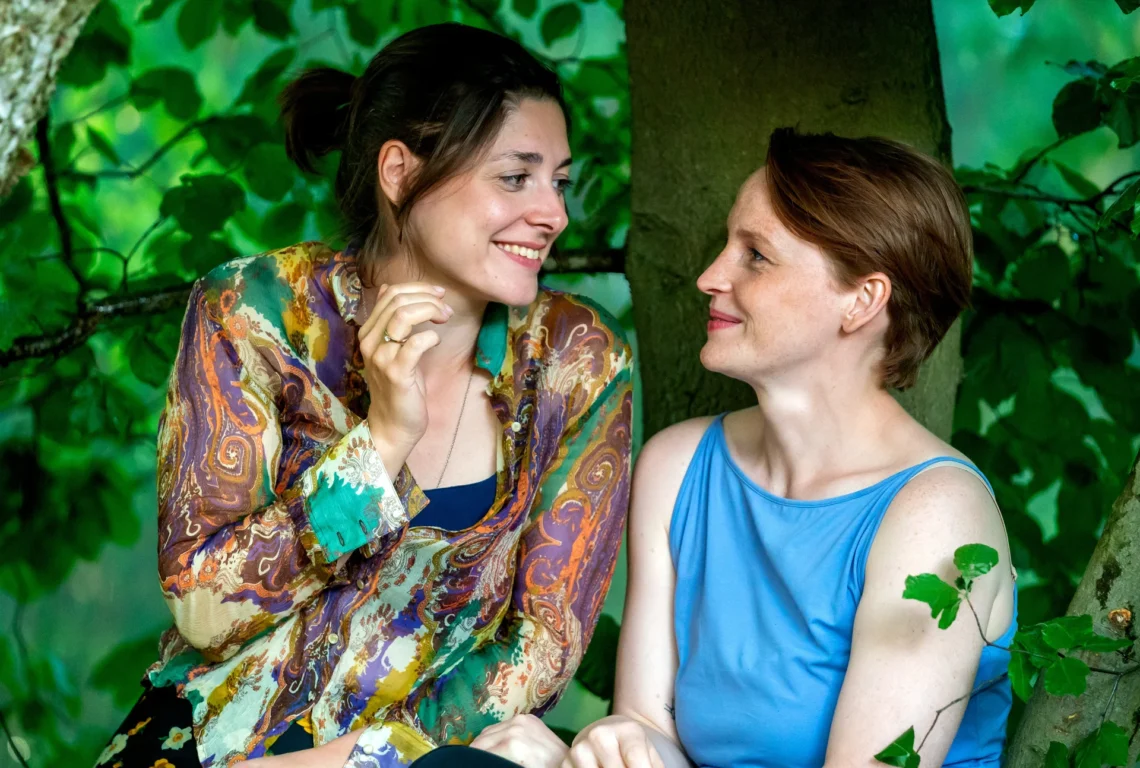
WIR: A Review of the German Drama and the Aesthetics of ‘Lack’—Waves of a Reunion Breaking 12 Years of Silence
We occasionally experience our daily routines—those we believed to be most secure—collapsing upon the appearance of a single person. We realize that buried memories have not vanished; they were merely latent, waiting for air of the right temperature to resurface.
Beyond a simple romance narrative, the German drama WIR is a work that persistently questions the price one must pay when confronting their true desires and the dignity earned in that process.
🌿 Moments when this drama deeply permeates the soul
- When a perfect life, designed over a long time to meet the expectations of others, feels inexplicably hollow.
- When you feel that an unresolved relationship from the past is holding your present self captive.
- For every soul wandering, lost between a stable ‘correct answer’ and a precarious ‘sincerity.’
- The reason to read until the end: This review goes beyond the simple continuation of a relationship to analyze the structural necessity of how two women break out of their respective isolated worlds through one another.
🎞 Notes before viewing the drama
This work is a sophisticated, narrative-driven drama that focuses on subtle psychological shifts between characters and the density of their relationship, prioritizing emotional communion and the intensity of conflict over physical exposure.
🎬 Drama Information
- Title: WIR (2021–2023)
- Director: Luzie Loose, Ester Amrami, et al.
- Screenplay: Christiane Kalss, et al.
- Country: 🇩🇪 Germany
- Genre: Drama, Romance, Psychology
- Running Time: Approximately 12 episodes per season (around 20 minutes per episode)
- Platform: ZDF
- Cast: Katharina Nesytowa (Helena), Eva Maria Jost (Annika), Malick Bauer (Tayo)
📖 WIR: The plot and developmental context of two women rewritten across 12 years [No Spoilers]
Helena lives a perfectly controlled life, planning marriage and pregnancy with Tayo, but cracks begin to form in her fortified walls when her first love, Annika—who left without a word 12 years ago—returns to their hometown of Teltow. As the ‘Zeit-Ei’ (Time Egg), containing secret past emotions, is discovered, long-suppressed desires erupt uncontrollably. Helena finds herself at a desperate crossroads between the stability she has settled into and a destructive sincerity. The process where Annika’s burnout clashes with Helena’s sense of realistic responsibility develops into a fierce psychological struggle that goes beyond a mere reunion to reset the very direction of their lives.
🔍 The Archaeology of Forgotten Time: Interpreting ‘Zeit-Ei’ and the Reconstruction of Memory in WIR
The ‘Zeit-Ei,’ a core object in the work, is not merely a childhood memory box but a metaphor symbolizing the frozen time between Helena and Annika. The moment this box, containing Annika’s confession from 12 years ago, is opened marks the point where the ‘stable adult’ persona Helena has constructed begins to deconstruct.
The drama coldly demonstrates that memories do not weather away; they only deposit, capable of swallowing the present at any time through a specific trigger. Helena’s attempt to initially define her reunion with Annika as a ‘mistake’ can be interpreted as a self-defensive mechanism against the negation of her entire life.
🌊 Those Who Crave Stability vs. Those Who Suffer from Freedom: Psychological Power Dynamics in WIR
While Helena is a character who seeks meaning in life through planning and control, Annika is one who reveals her emotions, intuition, and even her own collapse (burnout) without reservation. Their relationship begins in an asymmetrical structure of care and dependence, gradually evolving into a symmetrical relationship that mirrors each other’s deficiencies.
The conflicts during their cohabitation, in particular, serve as a modern variation of the classic question: ‘Is love enough?’ Helena’s desire for ‘social settlement’ and Annika’s ‘psychological drift’ appear as parallel lines difficult to bridge, yet that very difference becomes the driving force that allows them both to grow.
🔎 Reinterpreting the Ending: The Choice to ‘Get Lost Together’ Over Perfect Unity
The ending of Season 3 rejects the grammar of a typical happy ending. The two do not stay together because they have completely overcome the crisis of a long-distance relationship or their differences in values. Rather, it is a mature surrender—recognizing that they cannot be each other’s perfect answer—that sustains this relationship.
Where the past Helena withdrew due to anxiety, she now embraces uncertainty and holds onto Annika. This proves that love is not a magical cure-all, but a process of weary daily labor and choice. Their union is not the completion of a romantic fantasy, but a painful solidarity that acknowledges the crack of their differences and fills the gap.
Love is not a destination, but the dynamic act itself of following the ever-changing trajectory of the other.
🗳️ Critical Interpretation of WIR’s Narrative Devices and Ending
Q1. What are your thoughts on the criticism that Annika’s burnout setting reduces narrative tension?
Annika’s burnout is not a simple functional setting. It serves as a form of poetic justice for her unilateral departure in the past, while simultaneously acting as a device to move her from a position of ‘strength’ to one of ‘weakness’ in her relationship with Helena. From a critical standpoint, it may give the impression that the pace is stagnating; however, aesthetically, it balances the power dynamic between the two and provides the space for Helena to make autonomous choices.
Q2. Doesn’t Helena’s process of leaving Tayo feel too abrupt or irresponsible?
From the viewer’s perspective, Tayo was a ‘perfect partner,’ making Helena’s choice seem selfish. However, the work implies that the stability Helena felt with Tayo was, in fact, a state of ‘misidentifying another’s desire as her own.’ This breakup should be interpreted as a belated honesty toward herself rather than a betrayal of Tayo. The work places more weight on internal human truth than on moral right and wrong.
✨ WIR: On Finally Becoming ‘Us’ on the Stage of Life
The drama WIR asks us: Is the tranquility you currently enjoy truly yours, or is it merely the result of a silence maintained out of fear of conflict? The journey of Helena and Annika suggests that identity is not fixed but something constantly rediscovered through relationships.
Their love is closer to a struggle against ‘internal fear’ than a battle against social prejudice or external pressure. In a modern society where the continuity of relationships is becoming rare, the ‘labored love’ shown in this drama resonates deeply.
True solidarity does not begin with saving one another, but with the courage to silently witness each other’s collapse from by their side.
💬 Between Silence and Outcry: What is your choice?
The ‘stable silence’ of suppressing one’s essence to maintain a relationship, and the ‘destructive outcry’ of speaking the truth even at the risk of losing everything.
If you were Helena, could you willingly give up your current peace in the face of a wave from the past that has returned after 12 years?
📽 Violet Screen Curation: Time to meet another ‘Us’
- 20,000 Species of Bees (2023): A Spanish film that delicately depicts a child finding their identity within a family and the gaze of the women watching over them. It shows how sublime ‘understanding’ within a relationship can be.
- Falcon Lake (2022): While dealing with the subtle boundaries of a coming-of-age boy and girl, the subjective emotional lines of the female character resemble the early tension of WIR. It features a sensory direction that makes even the humidity in the air palpable.
To provide a more stable publishing environment, multilingual content, and better communication with our readers, we have moved our official publication to Substack.
All new film reviews and critical essays will be published on our new platform. This website will be closing down soon, so we would greatly appreciate it if you subscribed to our new space.
TODAY'S QUESTION
If you could say one thing to someone today, what would it be?
Your answer isn't saved. Feel free to share it in the comments below.


You May Also Like

No abras la puerta (2014): The Fetters of Queer Relationships and the Desire for Family in a Chilean Telenovela
《Transit Girls》 Review: An In-Depth Interpretation of Two Worlds Settling Into Each Other Beyond Taboo