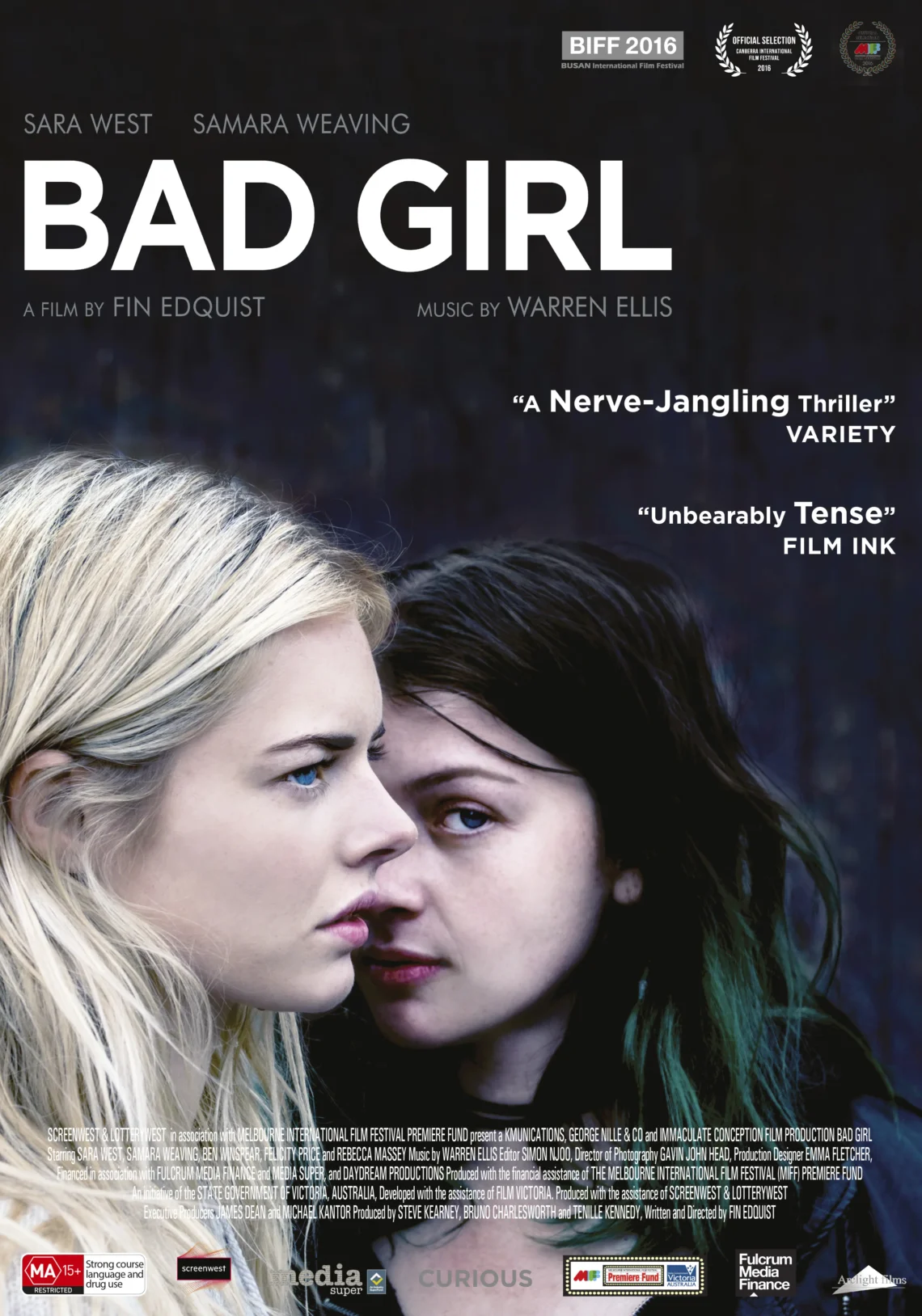
Bad Girl (2016): A Thriller of Isolation Wrought by Twisted Deprivation and Mimicked Desire
Love occasionally becomes the most cruel tool for disguise. What should we call an act of reaching out when it is not a gesture of pure solidarity, but a destructive desire to entirely seize the trajectory of another’s life? Through the madness of an “other” seeping through the cracks of adoption and a fragmented family, the film Bad Girl chillingly depicts how fundamental human deprivation can encroach upon the life of another.
🌿 Moments when this film deeply resonates
- When you feel a sense of isolation, trapped in the frame of being a “problem child” even by your closest family.
- When you wish to confront the chilling true intentions of another hidden behind a mask of intimacy.
- When, in a moment of desperate longing for unconditional acceptance, you witness the danger of a temptation that approaches like a poisoned chalice.
- Why you should read to the end: Because this film goes beyond a simple psychopathic thriller to reveal the conclusion of a fierce struggle for psychological sovereignty between two women fighting for the place of the “real” and the “fake.”
🎞 Note Before Viewing
This work belongs to the queer thriller genre, dealing with the subtle tension and psychological pressure between two female characters. It focuses on emotional shock and the suspense arising from the subversion of relationships rather than physical violence, unfolding the wandering and identity confusion of adolescence through a dark lens.
🎬 Movie Information
- Title: Bad Girl (2016)
- Director: Fin Edquist
- Screenplay: Fin Edquist
- Country: Australia
- Genre: Thriller, Drama
- Running Time: 95 minutes
- Platform: Netflix, Google TV, etc. (Varies by region)
- Cast: Sara West (as Amy Anderson), Samara Weaving (as Chloe Buchanan / Jessica Cooper), Felicity Price (as Michelle Anderson), Benjamin Winspear (as Peter Anderson)
📖 Bad Girl: An Alliance with a Lethal Intruder Prying into the Cracks of a Broken Home [No Spoilers]
Seventeen-year-old Amy Anderson is a so-called “problem child” wandering due to a deep discord with her parents and an innate sense of alienation as an adoptee. Unable to endure their daughter’s rebellion, her parents, Peter and Michelle, move to a remote rural town with the vague hope that a change in environment will change Amy. However, the disconnected space becomes not a place of healing, but another prison for Amy.
While continuing her precarious wandering at the edge of despair, Amy meets a charming and mysterious girl, Chloe, at a moment of crisis where she almost falls from a bridge. Chloe appeared to be a person who had perfectly internalised the freedom and rebellious temperament that Amy craved; the two grow rapidly close, developing into a physical connection. Even the parents trust Chloe, believing she is stabilizing Amy, and bring her into the house as a helper—but this was the prelude to a massive tragedy.
Chloe’s kindness was a sophisticated design to usurp Amy’s place. Her true identity, Jessica Cooper, was a figure who had been carrying out a serial streak of destruction, pushing out existing children while searching for her “real parents” amidst a delusion of abandonment. Now, Amy begins a desperate struggle with Chloe—whom she once believed to be her sole sanctuary—to protect her own life and her place in the family.
⛓️ Subversion of Relationships: Amy and Chloe, Mirror Images Created by Deprivation
In the film Bad Girl, the relationship between the two protagonists is like a mirror reflecting each other’s deficiencies. As an adoptee, Amy lacks confidence in “unconditional love” and is thus easily shaken by external stimuli. Conversely, Chloe chooses “social parasitism,” performing another’s narrative entirely to obtain that certainty.
The structure of their relationship shifts rapidly from enchantment in the beginning to encroachment in the middle, and exclusion in the latter half. Chloe acts out the role of the “ideal daughter” for Amy’s parents and shows the face of the “sole empathizer” to Amy, disintegrating the family system from the inside. The shift in power occurring during this process inflicts extreme psychological anxiety upon the audience. Ultimately, the core of this thriller is not physical assault, but the process of the very foundation of one’s existence (one’s position within the family) being erased by another.
🥀 Symbols of Space and Mise-en-scène: The Aesthetics of Isolation in a Remote Country House
The remote country house in Australia, which serves as the setting for the work, is not a simple location but a closed laboratory that imprisons the psychology of the characters. Though it features a modern architectural style, this space surrounded by forest on all sides is a symbol of a “fresh start” for the parents, yet a “place of exile with no escape” for Amy.
The director paradoxically visualizes the loss of privacy through the transparent glass windows and the open structure of the house. Chloe frequents this open space as if it were her own home, observing and manipulating Amy’s daily life. In particular, the scenes where the two girls commune in the primal nature of the forest and lake are portrayed beautifully, but beneath them lies a chilling mise-en-scène as if a predator were luring its prey. The lighting heightens the dramatic tension as blue tones, capturing Amy’s confusion, clash with the deceptive warmth of the orange tones associated with Chloe.
🔎 Reinterpretation of the Ending — The Paradox of Complete Ousting and Belatedly Acquired Sovereignty
The ending of the film goes beyond a physical victory in removing the intruder Chloe; it contains the process of Amy finally establishing her ego as the “daughter of the Anderson family.” Chloe’s madness, which leads her to murder a detective and threaten the lives of the parents, paradoxically awakens Amy. This is because Amy, who had previously wanted to destroy her family, now makes the choice to willingly dirty her own hands to protect them.
This ending declares an eternal rupture between the two girls. The “complete union” (the status of a daughter monopolizing the parents’ love) that Chloe dreamed of is proven to be a blood-stained delusion. Amy is victorious, but a terrible scar remains in her heart—the realization that the being she once loved and relied upon was a monster trying to erase her. In life after the conclusion, Amy gains reconciliation with her parents, but must simultaneously pay the price of a fundamental distrust that makes it difficult to fully trust others.
This conclusion is the completion of a tragic rite of passage in which an individual grows by internalizing the violence of the “other” to protect their own place.
🧐 FAQ on the Narrative Structure and Interpretation of Bad Girl
Q1. Is there a risk of Chloe’s (Jessica’s) motive being dismissed as a simple mental illness?
Certainly, Chloe’s behavior exhibits typical delusional disorders and sociopathic tendencies. From a critical perspective, this could be seen as a cliché that provocatively consumes female madness. However, rather than portraying Chloe as a simple villainess, the work depicts her as a social disaster that occurs when an extreme desire for recognition—which an “abandoned child” might possess—becomes twisted. This is more likely to be interpreted within a structural context of the dissolution of the family in modern society and the blind spots of the adoption system, rather than as an individual’s illness.
Q2. Regarding the criticism that the queer elements between Amy and Chloe are merely devices for the thriller?
The point where the sexual tension between the two is utilized as a means of manipulation by Chloe is open to debate. However, rather than seeing this as a simple device, it should be viewed as an expression of Amy’s longing to “be understood” through the most intimate form of physical solidarity. Rather than glamorizing the queer narrative, the work candidly demonstrates how the most vulnerable emotional connection can become a destructive weapon. Through this, readers come to judge the catastrophe brought about by an indulgence lacking in relational sincerity.
✨ Bad Girl: The Belated Birth of a Family Wrought by the Rage of the Encroached
This film warns that love can be a means of invasion rather than salvation. The moment we open the latch of our hearts to another, no one can be certain whether what enters through that crack will be warmth or a wave that will swallow us whole. Bad Girl suggests that “real family” is not proven through blood or documents, but through the struggle to willingly resist in order to protect one another.
One who performs the life of another can never possess their own soul, and a true sense of belonging blooms only within a wounded solidarity, not through plunder.
👁️ Is silence within a relationship trust, or is it a warning left unseen?
We sometimes overlook the shadow cast at a person’s feet, intoxicated by the sense of liberation felt when growing rapidly close to someone. When you claim to trust someone completely, is the basis of that certainty the “sincerity” of the other, or is it a “fantasy” you wish to see?
- Will you strive to fill the other’s deficiency, or will you first check your own boundaries?
📋 Violet Screen Curation (Female Narrative & Psychological Thriller)
- Black Bear (2020): A meta-cinematic psychological drama dealing with a female director’s creative agony and the ruin of relationships at a cabin.
- Influencer (2022): A thriller with a modern sensibility dealing with the desire to seize another’s life hidden behind the glamour of social media, offering enjoyment similar to an extended version of Bad Girl.
To provide a more stable publishing environment, multilingual content, and better communication with our readers, we have moved our official publication to Substack.
All new film reviews and critical essays will be published on our new platform. This website will be closing down soon, so we would greatly appreciate it if you subscribed to our new space.
TODAY'S QUESTION
What changed the most for you after coming out?
Your answer isn't saved. Feel free to share it in the comments below.


You May Also Like

Happy Ending (2023): A Method of Communication in Isolation Faced at the End of Deceptive Desire
Love Is a Map (2022): The Aesthetics of Female Queer Narrative on the Coordinates of Loss