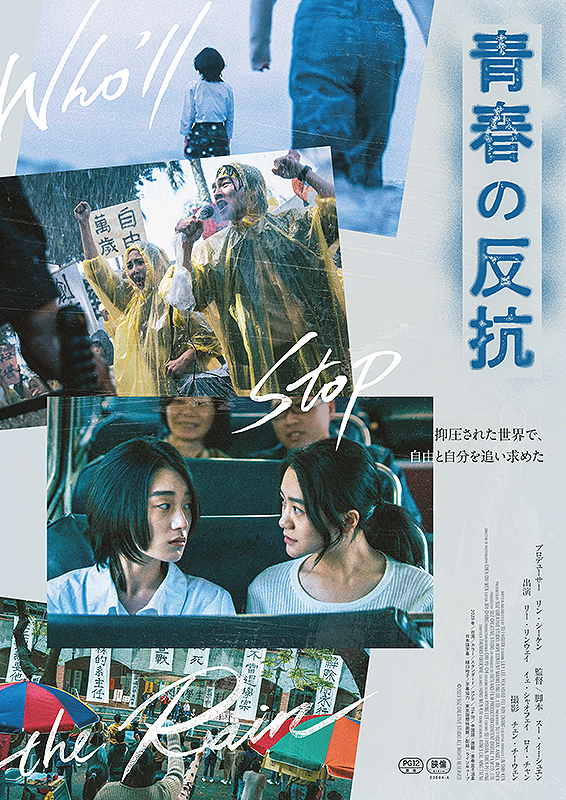
Who’ll Stop the Rain: An In-Depth Analysis of Two Women’s Inner Revolution and Queer Narrative Born of an Oppressive Era
Every transformation begins with a microscopic crack. Under the weight of unguaranteed freedom, before we can march into the grand public square, we must first confront the barriers that have confined us within the deepest chambers of our own minds.
The film Who’ll Stop the Rain is a work that meticulously captures a brilliant yet painful awakening—one where, amidst a macrocosmic yearning for democratization, an individual finally discovers their true countenance through the mirror of another.
🌿 Moments When This Film Deeply Permeates
- For those who yearn for their own unique colors and artistic liberation amidst institutional oppression and censorship.
- For those who wander, lost, at the boundaries of admiration and love, friendship and desire, searching for their own answers.
- For those who wish to witness how an individual’s identity subjectively awakens within the colossal waves of an era.
- The reason you must read to the end of this beautiful queer narrative, born at the intersection of historical solidarity and private love.
🎞️ Notes Before Viewing
This work realistically reconstructs the atmospheric tension of Taiwanese university campuses in the 1990s, sensually depicting the subtle emotional tension and physical attraction between characters. Rather than relying on direct or provocative portrayals, the film centers on a deep, emotion-driven narrative carried by the characters’ glances, minute tremors, and the shifting power dynamics of their relationships.
🎬 Film Information
- Title: Who’ll Stop the Rain (Original Title: 靑春並不溫柔, 2023)
- Director: Su I-hsuan (蘇奕瑄)
- Screenplay: Su I-hsuan (蘇奕瑄)
- Country: Taiwan
- Genre: Drama, Romance, Queer
- Running Time: 114 minutes
- Platform: Film festivals and major independent film VOD platforms
- Cast: Yeh Hsiao-wen, Lee Ling-wei, Wu Chih-han
📖 Who’ll Stop the Rain, a Gesture of Liberation Initiated Under the Rain of an Era [No Spoilers]
In 1994 Taiwan, martial law has been lifted, yet the invisible walls of authoritarianism and censorship still stand firm on university campuses. Chi-Wei, a freshman majoring in Fine Arts, is a pure-hearted student who simply wishes to paint her own pictures on canvas. However, in defiance of the university administration’s unilateral artistic censorship, her fellow students declare a massive strike, demanding “freedom of creation.”
By chance, Chi-Wei encounters Kuang, the central figure leading this protest, and his partner Ching, a woman of intellectual allure. Amidst the unfamiliar, burning heat of the struggle, Chi-Wei gradually awakens to the demands of the era and the essence of art, and above all, finds herself uncontrollably drawn to Ching. Surrounded by the raging vortex of the student movement and the love triangle involving Kuang and Ching, Chi-Wei faces the most destructive yet beautiful inner storm of her life.
🎨 A Duet of Art and Identity Blooming on an Oppressed Campus
🌧️ The Perfect Counterpoint of Social and Private Revolution
This film astutely utilizes the historical context of 1994 Taiwan. The national democratization and the struggle for creative freedom within the university flow in perfect alignment with the awakening of Chi-Wei’s sexual identity. For Chi-Wei, resisting the school’s censorship is synonymous with confronting—rather than suppressing—the unfamiliar desires lurking within her.
In the film, the canvas is not merely an artistic tool, but a liberating space onto which socially taboo desires are projected. As her relationship with Ching deepens, the transformation in Chi-Wei’s painting style aesthetically demonstrates the process of breaking external norms and acquiring her own inner subjectivity.
🎭 Ching and Chi-Wei, a Psychological Trajectory Transitioning from Admiration to Desire
Chi-Wei’s feelings toward Ching begin as admiration but soon evolve into uncontrollable love and desire. Ching, who seemed secure as the anchor of the student movement and Kuang’s partner, also discovers her own inner lack in the presence of Chi-Wei’s untarnished purity.
The sudden kiss between them as their emotions reach a tipping point is not a mere romantic device. It is a subjective declaration that fractures both the heteronormative order imposed by the era and the patriarchal power structures within the activist circle. The power dynamics previously mediated through Kuang gradually dissolve through the mutual understanding of the two women.
🔎 Reinterpreting the Ending — A Subjective Soul Standing Alone Where the Rain Has Stopped
In the latter half of the film, the student movement, which once seemed eternal, loses its momentum and disperses due to pragmatic compromises and internal divisions. Ching’s decision to sever ties with Kuang and choose Chi-Wei is a courageous step that prioritizes genuine personal feelings over collective revolution. Yet, the film does not preserve their relationship as a simplistic illusion of a happy ending.
On the campus where the protests have ceased, Chi-Wei finally frees herself from the gaze of others and the shackles of grand narratives, picking up her brush entirely of her own volition. The ending of this film emphasizes ‘self-salvation’ achieved through love, rather than the complete union of romance itself.
For Chi-Wei, the greatest revolution was not the struggle in the public square, but the internal awakening of fully accepting her own identity.
Ultimately, the ending these two characters reach is not the consummation of a relationship based on mutual possession, but a record of growth showing that each, using the other as a mirror, has finally stood tall as an independent artist and human being.
💬 Who’ll Stop the Rain: Historical Limitations and the Value of Female Representation
Q. How should we view the criticism that the film reduces the limitations of the student movement and the characters’ conflicts to a merely private love triangle?
Some viewers point out that by replacing the grand narrative of the ‘struggle for creative freedom’ with a melodramatic love triangle among three individuals, the nobility of the movement was somewhat diluted.
However, this is actually an intentional directorial choice by Su I-hsuan to bring the private desires of women—which have consistently been erased or instrumentalized within patriarchal grand narratives—to the forefront. The film argues that even within the colossal flow of history, an individual’s micro-level emotions and search for identity are by no means trivial; rather, they serve as the genuine starting point of true liberation. The ultimate judgment is left to the audience, depending on how deeply they empathize with this private revolution.
✨ Who’ll Stop the Rain, For Those Who Ultimately Painted Themselves in the Rain of the Era
This film compares the immaturity and passion of youth to the rain of an era. We lose our way and get drenched in the downpour, but the world after the rain stops can never be the same as before. To all those who constantly waver amidst the confusion of relationships, love, and identity, this film extends a quiet consolation.
A true revolution is not a grandiose slogan that changes the world, but begins with the honest courage to not turn away from one’s most authentic desires.
💭 A Journey to Find Oneself, What Is Your Choice?
We sometimes stand at a crossroads, deciding whether to settle within the safe norms set by others, or to face our own truth despite knowing we might get hurt.
In a world filled with struggle and chaos, do you tend to hide your inherent colors to protect yourself? Or do you show your true colors even if it means bracing the heavy rain? Please share the revolutionary moments of your youth in the comments.
🎞️ Violet Screen Curation: Other Masterpieces Capturing the Temperature of Relationships
- Fragrance of the First Flower (第一次遇見花香的那刻)
- Reason for Recommendation: A representative masterpiece that swept various ceremonies, including the Taiwan Golden Bell Awards, by beautifully depicting the psychology and realistic anxieties of a woman who has lived suppressing her feelings, alongside the tense, aching friction between two people.
- Moonlit Winter (윤희에게)
- Reason for Recommendation: Without relying on provocative or exaggerated conflicts, this film excels in restoring a middle-aged woman’s lost time and love amidst a winter landscape so beautiful it stings the eyes. Its lingering yearning, heartwarming salvation, and warm, mature gaze wishing the best for each other’s future will offer the most perfect emotional resonance for a winter curation.
To provide a more stable publishing environment, multilingual content, and better communication with our readers, we have moved our official publication to Substack.
All new film reviews and critical essays will be published on our new platform. This website will be closing down soon, so we would greatly appreciate it if you subscribed to our new space.
TODAY'S QUESTION
If you could say one thing to someone today, what would it be?
Your answer isn't saved. Feel free to share it in the comments below.


You May Also Like
The Curse of Styria (2014): Repressed Desire, Seductive Ruin, and an In-Depth Reading of a Gothic Vampire Text
Blue Is the Warmest Color Review: An Interpretation of Radiant First Love, Desire, and Class-Based Isolation