Portrait of a Lady on Fire Ending Explained: The Aesthetics of Gaze and Eternal Desire Named Memory
Silence sometimes draws a map more sophisticated than language. When we love someone, the act of memorizing the color of their eyes or the curve of their lips is the beginning of a ‘disengaged gaze’—one that transcends mere observation and moves beyond possession.
Can love become an art of memory rather than an art of occupation? On a remote beach in 18th-century France, filled only with the sound of waves, two women wrote sentences forbidden by their era through their gestures and gazes.
This film is not merely a flashback reminiscing on a past romance. It is a record of a sublime choice made by those who, while foreseeing loss, willingly walked into the flames.
🌿 Moments When This Film Sinks Especially Deep
- A chilling afternoon when you feel lost, trapped within the gaze of others.
- A moment when you want to believe that the beauty of the ‘process’ sustains life more than the result.
- When you wish to sublimate a whirlwind of inexplicable emotions into art.
- The reason you must read until the end: Because this review structurally proves why the final gaze left by the film is evidence of a ‘victory’ rather than a ‘tragedy.’
🎞️ Note Before Watching
Rather than physical exposure or provocative acts, this work focuses on the high-tension gazes and the surging waves of emotion flowing between two characters. It is a formal drama that delicately handles psychological dynamics exploding within a static mise-en-scène.
🎬 Film Information
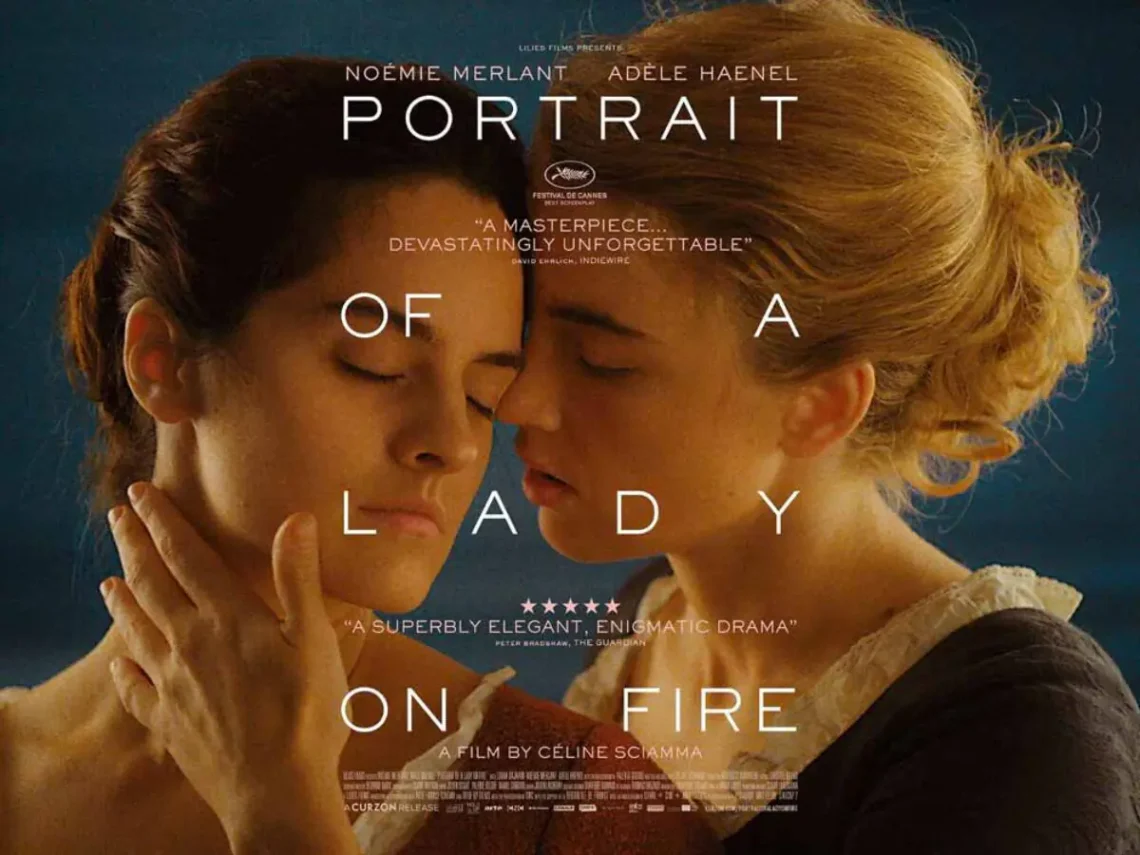
- Title: Portrait of a Lady on Fire (2019)
- Director: Céline Sciamma
- Screenplay: Céline Sciamma
- Country: France
- Genre: Romance, Drama
- Running Time: 120 minutes
- Platform: Theatrical Release, VOD, various OTT stores
- Cast: Noémie Merlant (Marianne), Adèle Haenel (Héloïse), Luàna Bajrami (Sophie)
📖 Portrait of a Lady on Fire Synopsis: A Secret Record Beginning Where the Gaze Lands [No Spoilers]
In late 18th-century France, Marianne, a painter, is commissioned to paint the wedding portrait of Héloïse, a young noblewoman facing an unwanted marriage. However, Héloïse resists the commodification of her image and refuses to pose.
Marianne disguises herself as a ‘walking companion’ to stay by her side while hiding her identity as a painter. By day, she secretly observes Héloïse’s minute habits and glances; by night, she reconstructs her on canvas by gathering fragments of memory.
An observation born of deception gradually transforms into deep understanding, and the moment Marianne finally confesses the truth, their relationship enters a new phase. In a seaside manor untouched by oppressive customs, the two women begin to share the most passionate hours of liberation through the act of painting one another.
👁️ The Moment the Observer Becomes the Observed: Analyzing the Gaze Structure of Portrait of a Lady on Fire
The first half of the film proceeds with a structure where Marianne unilaterally observes Héloïse. While this appears to mimic the traditional ‘Male Gaze,’ it is subverted the moment Héloïse asks Marianne, “When you observe me, who do you think I am looking at?”
This scene is the starting point for a core analysis of the film’s relational structure. It is a declaration that the model is not a passive object, but a subject gazing back at the painter with equal intensity. As a horizontal relationship where each completes the other is formed, the camera no longer merely scours an object but becomes a tool for capturing their mutual communion.
The void left by the dismantled power structure is filled with artistic camaraderie. By looking at each other, they finally exist as themselves. This ‘equal gaze’ is the most modern form of solidarity, transcending the historical limitations of the 18th century.
🔥 The Choice of Orpheus and the Aesthetics of Parting: How to Face Predestined Sorrow
In the middle of the film, the myth of ‘Orpheus and Eurydice’—read aloud by Marianne, Héloïse, and the maid Sophie—serves as a crucial tool for symbolic interpretation, foreshadowing their fate. Regarding why Orpheus turned back and lost his beloved forever, Héloïse offers a unique interpretation.
She suggests that Orpheus made a ‘poet’s choice’—not to forget, but to preserve the ‘last image’ of Eurydice. This is the very attitude the two will adopt in the face of their impending separation.
For Héloïse, who must leave for a ‘death’ within an institutional marriage, and Marianne, who must remain a painter, parting is not a failure but the completion of a memory. The act of looking back is a decisive resolution to permanently preserve that moment in time, even as it confirms the loss.
🔎 Reinterpreting the Ending — Page 28 and the Eternal Fracture Left by Vivaldi
At the film’s conclusion, Marianne experiences two reunions. One is through ‘Page 28’ in a portrait of Héloïse seen at an exhibition; the other is the profile of Héloïse listening to music alone in a concert hall.
The portrait at the exhibition, showing Héloïse with a child while her finger marks Page 28—where Marianne’s self-portrait was drawn—signifies that she retains a secret subjectivity that remains uninvaded even within her social roles (mother, wife).
Héloïse’s face in the final concert scene, as she oscillates between sobbing and smiling while listening to Vivaldi’s ‘Summer,’ is the film’s zenith. She does not know Marianne is watching her, yet the music and emotions they shared live and breathe intensely within her body.
What the protagonist gains in the end is not eternal possession, but the dignity of a memory that can never be erased, even if it entails pain. Their relationship achieves a total union within the realms of art and sensation, transcending physical disconnection.
Héloïse’s final tears are not the sorrow of loss, but the most violent ecstasy of life, proving the fervor of existence.
💡 On the Ambiguity and Representation of Women in the Ending of Portrait of a Lady on Fire
Q1. Why are there almost no male characters in the film? Is this a distortion of reality?
The absence of male characters is an intentional directorial choice. The director sought to reveal the unique language and trans-class solidarity of women that emerges only in the absence of men. This is not a denial of reality, but an aesthetic device for examining through a microscope the ‘utopian moments’ of women that must have existed within historical voids.
Q2. Was it for the best that the two did not meet again in the end?
From a modern perspective, a reunion might be a happy ending, but within the context of this film, a ‘silent distancing’ carries a greater resonance. Had they met again, it would have been subsumed into the realm of petty reality. The setting—where they can fully feel each other just by watching from afar—suggests that their love has reached an artistic plane that transcends time and space.
✨ Portrait of a Lady on Fire: A Declaration of Love Written by a Remembering Painter and a Burning Model
This work asks us: Has it vanished because it is no longer visible? Do we not love because we cannot touch? Through the gaze, director Céline Sciamma demonstrated how to subvert power, and through memory, how to conquer time.
The essence of a relationship lies not in possession, but in ‘how we will remember each other.’ The flame of these two, which blossomed outside the frameworks set by society, leaves an eternal afterimage in the hearts of the audience, no matter how brief it may have been.
Love is the courage to gaze at one another, and memory is humanity’s most beautiful resistance against things that vanish.
👁️ What is drawn on your Page 28?
Is there a powerful medium (music, scent, object) that summons you back to a specific moment even after parting with someone? Please share if you have ever experienced a time when keeping a painful memory provided greater comfort than forgetting.
🎬 Violet Screen’s Next Curation
- Film <Ammonite (2020)>: The silence and longing of two women blossoming as they excavate fossils on a rugged coastline. Recommended if you enjoyed the static tension of Portrait of a Lady on Fire.
- Drama <Mine (2021)>: A powerful narrative of women sharing secrets and forming solidarity within the closed space of a glamorous conglomerate family.
To provide a more stable publishing environment, multilingual content, and better communication with our readers, we have moved our official publication to Substack.
All new film reviews and critical essays will be published on our new platform. This website will be closing down soon, so we would greatly appreciate it if you subscribed to our new space.
TODAY'S QUESTION
Is there a film whose ending you wish had gone differently?
Your answer isn't saved. Feel free to share it in the comments below.


You May Also Like

Mother, May I Sleep with Danger? (2016) Review: A Cruel Waltz of Queer Vampirism and Twisted Maternal Love

Film The Venus Effect Review: An Interpretation of Existential Awakening and Solidarity Beyond the Boundaries of Queer Identity