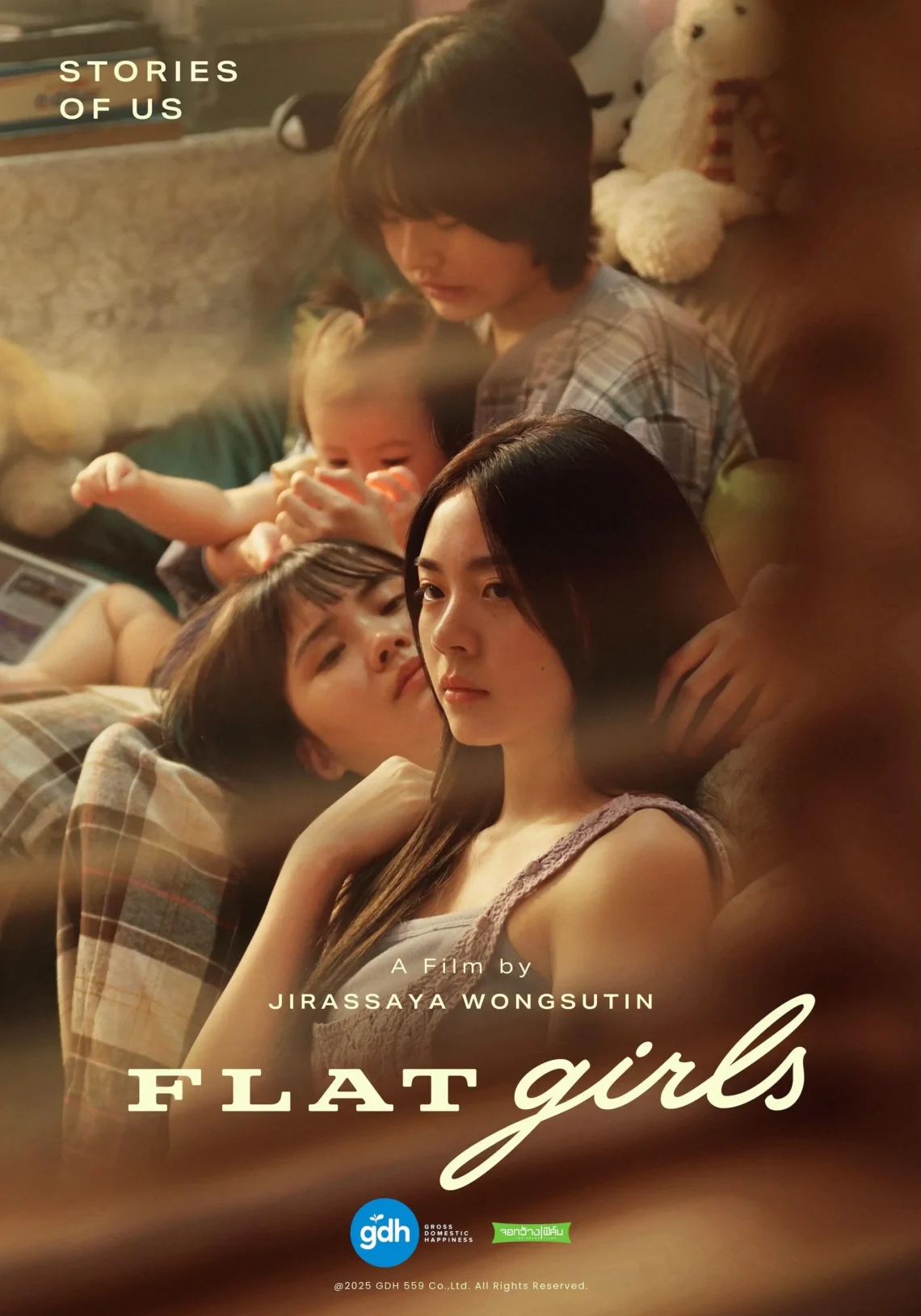
Flat Girls Review: Female Narratives Blocked by Class Barriers, the Collapse of First Love, and Interpretation of the Hidden Ending
Emotions that blossom within an isolated space are always immature, hence beautiful, and therefore cruelly painful. We all live our lives with one of the most radiant eras of our existence mortgaged to a specific space and person.
The film Flat Girls (เด็กแฟลต, 2025)—set against the backdrop of a dilapidated, claustrophobic police housing estate in Bangkok—is a work that microscopically examines the youth, first love, and cold reality of class between two girls who were closest to each other but could never occupy the same orbit. Moving beyond simple romance, this narrative relentlessly traces how the deprivations of an individual’s environment destroy the archetype of a relationship.
🌿 Moments When This Film Penetrates Particularly Deep
- The exact moment of intuiting that the futures they envisioned while looking out from the same rooftop during childhood are pointing in entirely different directions.
- When a lie uttered out of fear, amidst the ambiguous boundary between friendship and love, hardens into a permanent rift.
- When confronting the cold cruelty of a reality where the sheer weight of poverty renders even personal dreams and identity a luxury.
The reason to read until the very end is that it goes beyond a simple queer romance; it sharply dissects the structural tragedy of how Thai class structures and the female duty of familial support dismantle the lives of two young girls, alongside the symbolism of the film’s conclusion.
🎞 Note Before Watching the Film
This work strictly excludes sensational direction focused on visual stimulation or witty, dialogue-heavy banter. Instead, it is a dense, emotionally driven narrative drama that conveys waves of emotion through the characters’ micro-expressions, silence, and the palpable atmosphere inside the claustrophobic apartment complex.
🎬 Film Information
- Title: Flat Girls (Original Title: เด็กแฟลต / Subtitle: ชั้นห่างระหว่างเรา, 2025)
- Director: Jirassaya Wongsutin
- Screenplay: Jirassaya Wongsutin
- Country: Thailand
- Genre: Drama, Coming-of-age
- Running Time: 108 minutes
- Platform: Theatrical release and major local OTT platforms
- Cast: Kirana Pipityakorn, Fatima Dechawaleekul
📖 Flat Girls: The Crossed Trajectories and Loss of Two Girls, Close Yet Remote [No Spoilers]
Raised in a closed police family apartment complex (Police Flats) in Bangkok, Jane and Anne are best friends who shared their entire childhood and are akin to family. Looking out at the ships traversing the distant sea from the apartment rooftop, the two share a promise to one day leave this suffocating official residence and become free.
However, as they enter adolescence, a shift in emotion occurs between them. Jane realizes that her feelings toward Anne transcend friendship into a special love, but she conceals this due to fear regarding her own identity. Compounding this, the class disparity between the two begins to create realistic fractures.
Unlike Jane, the daughter of a police officer whose stable future is guaranteed, Anne’s reality is harrowing; following her father’s death in the line of duty, she must bear responsibility for her younger siblings and a mother consumed by gambling. For Anne, poverty becomes a shackle that forces her to abandon her dreams, and even Jane’s goodwill only serves to heighten the invisible wall between them.
To make matters worse, when a young police officer named Tong moves into the housing estate and emerges as Anne’s pragmatic savior, the trust and relationship between the two girls spiral into uncontrollable misunderstandings and conflict.
🏚 The Stigma of Class Imposed by Space and a Multilayered Interpretation of Flat Girls
🏢 The Closed Community of the Police Flats and the Pressure of Identity
The ‘Police Flats’, which serves as the film’s setting, is a structural space where generations live completely cut off from the outside world. Here, Jane is pressured to thoroughly conceal her sexual identity. The symbolic scene in the film where Jane compresses her chest as if to hide her femininity projects the psychological confusion and bodily repression inflicted upon a young girl by a social environment that enforces discipline and normalcy.
💰 The Tragedy of a First Kiss Wrought by Material Disparity and the Starting Point of Misunderstanding
At the moment of their first kiss, when their breaths touched, Jane could not bear the rushing weight of emotion and the fear of her identity, throwing out the lie: “I didn’t feel anything.” While this declaration was a defense mechanism, it became a cruel rejection for Anne. For Anne, whose self-esteem was already fractured by poverty, Jane’s lie becomes a tragic turning point that strips away even the safe zone of their relationship.
💔 The Ambiguity of the Character Tong and the Mechanics of How Rumors Are Consumed
The newly arrived police officer, Tong, appears as a helping hand to Anne, but simultaneously acts as the axis of a fracture that severs her relationship with Jane. The film deliberately leaves the relationship between Tong and Anne ambiguous—whether they are lovers or whether he is a pure helper. By depicting the process through which the residents of the housing estate generate rumors that she is “dating a cop for money” using Anne’s poverty as a pretext, the direction functions as a device to indict society’s harsh gaze toward impoverished female youth.
🔎 Reinterpretation of the Ending — The Tender Flight of a Ghost Built Upon Loss
In the latter half of the film, the final journey of the two girls, who have at last boarded the cruise ship they yearned for in childhood, blurs the line between reality and fantasy, posing a question to the audience. The image of Jane left entirely alone, having retrieved only a single ring left behind by Anne, proves that the conclusion reached by their relationship is an ‘eternal rift’ brought about by realistic limitations.
Anne’s disappearance can be read either as an autonomous escape to free herself from the shackles of poverty, or as a tragic end from being unable to bear the weight of life. By refusing to define this explicitly, the film leaves Anne as a symbol of tragedy swallowed by the space of the flats.
The voice message Jane leaves after time has passed—expressing a desire to one day meet Anne on an airplane after Anne has become a first-class flight attendant—is paradoxically akin to the sorrowful flight of a ghost that can never be realized in reality.
💬 On the Direction and Female Representation in Flat Girls
Q1. Is the narrative ambiguity, which leaves Anne’s disappearance and her relationship with Tong without explicit explanation, a flaw in the work?
A1. Viewed through the grammar of commercial romance, it may appear to be an unfriendly structure. However, the purpose of this film is not to neatly close the causal relationships of the narrative. By leaving Anne’s whereabouts and Tong’s true identity ambiguous, the film effectively maximizes the internal confusion of the characters and the violence inherent in the gaze of those within the housing estate.
Many viewers focus on whether Anne dated Tong for monetary purposes, but this is a device designed to allow the audience to multi-dimensionally experience the gossip-laden gaze of the residents and Jane’s anxiety-ridden jealousy. The essence does not lie in whether Tong is a good or bad person, but in the class tragedy where another person’s goodwill cannot be received with absolute purity amidst the severe poverty Anne faces.
Q2. In what ways does this work differentiate its female representation from conventional, typical GL (Girl’s Love) genre titles?
A2. Flat Girls achieves an outstanding aesthetic accomplishment in that it does not confine the exploration of sexual identity to a sweet romance, but instead fuses it with a sharp, realist coming-of-age tale. However, there is a divisive critical reception; some regret that the anxiety over identity and Jane’s self-repression are somewhat buried under the rapid narrative progression of the latter half and the extreme event of Anne’s disappearance, failing to find an organic resolution. Nonetheless, this ambiguity itself functions as a directorial device that perfectly represents the unstable confusion of adolescence.
✨ Flat Girls: The Sea Viewed from the Rooftop Was Not Equally Blue for Everyone
This film is a text so beautiful it is cruel, proving how easily the fragile solidarity of first love can crumble before the solid concrete wall of capital and class.
Excluding premature sympathy or romantic fantasy, the camera fixedly stares into the eyes of two girls who wished to save each other but ultimately had to confirm only each other’s limitations.
Love sometimes fails to become a weapon that saves the other person, and the deepest solidarity is finalized at the moment they ultimately let each other go.
🌊 On the Lingering Silence and the Departing Silhouette
We all live harboring memories of precious relationships that we wished to protect but had to let go of ourselves, either due to the weight of reality or because of our own fear.
Does there exist for you, too, a moment of first love left forever incomplete, where you cowardly hid your heart before the wall of reality, turned away, and said, “I didn’t feel anything”?
👁🗨 Violet Screen’s Recommended Curation of Female Narratives
- Bound (1996)Reason for Recommendation: The Wachowski sisters’ powerful directorial debut, this crime thriller follows two women, Corky and Violet, who devise a perfect plan to steal mafia money. It features stylish mise-en-scène, taut tension, and the unyielding trust between the two leads.
- Blue Gate Crossing (藍色大門, 2002)Reason for Recommendation: A classic of 2000s Taiwanese youth cinema, this narrative captures the confusion over one’s sexual identity during adolescence and the archetype of liking someone in the most transparent and tender manner. It will densely fill the void regarding the identity confusion and growing pains of growth that Jane experienced.
To provide a more stable publishing environment, multilingual content, and better communication with our readers, we have moved our official publication to Substack.
All new film reviews and critical essays will be published on our new platform. This website will be closing down soon, so we would greatly appreciate it if you subscribed to our new space.
TODAY'S QUESTION
What genre or mood do you always reach for when you're alone?
Your answer isn't saved. Feel free to share it in the comments below.


You May Also Like

An In-Depth Analysis of Boys Don’t Cry: A Gaze of Salvation Born Out of a Cruel Reality
Same But Different (2019): Discovering Radical Hospitality and Love Beyond the Chaos of Identity