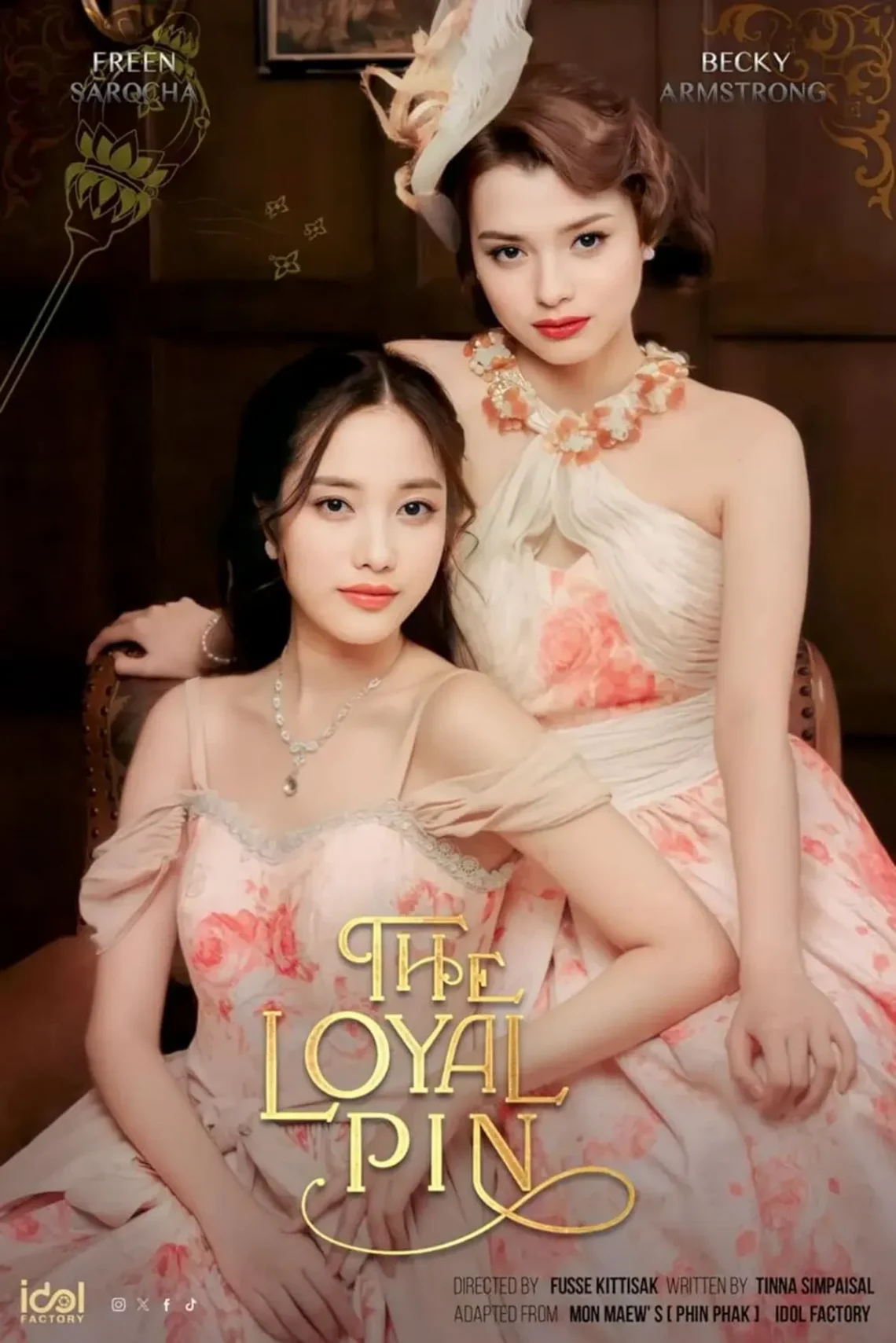
The Loyal Pin: A Narrative of Noble Aspiration Piercing Through Oppressive Eras
In a human lifetime, the most agonizing thirst stems not from a lack of external validation, but from ‘silence’—the inability to fully reveal one’s truth. Within the 1950s, a period shackled by rigid hierarchy and tradition, the act of loving someone transcends a mere sharing of emotions; it is a revolution that shatters one’s very ontological foundation.
Set against the backdrop of the Thai royalty, where classical aesthetics are concentrated, this story tenaciously traces how two women, blossoming behind closed doors, become each other’s salvation, destruction, and ultimately, their only world.
🌿 Moments When This Drama Deeply Permeates
- For those who remember having to deny their instincts before the towering walls of social status and family honor.
- For those who prefer dense emotional lines where the entire universe feels connected through a single gaze, without the need for words.
- For those who wish to indulge in the aesthetics of suppressed desire hidden within the meticulously woven costumes and etiquette of the Thai royal court.
- The reason you should read to the end is that this review goes beyond a simple romance to analyze the record of victory achieved by two women searching for their own agency within a feudal order.
🎞️ Note Before Watching
This work is set in an era dominated by conservative values regarding class systems and sexual orientation. It is an alluring melodrama that focuses on the emotional communion and depth of relationship between characters rather than physical indulgence.
🎬 Drama Information
- Title: The Loyal Pin (ปิ่นภักดิ์, 2024)
- Director: Kittisak Cheewasatjasakun
- Screenwriter: Tinna Simapaisal
- Original Work: The novel The Loyal Pin by Mon Maeo (Mon Maew)
- Country: Thailand
- Genre: Period Drama, Queer Romance, Royal Melodrama
- Running Time: Approx. 45 minutes per episode (16 episodes total)
- Platform: IdolFactory Official YouTube, Netflix (Selected regions)
- Cast: Becky Rebecca Patricia Armstrong (as “Anin” Aninlaphat), Freen Sarocha Chankimha (as “Pin” Pilanthita)
📖 The Loyal Pin: A Trajectory of Fate Flowing from Childhood Bonds to Inevitable Love [No Spoilers]
Lady Pin (Pilanthita), a daughter of nobility raised under royal protection after losing her parents, is a character who lives suppressing herself through strict etiquette and temperance. The presence that cracks her static life is the brilliant and free-spirited Princess Anin (Aninlaphat). Their relationship, which filled each other’s deficiencies since childhood, begins to take a clear shape beyond ‘friendship’ through the physical distance created by Anin’s studies in England.
Upon reuniting as adults, a reality harsher than mere longing awaits them. A princess who must maintain the dignity of the crown, and a noblewoman forced into an arranged marriage for the survival of her family. The tension between them escalates into a sharp sense of crisis, mirroring their deepening affection. The conflicting choices—Anin, who is willing to cast away her status to win love, and Pin, who attempts to sacrifice herself to protect her lover from ruin—constantly force the audience to question who the true object of ‘Loyalty’ should be.
🏛️ The Prison of Status and the Symbolism of Possession Projected onto the Pin
In this work, the ‘pin’ (hairpin) is a pivotal symbol that transcends being a mere accessory. Originally a ‘norm’ that bound women within traditional patriarchy and royal order, the pin is transformed within Anin and Pin’s relationship into a token of voluntary submission—a desire to belong to the other.
The pin Princess Anin gifts to Pin is not an oppression by power, but a declaration: “I will fasten my soul only to you.” From an analytical perspective, this is a subjective movement to establish oneself within a chosen relationship, shedding the status imposed by others. Through this mise-en-scène, the work beautifully visualizes how the classical female archetype transforms into a modern self through mutual longing.
🔗 The Deception of Sacrifice and the Completion of True Solidarity
In the mid-narrative, the point where Pin pushes Anin away and attempts to accept the arranged marriage is the most painful narrative inflection point of the drama. While this appears to be a typical self-sacrificial trope, a deeper look reveals it to be closer to the scream of a self defeated by the ‘social gaze,’ a giant monster.
However, Princess Anin does not simply accept this. She counter-utilizes the powerful structural weapon of royal authority to rescue Pin. The intriguing element here is that their relationship does not remain a simple dynamic of savior and saved. The moment Pin opens her own mouth to declare her desire before her family and society, their love is finally elevated from a tragic melodrama to a narrative of triumph.
🔎 Reinterpreting the Ending: Eternal Unity Scaling the Royal Walls and Breaking the Silence
The ending, where the two overcome all obstacles to be together, carries a structural meaning beyond a simple ‘happy ending.’ Considering the 1950s Thai setting, their union signifies a crack and expansion within the system rather than a total severance from it.
Anin chooses the latter between her responsibility as a princess and her carnal desire for Pin, thereby grafting the unfamiliar value of ‘individual happiness’ onto the rigid space of the monarchy. Pin also breaks free from being a puppet of her family and declares her place as an individual. The tranquility they find is not the silence left in the wake of a storm, but a trophy of war that can only be enjoyed by those who became the storm themselves to change the world.
The union of Anin and Pin is the final period in an existential victory, breaking the chains of oppressive tradition and establishing their own micro-universe.
❓ The Historical Context of ‘The Loyal Pin’ and Controversies in Interpreting the Ending
Q1. How do you view the criticism that the 1950s setting is too idealistic for a queer narrative?
Certainly, considering the social atmosphere of the time, the process of two women’s union gaining even royal approval might be pointed out as closer to ‘fictional compensation’ than realism. However, the purpose of this work is not the reproduction of pain, but to provide an aesthetic answer to the question “What if we were this brave?” in the crevices of suppressed history. One should acknowledge the points of criticism while viewing the directorial intent as prioritizing the sense of emotional liberation it provides.
Q2. In what context is the opinion that Pin’s passive attitude makes the plot frustrating?
The character of Pin represents the ‘modesty’ and ‘self-censorship’ forced upon women of that era. Her hesitation is not mere indecisiveness, but stems from an existential fear of having to turn her back on the entire world that raised her. The reason her transformation in the latter half of the drama is so dramatic is that it proves exactly how high the internal walls were that she had to break through.
✨ The Loyal Pin: A Temple of the Noblest Love Built Upon the Ruins of an Old Era
This drama gracefully preaches, through the form of a period piece, how love makes humans both most cowardly and most brave. The devotion shown by Anin and Pin is not a simple romantic feeling, but a sublime will of the human spirit to make the other’s existence whole. Ultimately, to love someone is equivalent to a declaration that one is prepared to turn the whole world into an enemy for that person.
Love does not follow the laws of the times; it is the act of establishing new laws in the place where lovers face each other.
🦋 What Truth are You Hiding Within Your Silence?
When social expectations and individual aspirations collide, are you the type to suppress yourself like Pin, or the type to break boundaries like Anin?
📽️ Violet Screen Curation: The Allure of Other Female Narratives
- Anna (2022): A work dealing with the psychological isolation and distorted desire of a woman who begins to live an entirely different life triggered by a small lie.
- Jeongnyeon: The Star Is Born (2024): Set in a 1950s traditional women’s opera troupe (Gukgeuk), this drama depicts the intense artistic communion, solidarity, and competition among women.
To provide a more stable publishing environment, multilingual content, and better communication with our readers, we have moved our official publication to Substack.
All new film reviews and critical essays will be published on our new platform. This website will be closing down soon, so we would greatly appreciate it if you subscribed to our new space.
TODAY'S QUESTION
What genre or mood do you always reach for when you're alone?
Your answer isn't saved. Feel free to share it in the comments below.


You May Also Like

Interpreting the Ending of Netflix’s The Hunting Wives: A Forbidden Solidarity Engineered by Twisted Desire
The Secret of Us (2024) Review: A Chronicle of Isolation, Reunion, and the Profound Nature of ‘Loss’
