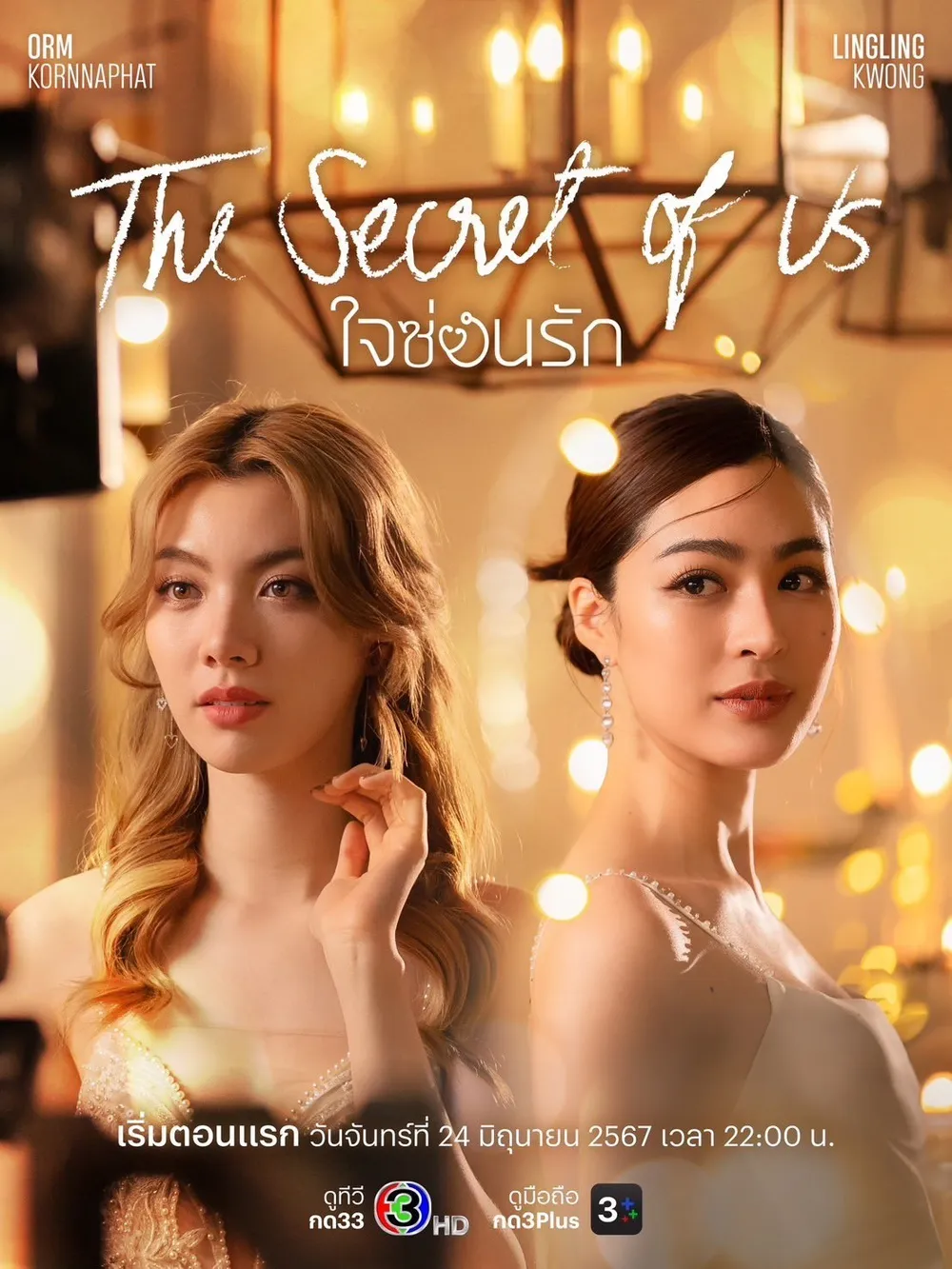
The Secret of Us (2024) Review: A Chronicle of Isolation, Reunion, and the Profound Nature of ‘Loss’
Love, at times, becomes the sharpest of weapons, carving into one another. In the name of protecting the other, we often choose to isolate ourselves, inflicting an inexplicable sense of loss upon our partners and leading the relationship toward catastrophe.
This work is not merely a “reunion” story about former lovers meeting again. It is a desperate record of autonomous recovery—of restoring a damaged truth and completely reclaiming one’s life from the control of others.
🌿 Moments When This Drama Deeply Permeates the Soul
- When you realize how cruel a violence silence can be in the name of love.
- When you find yourself wanting to hold someone’s hand again, despite carrying indelible scars from the past.
- When you desire to exist solely as “myself,” escaping the prison of parental expectations.
- Therefore, I hope that by reading to the end of this piece, you might find the missing puzzle pieces of your heart that you once turned away from.
🎞 Note Before Viewing
This production densely handles psychological conflict between lovers and past trauma. It is a relationship-centered narrative where the emotional amplitude outweighs physical explicitness, deeply depicting the delicate emotional bonds and confrontations between women.
🎬 Drama Information
- Title: The Secret of Us (ใจซ่อนรัก, 2024)
- Director: Sarasawadee Wongsomphet
- Screenwriter: Pranprisa
- Original Work: Meenam (Novel ‘Jai Sorn Rak’)
- Country: Thailand
- Genre: Romance, Drama, GL (Girls’ Love)
- Running Time: 8 Episodes
- Platform: CH3, Netflix
- Cast: Lingling Sirilak Kwong (as Fahlada), Orm Kornnaphat Sethratanapong (as Earn)
📖 The Secret of Us: A Relentless Reunion Where Misaligned Puzzles Meet Again [No Spoilers]
During their years studying abroad, Fahlada and Earn were each other’s entire world, only to be shattered by Earn’s unilateral breakup notice for reasons unknown. Years later, Fahlada, now a skilled doctor living behind cold walls, finds her tranquil life thrown into upheaval once more when Earn, now a rising star, appears as the model for her hospital’s advertisement.
The central tension of the drama lies between Earn, who approaches desperately to undo past mistakes, and Fahlada, who pushes her away, crushed by a sense of betrayal. Their conflict transcends simple misunderstanding; it is entangled with external pressures that forced the truth to remain hidden and the profound distrust spawned by that silence, making the audience long for their fateful reconciliation.
🧩 Broken Puzzles and Rewritten Trust: Interpreting the Resilience of Relationships in The Secret of Us
The puzzle Fahlada made from a photo of the house Earn once dreamed of is the work’s most significant metaphor. A puzzle cannot be finished if even a single piece is missing, and it loses its original form if one tries to force the pieces together. Fahlada’s act of destroying this puzzle due to a misunderstanding is an expression of despair: the realization that once trust is broken, it can never be the same.
Paradoxically, however, the destruction of the puzzle becomes the catalyst for shattering “past illusions” and facing “present truths.” Only after the two characters witness each other’s absolute rock bottom does the hidden truth begin to surface. This process suggests that the recovery of a relationship is not simply about returning to the past, but begins with the courage to pick up the broken pieces once more.
🤱 The Great Barrier of the Mother: Lessons from the Finales of Power Structures and Narratives of Sacrifice
In the series, Fahlada’s mother, Rusamee, is not a simple villain but a figure representing patriarchal authority and elitist class consciousness. The pressure she exerted on Earn—demanding a breakup in exchange for her mother’s medical expenses and Fahlada’s future—resembles a typical melodrama cliché. However, when this dynamic operates within a sapphic romantic narrative, its destructive power is doubled.
Ultimately, the conclusion of this drama focuses as much on the “emotional separation” between Fahlada and her mother as it does on the union of the two leads. Fahlada’s choice to distance herself upon learning of her mother’s transgressions is a declaration that she prioritizes her own identity and love over the shackles of blood ties. True growth is achieved by tearing down the paradise designed by others and cultivating one’s own land of pain.
🩺 The Scars a Doctor Could Not Heal: A Review of Where Fahlada’s Isolation and Earn’s Desperation Collide
It is contradictory that Fahlada, who treats the pain of others as a physician, chooses to isolate herself by locking up her own heart. Conversely, the actress Earn, who reveals herself under bright lights, constantly knocks on Fahlada’s rigid fortress. This professional contrast translates into a confrontation between the one who hides (Secret) and the one who reveals (Show).
Fahlada’s coldness is, in fact, a defense mechanism to avoid being hurt again, while Earn’s aggressive apologies are a process of atonement for her past cowardice. The moment they share their vulnerabilities at the end of their conflict, the drama proves that the greatest salvation one human can offer another is “understanding,” moving beyond simple romance.
🔎 Reinterpreting the Ending: Complete Unity Achieved After Paying the Price of Silence
The finale of this work concludes with the resolution of all misunderstandings and the two characters holding a wedding. This carries great significance beyond a mere happy ending; it represents the validation of a relationship that has undergone “social consensus.” Specifically, the process of the mother, Rusamee, acknowledging her daughter’s love and restoring their relationship demonstrates a reconciliation between generations.
Earn’s act of sending Fahlada back to her mother’s side is qualitatively different from her past unilateral sacrifice. In the past, she “left” for the sake of the other, but now she chooses the maturity of “waiting” for the other. The final kiss shared by the two is like new flesh grafted over old scars.
The completion of love stems not from the removal of obstacles, but from the will of two people to overcome those obstacles together.
💬 Deep Inquiries Regarding the Narrative and Interpretation of the Ending in The Secret of Us
Q1. How should we view Earn’s unilateral sacrifice and her choice to break up?
From a critical perspective, Earn’s choice can be seen as “deception” that deprived Fahlada of her right to choose. However, the economic poverty and the survival of her mother that Earn faced at the time were forms of massive structural violence that could not be resolved by individual will. While acknowledging that Earn’s choice was not the best, the work completes the narrative through the process of Fahlada forgiving even that cowardice as a form of love.
Q2. Was the mother’s forgiveness and reconciliation in the ending too sudden?
The setting where Rusamee, who lived her whole life dogmatically, suddenly changes her attitude may draw mixed reviews regarding realism. However, in the aesthetic context of the play, this symbolizes the “essential return of maternal love” and the “acceptance of a child’s independence.” Rather than a perfect reformation, it is more appropriate to interpret it as a human limitation where she finally understands her child’s loss through her own loss (health).
✨ The Secret of Us: The Sturdiest Castle Built by the Wounded
This drama relentlessly tracks how love destroys a person and how it raises them up again. The relationship between Fahlada and Earn reflects the lack of communication, misunderstandings, and resulting isolation we experience in modern society. We may all be a Fahlada, wounded by someone, or an Earn, possessing a secret that cannot be told.
Ultimately, The Secret of Us asks us: What are you prepared to destroy and what are you prepared to reassemble to protect your love? Love is not buying a completed picture, but a blessing obtained at the end of the arduous labor of fitting broken pieces together one by one.
True solidarity is another name for the patience required to read the hidden screams within another’s silence and remain by their side.
🕊 What shape is your puzzle in right now?
Silence sometimes protects the other, but sometimes it causes a relationship to wither. Do you have a secret you are keeping in the name of “good intentions” for someone you love?
Is that secret protecting you, or is it isolating you?
📽 Violet Screen Recommendations: Further Depths of Female Narratives
- Blank The Series (2024): Features a provocative narrative that shatters social conventions alongside the complex psychological warfare between two women overcoming an age gap.
- The Loyal Pin (2024): A period drama set in the Thai royal court; the restrained emotional lines of two women agonizing between duty and love, combined with exquisite mise-en-scène, are masterful.
To provide a more stable publishing environment, multilingual content, and better communication with our readers, we have moved our official publication to Substack.
All new film reviews and critical essays will be published on our new platform. This website will be closing down soon, so we would greatly appreciate it if you subscribed to our new space.
TODAY'S QUESTION
Which ending has stayed with you the longest?
Your answer isn't saved. Feel free to share it in the comments below.


You May Also Like
Conversations with Friends: The Aesthetics of the ‘Fissure’ Born from the Collision of Isolated Interiors and the Worlds of Others

La vita che volevi: A Gift from an Erased Past, an Unexpected and Complete Oneness
