Interpreting Euphoria: The Catastrophic Aesthetics of Addictive Illusions and the Obsession with Salvation
We often mistake another person for the “perfect piece” that will fill our own deficiencies. The moment someone’s presence becomes the sole breathing hole in one’s life, that love accelerates beyond romance and into the realm of survival. HBO’s Euphoria pierces through the raw pain of adolescence hidden behind brilliant glitter, relentlessly investigating how the arrogance of trying to “save” another eventually consumes both parties.
🌿 Moments When This Drama Deeply Permeates the Soul
- When the act of loving someone feels less like “healing” and more like “addiction,” leaving you terrified of yourself.
- When you find yourself standing precariously before the mirror of another’s gaze just to prove your own identity.
- When two wounded souls meet and, in an attempt to embrace, only puncture each other with their respective thorns.
- The reason you must read this through to the end is to discover the value of “true independence” that lies beyond the destructive relationship of Rue and Jules.
🎞 Note Before Viewing
This work deals with adolescent substance abuse, mental health, and complex gender identity, featuring a very high level of graphic content. It is a psychological drama that focuses on the devastating isolation and relational tragedies of characters masked by visual opulence.
🎬 Series Information
- Title: Euphoria (2019–)
- Director: Sam Levinson
- Screenplay: Sam Levinson
- Original Work: Israeli series of the same name (Ron Leshem, Daphna Levin)
- Country: USA
- Genre: Drama, Coming-of-age, Psychological
- Running Time: Approx. 55 minutes per episode
- Platform: HBO Max
- Cast: Zendaya (Rue Bennett), Hunter Schafer (Jules Vaughn), Jacob Elordi (Nate Jacobs), Alexa Demie (Maddy Perez)
📖 Euphoria Synopsis: A Precarious Light Found Within the Cycle of Addiction [No Spoilers]
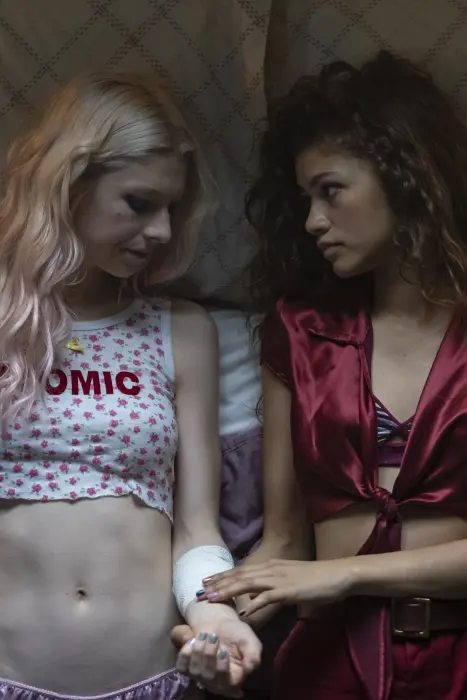
Returning from a drug rehabilitation center, Rue spends her empty daily life still unable to find a reason for living. It is then that she meets Jules, a new transfer student, and for the first time, Rue feels a powerful life energy from a being rather than a substance. Jules, too, is drawn to Rue’s pure affection amidst her own struggles with identity and loneliness, and the two grow rapidly close.
However, to Rue, Jules becomes more than a mere lover; she becomes a “new object of addiction” to replace the drugs. Jules begins to feel crushed under the heavy burden of being responsible for Rue’s recovery, caught in a conflict between her own desires and Rue’s survival. As the destructive desires of surrounding characters like Nate intermingle, the relationship between the two girls begins to spiral toward an uncontrollable catastrophe that transcends beautiful salvation.
💎 Rue and Jules: A Suffocating Interpretation of Love as a Substitute for Addiction
Euphoria does not depict love as a beautiful cure. Instead, it applies the sharp scalpel of dependency. To Rue, Jules is a variation of a “drug.” To a brain whose dopamine system has collapsed, Jules is the only external stimulus providing pleasure, which inevitably creates an abnormal power structure where Rue’s life and death are determined by Jules’s every move.
From Jules’s perspective, this relationship is akin to the “suffering of a saint.” She loves Rue, but she mortgages her own freedom to ensure Rue does not touch drugs again. In Season 2, Jules’s exposure of Rue’s drug use may superficially appear as a betrayal, but structurally, it can be interpreted as a manifestation of a desperate survival instinct to break the chains of codependency.
🌊 Jules Vaughn’s Interiority: The Liberation of a Girl Who Wanted to Be a “Sea Blob”
The special episode “F*ck Anyone Who’s Not a Sea Blob” is the essence of this drama. Jules, who had been preserved as an “angel” or “savior” in Rue’s eyes, finally descends as a flesh-and-blood human through this episode. She regrets a past where she carved her femininity to fit the male gaze and expresses a desire to be a “sea blob”—an undefined entity.
This exploration of identity by Jules clashes with Rue’s static world. Rue wants Jules to be an unchanging sanctuary, but Jules wants to constantly change and expand. Ultimately, the rift between the two does not stem from personality differences, but from a discrepancy in the speed of growth. Jules seeks to move forward, while Rue seeks to remain in Jules’s arms to forget the past.
🔎 Reinterpreting the Ending: A Solitary Confrontation Left Behind the Spilled Glitter
In the Season 2 finale, the scene where Rue kisses Jules on the forehead and walks away alone signals both the end of the relationship and the beginning of true rehabilitation. Until then, Rue’s recovery was always leaning on the external motivation of being “for Jules.” However, waking up from the perfect illusion that was Jules, Rue finally stares directly into her own broken interior with her own eyes, rather than through the vicarious satisfaction of another.
This ending destroys the romantic formula that two people must be together to be happy; instead, it proves how much sublime growth can be brought about by “escaping a love that destroys me.” What Rue loses is the sanctuary of Jules, but in exchange, she gains the “ego muscle” to endure her own pain. Jules, too, escapes the compulsive savior narrative of being responsible for another’s life and finally reclaims her right to focus on her own desires.
Love must not be the act of filling another’s deficiency, but the act of walking side by side while carrying one’s own.
❓ Deep FAQ on Euphoria’s Provocative Direction and Ending Interpretation
Q1. How do you view the criticism that the drama’s provocativeness and portrayal of drugs are excessively glamorized?
Certainly, the visually splendid lighting and music aesthetically present the “euphoria” of a drug-induced state. However, as the show progresses, the direction depicts the vomiting, seizures, isolation, and family breakdown—the price of that splendor—with chilling coldness. This is not glamorization, but an aesthetic device to maximize the contrast between the addict’s fleeting illusion and eternal hell. Readers should focus on Rue’s pain as she realizes that this splendor is ultimately “fake.”
Q2. Isn’t Rue and Jules’s breakup ultimately an irresponsible result for both?
From a critical perspective, one could see Jules’s whistleblowing as pushing Rue to the edge. However, in an unhealthy relationship, irresponsibility is actually “silence.” Jules chose the truth and gave up her right to be loved to avoid being a bystander to Rue’s death. This may be the most responsible form of affection, one that accepts the destruction of the relationship. It is reasonable to interpret their breakup not as a failure, but as the ultimate consideration to prevent them from ruining each other.
✨ Euphoria: An Independent Life Finally Blooming Atop a Collapsed World
Euphoria asks us: Is your love saving the other person, or is it devouring them to fill your own hunger? The story of Rue and Jules is not merely about wandering adolescents. It is a report on the universal human vulnerability of trying to depend on someone amidst a crisis of identity.
Ultimately, true salvation is completed not by another’s touch, but by walking out of the darkness on one’s own feet. The tears Rue shed and the departure Jules chose are like the rites of passage of “standing alone” that we must all undergo.
True solidarity is not becoming each other’s savior, but silently watching the back of someone as they endure their own personal hell.
💬 Growth Through Loss, What Is Your Choice?
Between the life of a savior who sacrifices everything for another, and a life of protecting one’s own identity even at the cost of being criticized, which side does your heart lean toward?
When love becomes a poison rather than a medicine that saves someone, do you have the courage to sever that relationship?
🎥 Another Perspective from Violet Screen: Recommended Women’s Narratives
- Yellowjackets (2021–): A psychological thriller following women who survived a plane crash, moving between their past and present. It intricately depicts the bizarre yet tight-knit power structures and solidarity formed by women in an isolated environment.
- Girls Can’t Surf (2021): A chronicle of women who created their own waves in the male-dominated surfing scene. Recommended for those who wish to focus on expansion through relationships rather than the destruction of them.
To provide a more stable publishing environment, multilingual content, and better communication with our readers, we have moved our official publication to Substack.
All new film reviews and critical essays will be published on our new platform. This website will be closing down soon, so we would greatly appreciate it if you subscribed to our new space.
TODAY'S QUESTION
Is there a film whose ending you wish had gone differently?
Your answer isn't saved. Feel free to share it in the comments below.


You May Also Like

Orphan Black: A Critique of Love and Scientific Vows Beyond Subjugation

The Stripper (2019): Temptation Born of Secrets, a Multilayered Interpretation of a Love Trapped Between Two Worlds