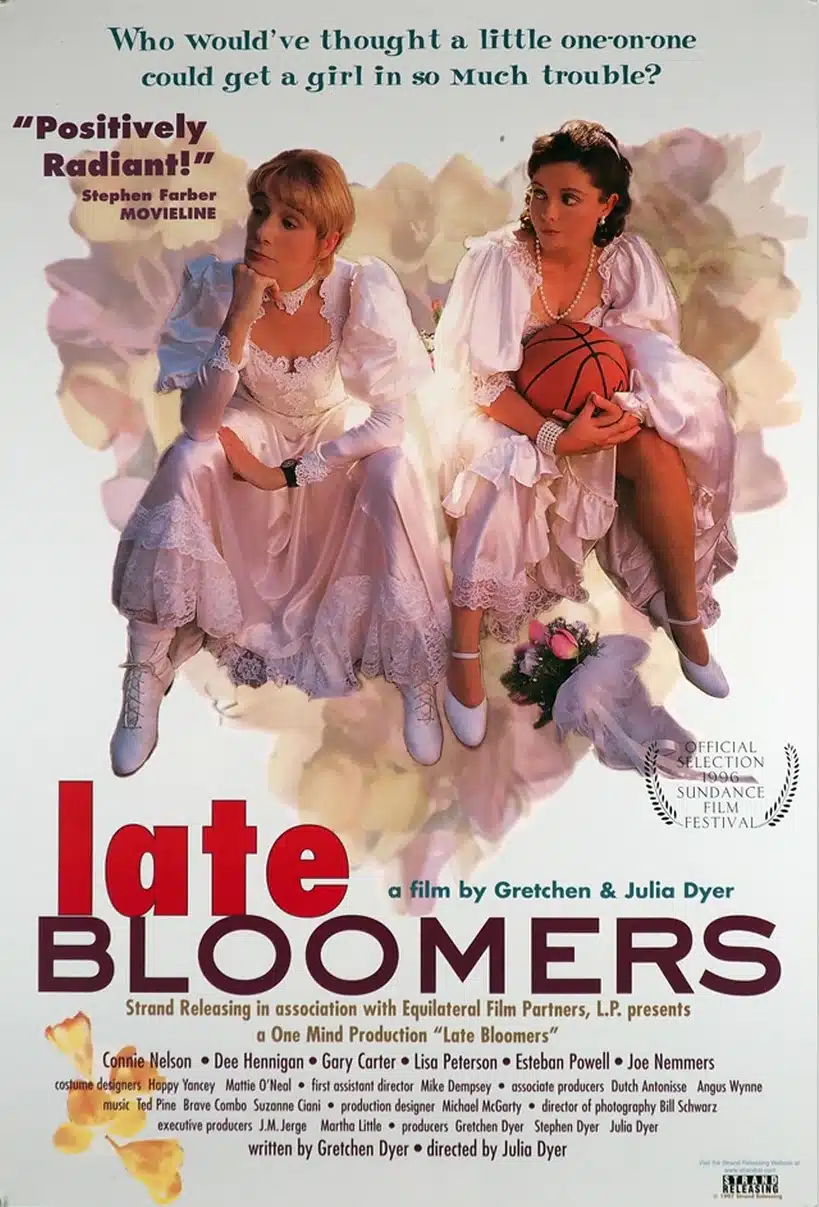
Late Bloomers (1996) Queer Film Review: Mid-life Awakening and the Solidarity of Late-Blooming Desire
Every flower has its own season for blooming. Some break through the late winter snow, while others reveal their true colors only under the scorching midsummer sun or in the cool air of late autumn. The film Late Bloomers begins precisely at that comforting realization: the moment we call “too late” might actually be the most fervent peak of the self.
This work is more than a romantic comedy about a mid-life dalliance. It is a record of a subversive yet beautiful revolution—shattering the rigid shells of “wife,” “mother,” and “teacher” imposed by society for decades. The process of two women finding their way in each other’s eyes amidst the stagnant air of Texas continues to pose valid questions to us today.
🌿 The Moments This Film Sinks Deeply Into the Soul
- When the order of familiar daily life suddenly feels foreign, leaving a hollow ache in a corner of your heart.
- When you grow weary of the roles scripted by others and long to hear your own authentic voice.
- On nights when you are curious about the subversive power and courage of love.
- When the fear that it might be “too late” holds you back.
- The reason to read until the end is to witness how this optimistic narrative, blooming through the conservative landscape of the 1990s, offers a form of salvation for our present.
🎞️ Note Before Viewing
This film prioritizes the psychological tide and the density of relationships over physical exposure or provocative imagery. While it includes scenes of intimate communion depicting the sexual awakening of middle-aged women, these are directed with respect and warmth as essential narrative devices for establishing identity.
🎬 Film Information
- Title: Late Bloomers (1996)
- Director: Julia Dyer
- Screenwriter: Gretchen Dyer
- Country: USA
- Genre: Romantic Comedy, Drama, LGBTQ+
- Running Time: 104 minutes
- Platform: DVD and select international streaming platforms
- Cast: Connie Nelson (as Dinah Groshardt), Dee Hennigan (as Carly Lumpkin), Gary Carter (as Ronald Lumpkin)
📖 Late Bloomers: A Late Love That Cracks the Surface of Ordinary Life [No Spoilers]
Set in a typical Texas suburb, Carly—a school secretary, wife, and mother of two—lives the life of a quintessential “good wife and wise mother” recognized by all. However, like a satellite in a fixed orbit, her life is as dry as it is stable. One day, Carly begins learning basketball from Dinah, a mathematics teacher and coach at the school.
Dinah is an isolated figure who maintains extreme emotional restraint, immersing herself solely in work. Within the confined space of the basketball court, the two share physical contact and breath, leading to an explosion of long-suppressed emotions. Carly, who has believed herself to be heterosexual her entire life, and Dinah, who has lived ignoring her own desires—their rigid daily lives are swept into an uncontrollable whirlpool as their relationship becomes known to the conservative community.
🏀 The Basketball Court as a Liberation Zone: Interpreting Physical Communion and Psychological Subversion in Late Bloomers
In the film, the basketball court functions as more than a sports venue; it is a “liberation zone,” a sole sanctuary for escaping social oppression. Carly’s acts of throwing the ball and bodily contact represent her first experience of using her body—previously confined to the “realm of care” through domestic labor and secretarial work—entirely for her own desire.
Physical contact with Dinah awakens unfamiliar sensations in Carly. This extends beyond mere sexual attraction into a humanistic reflection: realizing that her body is not an object or a tool for others, but her own “self.” The sight of two women sweating and moving across the court highlights their status as dynamic, autonomous human beings, providing a sense of catharsis to the audience.
This subversive direction is completed by the Dyer sisters’ delicate mise-en-scène, utilizing natural Texas light rather than artificial lighting to visually prove that their love is not an “unnatural aberration” but a “natural manifestation of vitality.”
🌵 Truth Isolated Under the Texas Sun: An In-depth Review of the Clash Between Conservative Community and Queer Identity
Late Bloomers deepens the layers of conflict by setting the story in a mid-90s American community dominated by conservative Christian values. The collective groups—the school and the Parent-Teacher Association (PTA)—ostracize the two women, dismissing their relationship as a mere scandal. Crucially, the film portrays these groups not as simple villains, but as a “system of fear” rooted in ignorance.
The hardships Carly and Dinah face are not matters of individual morality, but symbolize the violence inflicted when one deviates from the “normalcy” prescribed by the system. In particular, the cold stares and rumors from fellow teachers poignantly illustrate how impossible a challenge it was for a middle-aged queer woman to maintain social standing while revealing her identity.
Nevertheless, the film does not lapse into cynicism. Instead, it neutralizes social pressure through a humorous twisting of bigotry and the dignified posture of its characters. This offers a critic’s insight that rejects the grammar of tragedy common in minority narratives, asserting the value of “dignity” beyond mere survival.
🔎 Reinterpreting the Ending — The Most Radical and Warm Declaration of Union from 1996
The most striking aspect of this film lies in its “optimistic conclusion.” Unlike many 90s queer films that ended in death, separation, or lonely escape, this work chooses a dignified union in the heart of the town. The understanding and support shown by Carly’s husband may seem unrealistic, but within the narrative structure, it signifies a peaceful parting from the old system.
The wedding scene at the end goes beyond the fruition of their love; it suggests a new crack in the consciousness of the community that once rejected them. Carly and Dinah build a new self upon the fragments of the past without denying it. What they gain is not just a beloved partner, but a “truthful life” in which they no longer have to deceive themselves.
The conclusion of this film is a structural victory that captures the moment when relationship-as-social-contract yields to the individual’s truthful desire.
❓ Aesthetic Debates and Ambiguity in the Interpretation of Late Bloomers
Q. How do you view the criticism that the husband’s attitude is overly generous, making it feel unrealistic?
A. It is a valid point. In reality, divorce and coming out usually involve much more agonizing processes. However, this film was conceived not as a documentary, but as a “fairy tale for adults” or a “prototype of hope.” The placement of unrealistically kind characters should be interpreted as an intentional aesthetic choice by the director, asserting that the “right to be unhurt” and a “blessed ending” should be permitted for minorities.
Q. Why did it have to be a ‘mid-life’ love?
A. Youthful love is often in the realm of possibility, but mid-life love exists in the realm of “choice and sacrifice.” Coming out in mid-life, which necessitates upending established social foundations and family ties, requires that much more courage. Just as the “Late Bloomers” of the title leave a deeper fragrance, this narrative of facing oneself in the second half of life provides a universal sense of liberation.
✨ Late Bloomers: The Blossoming of a Self Unbound by Time
The film asks us: Are you living in a garden designed by others, or are you sprouting your own seeds? Late Bloomers shows that there is no expiration date on the discovery of identity, and that such discovery is completed through deep solidarity with another.
Its greatest legacy is pulling the queer narrative out of the abyss of darkness and suffering to dance under the midday sun. It proves that love and identity are not given in a finished state, but are processes shaped through constant trembling and collision.
True self-reflection is determined by the density of emotion, not the speed of time.
💬 What season is your hidden flower waiting for in the silence?
Some give up stability for love; others bury love in silence for stability. Do you have the courage, like Carly, to tear down the rigid walls and head to the unfamiliar court, or will you dream of a peaceful tomorrow on the familiar living room sofa?
🎥 Violet Screen Curation: Another Perspective on the Late-Blooming Self and Female Solidarity
- Blue Jean (2022)
- Reason for Recommendation: Set in 1980s Britain under the Thatcher government, it explores a PE teacher’s struggle with her identity. It is a masterpiece that depicts the social pressure and isolation Dinah would have felt, with colder, finer detail.
- Women Talking (2022)
- Reason for Recommendation: Shows the power of conversation among women in a closed community fighting for their dignity. While not a romantic comedy, it resonates through the theme of women’s solidarity breaking through oppressive environments.
To provide a more stable publishing environment, multilingual content, and better communication with our readers, we have moved our official publication to Substack.
All new film reviews and critical essays will be published on our new platform. This website will be closing down soon, so we would greatly appreciate it if you subscribed to our new space.
TODAY'S QUESTION
What changed the most for you after coming out?
Your answer isn't saved. Feel free to share it in the comments below.


You May Also Like

Elena Undone (2010): When the Repressed Self Faces Truth, the Aesthetics of Salvation Wrought by Flaws in a Relationship

Kiss Me Again (2006) – The Expansion of Desire and the Fracturing of Relationships: The Identity Remaining at the End