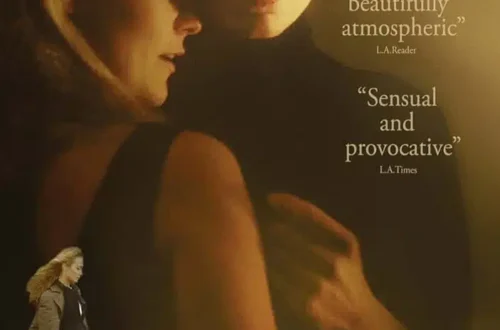
Eileen, a Noir of Suppressed Desire and the Illusory Fissure Named Rebecca (Eileen, 2023)
Every living being carries their own breaking point. In the dead of a freezing winter, when a massive fissure cracks open within a woman enduring an isolated daily existence of self-inflicted cruelty, what pours through that gap? Is it salvation, or utter ruin? The film Eileen is a cold yet scorching psychological noir that forces us to confront the darkest desires of the human abyss through the intense mutual attraction of two women.
🌿 The Moments This Film Deeply Permeates
- An evening when the longing to be fully understood by another curdles into an agonizing loneliness.
- When you experience a liberating awakening where your entire world is shaken by someone’s minor gesture or a single glance.
- When you are curious about the psychology of those who willingly choose to become monsters to break the chains of an oppressive reality.
- Why you must read to the end: Because the conclusion of this breathtaking relationship is not a simple crime, but holds a structural twist that leads to a human being’s complete self-awakening and liberation.
🎞 Note Before Watching the Film
While this work outwardly takes the form of a psychological thriller, it is essentially a relationship-driven narrative chasing the subtle tension and intimate emotional ripples between two women. Rather than visual stimulation, the true depth of the narrative can be felt when focusing on the psychological stakes embedded within the characters’ dialogue, breathing, and covert glances.
🎬 Film Information
- Title: Eileen (2023)
- Director: William Oldroyd
- Screenplay: Ottessa Moshfegh, Luke Goebel
- Original Work: Ottessa Moshfegh’s novel of the same name, Eileen
- Country: United States
- Genre: Psychological Thriller, Noir, Drama
- Running Time: 94 minutes
- Platform: Paramount+
- Cast: Thomasin McKenzie, Anne Hathaway, Shea Whigham, Marin Ireland
📖 Synopsis of — A Blonde Savior Stepping into a Gray Daily Life [No Spoilers]
In a frozen small town in Massachusetts, 1964, Eileen, who works as a secretary at a juvenile correctional facility, gradually withers under the emotional abuse of her alcoholic father and monotonous labor. Her world, which she used to fill with self-destructive fantasies, sees its cold silence shattered when a new psychologist, Rebecca, assumes her post.
The sophisticated and confident Rebecca introduces Eileen to a fascination and sense of liberation she has never experienced before, rapidly beginning to dominate her life. Tracking the secrets hidden behind a brutal crime committed by a boy inside the facility, the two gradually build a covert solidarity. Finally, on Christmas Eve, Eileen, invited by Rebecca, steps into her hidden space, and the narrative begins to hurtle toward unpredictable conflict and catastrophe.
🧠 Two Gazes Trapped in a Room of Mirrors: In-Depth Analysis of
❄️ Gray Oppression and Blonde Liberation: The Dichotomous Space of Eileen and Rebecca
In the film Eileen, space and mise-en-scène serve as the most precise mirrors reflecting the psychology of the characters. The home where Eileen stays and the prison are gray dungeons constructed by 1960s patriarchy and social alienation. Conversely, Rebecca appears as a gorgeous icon who subverts this suffocating space entirely.
The process by which the monotonous, colorless Eileen becomes fascinated by Rebecca’s green coat, blonde hair, and uninhibited gestures functions beyond mere admiration; it acts as a projection of the self. The dance they share at the bar and the sudden kiss become the decisive fuse that awakens the sexual desire and subjectivity lying dormant within Eileen.
💥 Confession and Gunshot: A Ruinous Solidarity Chosen by Suppressed Rage
On Christmas Eve, the basement torture space engineered by Rebecca is the stage where the structural relationship between the two shifts from an asymmetry of power into a partnership in crime. Rebecca’s justice in trying to punish Rita’s complicity appears rational on the surface, but a deceptive morality lies beneath it.
On the other hand, the moment Eileen pulls the trigger toward Rita is a pure explosion transcending logic. Her brief confession, “I got upset,” is a belated retaliation against the patriarchal abuse and oppression that had crushed her all this time. Eileen shakes up Rebecca’s plan and makes a proposal. This bold plan to frame her father and flee to New York is a powerful point of interpretation proving that Eileen is no longer a follower of Rebecca, but has transformed into a figure holding the initiative of the narrative.
🔎 Reinterpretation of the Ending — Dignity Accomplished on an Abandoned Road
At the end of the film, leaving behind Rebecca who failed to appear at the rendezvous, Eileen disposes of Rita’s body alone before hitching a ride on a truck. This conclusion signifies a complete rupture reached by the two women’s relationship, and simultaneously, the total independence of Eileen as an individual. Rebecca might have been an illusory entity summoned from the subconscious by Eileen in order to save herself.
In the space where the catalyst named Rebecca has vanished, Eileen no longer returns to the frail girl of the past. Though she has committed an irreversible sin called murder, she simultaneously breaks the chains of all social shackles and abuse that bound her with her own hands, flashing a subtle smile. Eileen’s liberation is not a salvation dependent on another, but a declaration of brutal subjectivity achieved by choosing to become a monster herself.
❓ On the Narrative of and the Representation of Women
💬 Q1. How do you evaluate the criticism that the sharp genre shift in the latter half and the change in Rebecca’s attitude feel somewhat contrived?
The point where the melodramatic tension built up until the middle of the film suddenly mutates into a thriller and brutal noir in the basement sequence of the latter half is a distinct point of divergence between critics and audiences. This is because Rebecca’s sudden transformation into a vigilante meting out private punishment can look like a narrative leap.
However, structurally, this must be interpreted as a directorial intent to maximize Eileen’s perspective. To Eileen, Rebecca was a perfect myth and a savior. The confusion and limitations Rebecca displays in the basement are aesthetic devices that imprint a cruel truth upon Eileen (and the audience): a flawless savior does not exist, and in the end, it is only oneself who must save oneself. The very discontinuity under criticism perfectly captures the moment Eileen’s illusion shatters.
💬 Q2. What kind of female representation does the madness and crime of women shown in this work assume from a contemporary perspective?
In countless noir films of the past, women have been bifurcated into either the ‘femme fatale’ leading men to ruin, or the victim waiting for salvation. However, Eileen places a relationship between two women who are morally flawed, cruel, and unreservedly revealing of their destructive desires at its center.
Without glorifying their crime, the film meticulously tracks the oppression within them, exploring why they had no choice but to make such extreme decisions. Deviating from the trope of the harmless, pure female victim, it can be evaluated as a work that expands the horizon of contemporary female narratives by representing women as agents expressing ugly, raw rage.
✨ The Final Sentence Penetrating the Subjectivity and Solitude of
This film depicts the lonely journey of a human being who eventually confronts their own deepest abyss through the mirror of a fascinating stranger. Salvation does not come from the outside; rather, it begins only when one fully accepts the darkness within and walks forth on their own. The birth of a true self always occurs exclusively within the painful fissures that completely destroy the existing world.
👁 To Become Fully Oneself, Free from the Gaze of Others
We often long for salvation from another, but within the chaos brought by that salvation, we ultimately learn how to stand alone. If a dangerous fascination came to break your world, would you willingly take that hand, or would you remain inside a safe prison?
🍇 Another Perspective from Violet Screen: Female Narrative Recommendation Curation
For those deeply captivated by the dark atmosphere, the taut psychological warfare, or the intimate relational dynamics of Eileen, I propose two hidden gems from indie and international cinema.
1. The Little Sister (La Petite Dernière, 2025) — Director: Hafsia Herzi
- Reason for Recommendation: A French film dealing with the bureaucratic barriers and emotional fissures a lesbian couple faces ahead of the birth of their first child, as the non-biological partner struggles to be legally recognized as a mother. The highly realistic, high-density solidarity of the two women trying to protect their relationship amidst social oppression delivers a profound resonance.
2. Lucky, Apartment (2024) — Director: Kang Yu-garam
- Reason for Recommendation: A Korean independent film that relentlessly captures the rupture between a lesbian couple (Sun-woo and Hee-seo) whose relationship is shaken by financial pressure, an unexpected injury, and the subtle gazes of those around them within the confined space of an apartment purchased through stretched loans. It coldly and sharply suggests how realistic anxiety permeates and alters an intimate relationship.
TODAY'S QUESTION
If you could say one thing to someone today, what would it be?
Your answer isn't saved. Feel free to share it in the comments below.


You May Also Like
The Favourite: An Interpretation of the Triangular Structure of Isolation and Desire Eroding Beneath the Facade of Power

Breaking the Shackles of Eternity with a Single Kiss: With a Kiss I Die, 800 Years of Loss and a Queer Reimagining