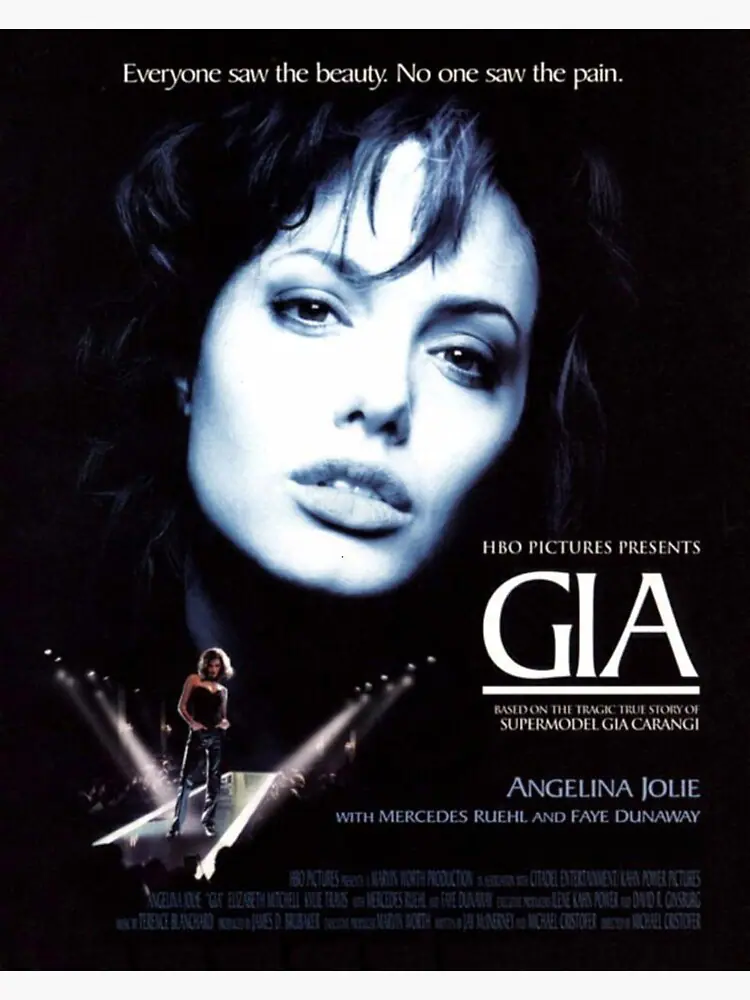
Gia (1998): A Desperate Record of Destructive Desire and Isolated Beauty
Have you ever imagined a life of having everything yet possessing nothing? The camera captures the most glamorous moments, but it fails to record the silence that follows after the shutter stops. Through the brief yet intense life of legendary model Gia Carangi, who shook the fashion world in the late 1970s, the film Gia poignantly depicts how a human being is consumed and isolated under the gaze of others.
We all live with a sense of deficiency. For some, it may be a thirst for success; for others, a profound loneliness. This work is more than a mere biographical film about a model’s rise and fall. It is an existential struggle of a woman who, while plummeting from the highest peaks to the lowest depths, yearned until the very end for the warmth of a single person who would embrace her “true self.”
🌿 Moments When This Film Permeates Deeply
- When you lie awake through long nights, haunted by an inexplicable emptiness following brilliant achievements.
- When you recall a love given with total sincerity that faltered due to social oppression or personal instability.
- When you feel lost in the disparity between the “self” defined by others and your actual reality.
- The reason to read this review to the end is to discover the “essence of relationships” and the meaning of “self-salvation” that we must not lose, even at the edge of destruction.
🎞 Note Before Viewing
This film portrays destructive psychological states, drug addiction, and unmitigated emotional conflict. While some scenes include nudity and sexual depictions, these are not devices for sensationalism but function as essential narrative tools to express the indulgence, isolation, and desperate bond between the characters.
🎬 Film Information
- Title: Gia (1998)
- Director: Michael Cristofer
- Screenplay: Jay McInerney, Michael Cristofer
- Country: USA
- Genre: Drama, Romance, Biography
- Running Time: 120 minutes
- Platform: HBO Max (Varies by region)
- Cast: Angelina Jolie (as Gia Carangi), Elizabeth Mitchell (as Linda), Faye Dunaway (as Wilhelmina Cooper), Mercedes Ruehl (as Kathleen Carangi)
📖 Gia, A Chronicle of Solitude Hidden Behind the Glamorous Runway [No Spoilers]
In the late 1970s, Gia Carangi, a wild and free-spirited girl from Philadelphia, quickly dominates the fashion world with a unique aura that breaks the mold of conventional modeling. Under the full support of agent Wilhelmina, she becomes the progenitor of the term “supermodel,” amassing wealth and fame, yet the deep void within remains unfilled. The trauma of being abandoned by her mother in childhood drives her into a constant state of emotional deprivation, leading her into a deep love with Linda, a makeup artist she meets on a photoshoot.
However, Gia’s unstable psyche and meteoric success lead her into the abyss of drug addiction, jeopardizing even her relationship with Linda. At the height of her success, what she encounters is not praise, but a cold camera lens and a world that judges her solely by her commercial value. The film utilizes a non-linear structure and interview formats to densely track Gia’s transformation into a disposable commodity of the world and her desperate efforts to hold onto Linda, her only sanctuary.
📸 The Ghost Trapped in the Mirror: Gia’s Loss of Identity and Longing
In the film Gia, the mirror is not a mere prop but a core mise-en-scène symbolizing the character’s fragmented ego. Gia becomes the perfect subject in front of the camera, but she does not know how to define herself outside the lens. For her, modeling was not self-actualization, but a means to be loved by someone.
In particular, the expressions Gia directs toward Linda during photoshoots are closer to pleas for survival than acting. The gap between the brand “Gia” that the public adores and the “child” who wants to cry in Linda’s arms drives her toward the extreme escapism of drugs. The director intentionally alternates between coarse-grained film and the brilliant lighting of fashion shows, visually proving how her life was shattering within such an artificial environment.
A crucial point in the interpretation of this work is that it does not portray Gia simply as a tragic victim. She possessed an energy intense enough to destroy her own destiny, and the film shows the process of that energy consuming her when it loses direction. Her self-destructive desire, highlighted in bold, is ultimately a portrait of every modern individual attempting to verify their existence through the validation of others.
🥀 Analysis of the Relationship with Linda: The Thin Line Between Salvation and Bystanding
The relationship between Gia and Linda is the emotional spine of this film. To Gia, Linda was not just a lover; she was a surrogate for the mother she had craved all her life and the only being who saw her as a “human” rather than a “product.” The narrative of these two women transcends the social prejudices of the time, posing a fundamental question: can one human being save the soul of another?
Linda sincerely loves Gia, but she hits a realistic wall in enduring Gia’s self-destructive tendencies and drug addiction. The scene where Gia wails outside Linda’s door symbolizes not a power structure within the relationship, but the extreme terror a human feels when emotional bonds are severed. Linda was Gia’s only light, yet even that light could not mask all of Gia’s darkness.
Their relationship yields an even more heartbreaking interpretation at the end. Ultimately, love is not a panacea; it confronts the chilling truth that for one who cannot love themselves, the love of others is like pouring water into a bottomless vessel. Angelina Jolie’s explosive performance poignantly demonstrates that her obsession with Linda was, in fact, a final, desperate struggle to hold onto her own self.
🔎 Reinterpretation of the Ending — The Eternal Fissure Left by Broken Beauty
The film’s ending depicts Gia’s lonely death due to AIDS complications. The stark contrast of the queen of the glamorous runway dying in a hospital bed, unobserved by anyone, is profound. However, this ending is not a mere display of tragedy. The journals Gia kept toward the end imply that she was finally liberated from the gaze of others and faced her inner self.
Her death is a structural homicide, showing how the massive capital power of the fashion industry exploits and discards an individual. Although Linda could not remain by her side until the very end, Linda remains an eternal symbol of pure love in Gia’s memory. Gia lost her physical body, but paradoxically, through death, she returned to her whole self, no longer anyone’s possession.
The death of Gia Carangi marks the point where the world’s greed for consumable beauty stops. What she gained was the memory of a brief, truthful love; what she lost was a painful life spent performing for the desires of others. What remains after the conclusion is not her photographs, but the resonance of her existence—the cry of “I am here” that she shouted so fervently.
❓ Interpretation of Gia’s Tragic Narrative and Female Representation
Q: What is your take on the criticism that this film excessively glamorizes or sensationally consumes Gia’s drug addiction and downfall?
A: This is a valid critique. Produced in the late 90s, the film tends to visually romanticize Gia’s suffering or depict her erratic behavior as the madness of a “genius artist.” It is difficult to escape the accusation of putting a real person’s pain on display for cinematic entertainment.
However, this directorial style paradoxically reflects the attitude of the fashion industry at the time—the contradiction of consuming even her wandering as a “chic style.” The film employs a dual mechanism that makes the audience pity Gia while simultaneously forcing us to realize that we are also observers consuming her. The judgment lies with the audience, but to prevent her life from remaining a mere “tragic icon,” one must strive to read the systemic violence behind the glamour.
✨ Gia: On the Uniqueness of Salvation Named Love, and Its Impossibility
The film Gia asks us: Is it the applause of others that defines you, or the warm touch of the person you love? This work sharply probes how dangerous success can be when identity is not yet established, and how the absence of solid relationships can corrode a soul.
Modern society resembles Gia’s era in that individuals constantly exhibit themselves via social media and crave external validation. Her downfall is not just a story of the past; it is a warning to all of us who are losing our “true selves” by being submerged in the “self that is shown.” The essence of a relationship is coexistence, not possession, and Gia’s short life proves that a healthy solidarity with others is only possible when one fully accepts themselves.
True salvation begins not with the praise of others, but with the courage to face one’s own wounds.
💬 Who Lives Inside Your Mirror?
Looking into one’s inner self in silence sometimes requires greater courage than facing the world. Have you ever discarded a most precious piece of “yourself” to become what others wanted?
Observing the eyes of Gia, who was loneliest at her most brilliant moments—tell us, what is the authentic version of yourself that you wish to protect until the end?
🎬 Violet Screen’s Perspective: Other Faces of Female Narrative
- Elisa & Marcela (2019): Based on a true story from 1901 Spain, this narrative follows two women who chose to disguise one as a man to marry and break social taboos. The black-and-white mise-en-scène offers a restrained beauty that contrasts with the vibrancy of Gia.
- The Five Devils (2022): A dreamlike thriller that tracks the fierce loves and secrets of women from the past through a young girl with a mysterious sense of smell. Highly recommended if you appreciated the sensory direction of Gia.
To provide a more stable publishing environment, multilingual content, and better communication with our readers, we have moved our official publication to Substack.
All new film reviews and critical essays will be published on our new platform. This website will be closing down soon, so we would greatly appreciate it if you subscribed to our new space.
TODAY'S QUESTION
What's your favorite line from a WLW movie or show?
Your answer isn't saved. Feel free to share it in the comments below.


You May Also Like
The Isolation of Perpetual Desire: The Hunger (1983) Ending Explained and Miriam’s Tragic Solidarity
Affinity (2008) – The Interaction of Deception and Longing Within a Closed Circuit of Prison