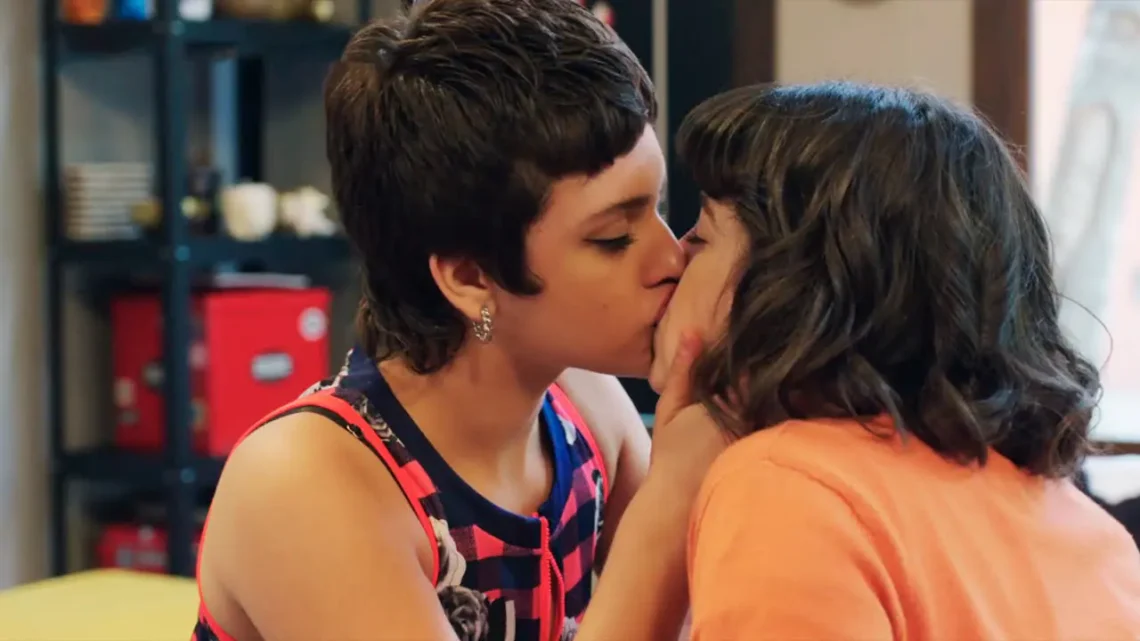
Buenos Chicos Brumora: Between Friendship and Love, on Unnamed Emotions
We can never pinpoint the exact moment we begin to love someone. When a friendship quietly shifts its weight into something else, we find ourselves asking when that transformation truly began.
The relationship between Bruna and Mora in Buenos Chicos—known as ‘Brumora’—starts from that very question. The two did not meet with a declaration of love. They began simply as close friends, and that intimacy slowly started to take on a different hue.
This is what makes the series special: instead of exploding into dramatic gestures, it observes the process of feelings seeping into one another.
🌿 The Moments Where This Drama Particularly Resonates
- For those who have witnessed a relationship that began as friendship slowly stain itself with a different kind of affection.
- For those who wish to understand the moments when the realities of class, livelihood, and family become heavier than love.
- For those who want to read the texture of emotions within the tension and anxiety created by a secret romance.
- For those who want to confirm that even if it isn’t a perfect “happy ending,” that love was undeniably real.
From the moment Bruna confessed her fears and Mora’s hesitant silence, to the final scene where they ultimately had to let each other go, this relationship shows, from beginning to end, the place “where the boundary between friendship and love collapses.”
This is why you must read until the end: because the conclusion of Brumora is not merely a breakup, but a story about what each person chose to protect in their respective lives.
🎞 Note Before Watching
Buenos Chicos is a series where crime drama and youth melodrama intersect. It focuses more on the psychological tension between characters and the emotional currents of their relationships rather than physical explicitness. The Brumora narrative also unfolds around an emotional axis of relationship, identity, and guilt.
🎬 Drama Information
- Title: Buenos Chicos (2023–2024)
- Directors: Alejandro Ibañez, Gustavo Luppi (Planning/General Director: Adrián Suar)
- Writers: Leandro Calderone, Willy Van Broock, Claudio Lacelli
- Country: Argentina
- Genre: Youth Crime Melodrama (Telenovela)
- Runtime: Approx. 50 minutes per episode, 125 episodes total
- Platform: El Trece (Argentine terrestrial broadcast), El Trece official YouTube channel
- Cast: Ornella D’Elía (as Bruna Lucero), Rocío “Rochi” Hernández (as Mora Rossi), Tomás Kirzner (as Ezequiel “Zeta” Grenón), Lautaro Rodríguez
📖 Buenos Chicos Brumora: Plot and the Start of Conflict (No Spoilers)
Bruna and Mora were not lovers from the start. When Bruna joined the group of her brother Chino’s friends, the two naturally began as close friends.
Bruna is a character who grew up caring for her sick father alongside her brother, possessing a personality that is honest and impulsive. In contrast, Mora is a realistic and resilient person who works day and night to support her seven younger siblings. Mora already had a boyfriend, Zeta.
As time passes, a tension that cannot be explained by friendship alone grows between Bruna and Mora. Their gazes toward one another change, and the time they spend together becomes special. However, Mora had her current boyfriend, Zeta, and Bruna faced the fear of having to accept emotions that were unfamiliar even to herself.
Just before the two could acknowledge their feelings, the presence of Zeta continuously intervened, becoming the seed of conflict. The story of Brumora begins in earnest at the point where friendship and love, loyalty and desire collide.
🎭 Bruna and Mora: The Structure of Attraction Created by Different Deficiencies
The core of the Brumora relationship lies in the fact that the two discover in each other what they lack themselves.
Bruna is a character who is honest and headstrong with her feelings. On the other hand, Mora is someone who has long deferred her own desires for the sake of her family. This contrast functions as a narrative device that goes beyond simple characterization, explaining why the two are drawn to each other.
For Bruna, Mora was someone who accepted her exactly as she was; for Mora, Bruna was the person who made her choose, for the first time, what she herself truly wanted. Contained within this relationship is not just love, but a sense of liberation from the desires each had repressed.
At this point, Brumora expands from a simple romance into a narrative of identity and self-determination. The process of the two being drawn to each other is also the process of each regaining agency over their own lives.
🔒 Secret Romance and Exposure: The Triangular Dynamic That Shook Brumora
The reason Brumora could not begin publicly is clear: Mora was still linked to Zeta. Even after confirming their feelings, the two had to hide them, and this secret was eventually discovered by Zeta.
This moment of exposure holds significance beyond a simple conflict. For Zeta, the loss of his partner and the betrayal by a close friend arrive as a dual wound. For Mora, it leaves a realistic dilemma: she cannot protect both her love and her friendship at the same time.
A point to note here is Mora’s attitude. She struggles to recover her long-standing friendship with Zeta even while refusing to give up on Bruna. This suggests that Mora is a character who prioritizes the continuity and responsibility of relationships over transient emotions. Conversely, for Bruna, this relationship is far more absolute. Once she acknowledges her feelings, she does not easily back down.
As such, Brumora is not merely a story between two people, but unfolds within a structure tangled with trust and loss involving Zeta. And this structure, intertwined with the unstable lives they lead within the crime narrative—the realistic constraints they face—pushes them toward a relationship that becomes increasingly difficult to sustain.
🔎 Reinterpreting the Ending: What Brumora Left Behind
The ending of Brumora is not a happy ending in the common sense. As time passes, Mora eventually reconnects with Zeta, and Bruna begins a new life alone.
However, it is inaccurate to summarize this ending by saying “love failed.” The relationship did not end because Bruna stopped loving Mora. It is because Mora’s choices headed in a different direction, causing Bruna to lose that relationship.
What is important here is the attitude Bruna chose after the separation. She chose neither revenge nor hatred. Instead, she chose to keep Mora in her memory as someone she once loved and continue living her own life. This is an ending that preserves dignity, where a character who has suffered loss does not deny that loss but moves forward.
Mora also loses something in this ending. She leaves behind a relationship where she had chosen what she wanted for the first time and returns to a familiar, stable relationship. This is relief and simultaneously a renunciation; an ending where two conflicting emotions coexist.
The ending of Brumora coolly confirms the fact that while their love was real, that love alone could not sustain their lives together.
This is the structural conclusion this narrative throws out. After the finale, Bruna’s life continues, carrying the weight of loss, and Mora’s life continues, bearing the cost of her choice. The lingering resonance of the two living in their own ways is precisely the point that makes this drama one that requires interpretation rather than mere consumption.
❓ Frequently Asked Questions About the Buenos Chicos Brumora Ending
Q. Why couldn’t Bruna and Mora stay together until the end? It is not because their love was insufficient. Between the realistic pressure of having to support her family and the long-standing trust built with Zeta, Mora ultimately chooses the familiar stability. This is a choice that breaks away from the formula typically presumed by romance narratives—that “love conquers all”—and is an ending understandable when considering the characters’ socioeconomic conditions.
Q. Some react that the ending of Brumora feels somewhat empty. These reactions are largely valid. Although Brumora devotes a significant portion of the series to the process of transitioning from friendship to love, the time the two spend together as lovers is depicted as relatively short. This is also a limitation arising from the structure of the series, where romance is positioned as a subplot within a crime-centered narrative. However, there exists a perspective that this brevity leaves a deeper, more poignant resonance, and satisfaction with the ending can be read differently depending on each reader’s own views on relationships.
✨ Buenos Chicos, From the Place Where Love Could Not Be Everything
Brumora shows that even if love cannot completely change one’s life, it can shake and expand an individual’s identity.
The ending of Brumora is not a failed love, but a story of two people who let each other go to protect their own lives.
🕯 Between Faith and Distance
To cherish someone as a memory even after love has ended—that, too, is a way of treating love.
Would you choose to move forward while carrying the loss, as Bruna did, or would you choose to stay a little longer in the place where the relationship ended?
🎬 Violet Screen Curation
- Stupid Wife (2022–2024):
- Deals with the process of two women falling for each other again through the device of amnesia, delicately illuminating deep emotional solidarity and the complex layers of relationships.
- Skam España Season 2 (2019):
- Sensibly depicts the realistic conflicts and love of teenagers finding their feelings amidst confusion of identity and the gaze of others.
To provide a more stable publishing environment, multilingual content, and better communication with our readers, we have moved our official publication to Substack.
All new film reviews and critical essays will be published on our new platform. This website will be closing down soon, so we would greatly appreciate it if you subscribed to our new space.
TODAY'S QUESTION
Which ending has stayed with you the longest?
Your answer isn't saved. Feel free to share it in the comments below.


You May Also Like

Just Another Love Story (2019) — A Nepali Web Drama on the Boundary of Friendship and Love
Portrait of a Marriage (1990): Passion Coveted in the Name of Freedom and Fractures in an Open Relationship