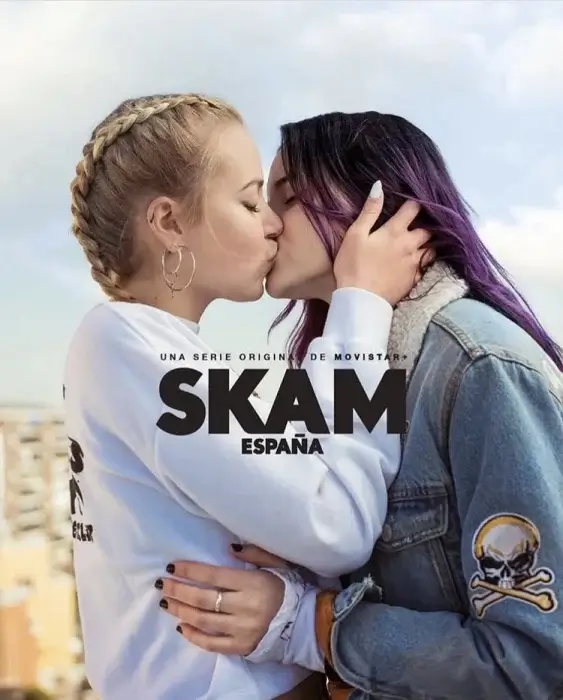
Skam España: Bisexuality, BPD, and a Solidarity of ‘Anxiety’ Embracing Uncertainty
To fully shoulder the abyss of another is perhaps the most reckless yet sublime act of courage a human can perform. We often believe that love will heal all, but in reality, love is less about healing and more about the process of learning “how to ache together.”
When someone’s deficiency destabilizes our daily life, we are faced with a choice: to flee, or to remain within those cracks. Skam España Season 2 gazes steadfastly at the solitude of youth hidden behind the noise of glamorous parties and the essence of an individual obscured by a medical diagnosis.
🌿 Moments when this drama deeply permeates
- Nights of confusion spent realizing that one’s identity is not a clear line, but a blurred gradation.
- Silences spent struggling to understand that a loved one’s erratic behavior is not a “change of heart,” but “pain.”
- Moments of wishing to witness how a safety net named friendship sustains an individual’s life.
- The reason to read to the end: To interpret the most mature chemical reaction that occurs when mental health and queer narrative intersect, moving beyond a simple teen romance.
🎞 Note before viewing
As this work explores adolescent sexual identity and Borderline Personality Disorder (BPD), it contains some emotionally intense depictions. The series focuses on a detailed portrayal of psychological distance and relational density rather than provocative direction.
🎬 Drama Information
- Title: Skam España (2018–2020)
- Director: Begoña Álvarez Rojas
- Screenplay: Beatriz Arias et al.
- Original Work: Norwegian series SKAM (Created by Julie Andem)
- Country: Spain
- Genre: Teen, Drama, Romance
- Running Time: 8–10 episodes per season (approx. 30–50 min per episode)
- Platform: Movistar+, Major Domestic OTTs
- Cast: Irene Ferreiro, Tamara Luz Ronchese, etc.
📖 Skam España Season 2: Cris and Joana, an ‘Unfamiliar Attraction’ Cracking the Ordinary [No Spoilers]
Cris, a free-spirited party girl who avoided deep commitment, reaches a turning point in her life upon meeting Joana, a mysterious transfer student. Their connection, which began as mere curiosity, leads Cris to question the heteronormative values she once took for granted, while simultaneously confronting the precarious secret Joana is hiding.
As the relationship deepens, Joana repeatedly pushes Cris away with unpredictable behavior. Cris finds herself at a crossroads where she must affirm her bisexual identity while choosing whether to embrace her partner’s pain. Through the emotional surges of these two girls, the drama asks what true understanding entails.
🌊 Cris’s Identity Formation and the Interpretation Offered by ‘Joana’ as a Mirror
The core of Skam España Season 2 lies in the process of Cris reconstructing how she defines “self.” If the version of Cris shown in Season 1 was a “joyful mask” tailored to the gaze of others, her encounter with Joana acts as the catalyst that strips that mask away.
The point of interpretation here is that Cris does not view Joana simply as an “object of love,” but as a mirror reflecting the authentic desires latent within her. The process of gaining courage while watching Lucas’s coming out is an excellent piece of direction that illustrates how a personal narrative interlocks with community support.
🧠 A Mature Perspective on BPD and the Narrative’s Conclusion
The work does not consume Joana’s Borderline Personality Disorder (BPD) as a mere device for dramatic conflict. The greatest virtue of this drama is the process of gradually understanding Joana’s “fear of abandonment” and emotional volatility from Cris’s perspective.
By the conclusion, Cris abandons the arrogant hero complex of trying to “cure” Joana’s illness. Instead, she chooses “patience” and “study” as a partner living alongside the condition. This shatters the romantic fantasy that love solves everything and completes the narrative by suggesting the possibility of realistic solidarity.
🔎 Reinterpreting the Ending — Not a Total Union, but the Discovery of a ‘Sustainable Distance’
The ending of Skam España Season 2 does not signify a fairy-tale union where two people completely melt into one another. Rather, this conclusion is closer to a “volitional choice” to remain by each other’s side while clearly recognizing their respective wounds and limitations. Joana’s BPD will threaten them again at any time, and Cris’s patience will also be put to the test.
However, they now treat each other not as objects to be “saved,” but as companions walking together while sustaining their own lives. This is a dignity brought about by growth, and the most mature form of restraint exercised in the name of love. Their relationship is not about filling wounds, but the process of fitting the shape of their wounds to one another.
❓ Regarding the Realistic Constraints and Diversity of Interpretation in Skam España
Q1. Regarding the criticism that Joana’s behavior could constitute “emotional violence” toward Cris.
The point that Joana’s emotional fluctuations and pushing away are harsh for Cris is valid. In reality, the emotional exhaustion experienced by those around someone with BPD is significant. However, rather than beautifying this, the work explores the boundaries of “healthy support” by showing Cris consulting her friends and setting her own limits.
Q2. What is the distinction of the “Crisana” narrative compared to Season 3 of the original (Norwegian) version?
While the original Isak narrative focused on a male queer character’s religious and identity-related struggles, the Spanish version varies this into a female queer narrative, showing a broader spectrum of “female solidarity” and “bisexuality.” In particular, the social pressures and psychological interiority experienced by female characters have been more delicately reinforced.
✨ Skam España: Love Is Not Kneeling Before the Abyss of the Other
This work is ultimately a record of the “effort to understand the incomprehensible.” In modern society, relationships are often caught in the logic of cost-effectiveness and efficiency, but Cris and Joana prove the essence of love by choosing the most inefficient and painful path.
From the dual surges of identity confusion and mental illness, what they pull to the surface is not “unconditional acceptance,” but “realistic responsibility.” True solidarity is not about lighting up the other’s darkness, but is born from the strength to not let go of their hand even within that darkness.
🗨️ How far does your ‘staying’ go?
We often wish to possess only the bright side of the person we love, but a true relationship begins when we witness their most uncontrollable parts.
When the other person’s sharpest thorn pricks you, will you leave to treat your wound, or will you dig deeper to understand the root from which that thorn grew?
🕵️ Violet Screen’s Curation of Female Narratives
- The End of the Fing World (2017):* A road-movie style drama where precarious teenagers grow by filling each other’s deficiencies. It aligns with the raw yet delicate sensibility of Skam España.
- A Good Girl’s Guide to Murder (2024): A mystery narrative about a girl’s courage in tracing the truth and the strange friendship and solidarity that bloom in the process.
To provide a more stable publishing environment, multilingual content, and better communication with our readers, we have moved our official publication to Substack.
All new film reviews and critical essays will be published on our new platform. This website will be closing down soon, so we would greatly appreciate it if you subscribed to our new space.
TODAY'S QUESTION
When did you first feel fully accepted for who you are?
Your answer isn't saved. Feel free to share it in the comments below.


You May Also Like
You Me Her: The Authenticity of Female Narratives on the Experimental Stage of Polyamory

The Air (2026) Review: Between Duty and Salvation, a Transnational Political Thriller and Melodrama of Two Women