The Isolation of Perpetual Desire: The Hunger (1983) Ending Explained and Miriam’s Tragic Solidarity
When love promises eternity, we believe it to be a blessing, but sometimes it becomes a curse. The Hunger is a masterpiece that uses elegant mise-en-scène to depict the most fatal greed humans indulge in when faced with the waves of time—the craving for “unchanging beauty”—and the profound loneliness lurking behind it.
Combining the chill of Gothic horror with the aestheticism of 1980s Neo-Noir, this film goes beyond merely consuming the vampire trope. Instead, it tracks the destructive tracks left by the “desire to possess someone forever.” The tragedy of a life that can only be sustained by craving the life of another resonates with the obsessive nature of relationships we form today.
🌿 Moments When This Film Deeply Permeates
- For those who have stared at their own wrinkles in the mirror for a long time, fearing the passage of time.
- On lonely nights when you realize that being forgotten is more terrifying than the pain of loss.
- For lovers confused as to whether the fatal indulgence of sinking into each other’s necks is salvation or ruin.
- Why you should read this to the end: To discover the structural aesthetics of how the brief yet intense communion between two women, Miriam and Sarah, breaks an eternal curse and transfers into a new sense of agency.
🎞 Note Before Viewing
This work combines the uniquely gloomy atmosphere of Gothic horror with eroticism. It is an aesthetic drama that focuses on depicting the “addictiveness of relationships” through sensory cinematography and the taut tension between characters rather than direct gore.
🎬 Film Information
- Title: The Hunger (1983)
- Director: Tony Scott
- Screenplay: Ivan Davis, Michael Thomas
- Original Work: Whitley Strieber (Novel The Hunger)
- Country: UK, USA
- Genre: Horror, Drama, Erotic
- Runtime: 97 min
- Platform: Apple TV, Prime Video
- Cast: Catherine Deneuve (Miriam Blaylock), David Bowie (John Blaylock), Susan Sarandon (Dr. Sarah Roberts)
📖 The Hunger Plot: The Moment the Promise of Eternal Youth Crumbles [No Spoilers]
Miriam, a noble vampire who has lived for thousands of years, leads an elegant life in a lavish New York mansion with her human partner, John. Miriam promises eternal life to the lovers she chooses, but that immortality is imperfect. Suddenly, one day, John is struck by rapid aging, facing centuries of time in just a few hours as he collapses.
Driven to despair, John seeks help from Dr. Sarah Roberts, an authority on aging research, but she dismisses his claims as the ravages of a madman. Eventually, when John becomes beyond recovery and is sealed in a coffin, Miriam sets her sights on the intelligent and vibrant Sarah as a new companion to fill her solitude.
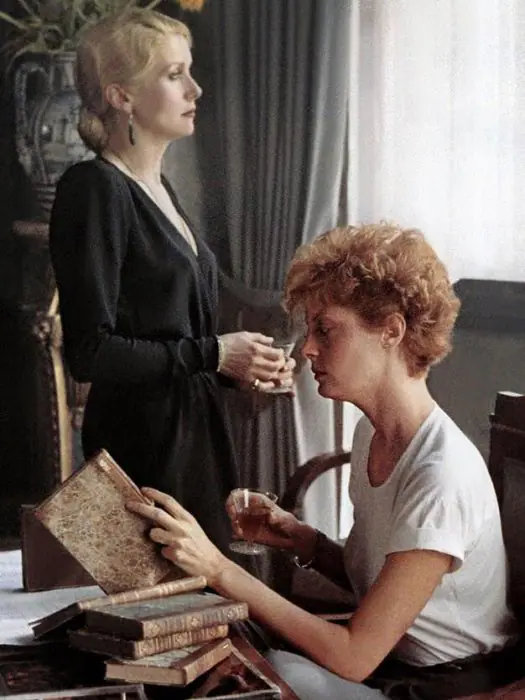
Under Miriam’s seductive approach, Sarah gradually feels an irresistible pull, and a strange tension and desire bloom between the two women. However, Sarah does not yet know the terrible price hidden behind the gift of “eternity” that Miriam offers. Sarah finds herself at a fatal crossroads between her identity as a human and the perpetual existence offered by Miriam.
🦇 Aesthetic Isolation Designed by Tony Scott: Mise-en-scène and Power in The Hunger
What overwhelms the audience from the film’s opening is the cold blue-toned lighting, fluttering curtains, and the music of Bauhaus. Director Tony Scott, drawing on his background as a commercial director, visually proves how trapped Miriam’s world is within a stagnant beauty through sensory imagery.
Miriam’s mansion is like a massive tomb disconnected from the outside world. Here, she reigns as both predator and savior. The “eternal life” she grants her lovers is not a biological blessing, but rather a sentimental taxidermy intended to postpone her own solitude. This vertical relationship structure begins to crack with the appearance of Sarah. Sarah’s presence, representing modern science and reason, acts as a heterogeneous vitality that challenges Miriam’s classical and conventional system of dominance.
🩸 A Narrative of Craving and Transference: Feminine Desire Projected in the Relationship of Miriam and Sarah
The most pivotal aspect of The Hunger is the communion between Miriam and Sarah. While traditional male-centered vampire films dealt with narratives of intrusion and conquest, this work deals with fascination and transference. The meeting of the two women is depicted as a resonance between those who recognize each other’s deficiencies, moving beyond mere physical indulgence.
Miriam sees in Sarah an intellect that can understand her eternal solitude, while Sarah sees in Miriam a sense of liberation regarding a forbidden world. Here, blood is not simply food for survival, but a medium of ultimate sharing through which the essence of one being flows into another. Sarah is not a being who becomes passive through Miriam, but undergoes a process of subjective metamorphosis, witnessing her own transformation with both pain and ecstasy.
🔎 Reinterpretation of the Ending: The Counterattack of the Sealed Past and the Birth of a New Predator
The film’s ending vividly demonstrates how the fortress of eternity built by Miriam collapses. When Sarah attempts to take her own life, thwarting Miriam’s plan, the shock awakens the past lovers sealed in the attic. The wailing of those trapped in rotting bodies, unable to die for eternity, exposes that the “love” Miriam practiced was, in reality, a cruel obsession.
The process of Miriam’s annihilation at their hands is closer to a justified rebellion of oppressed victims than a mere transfer of power. However, the true lingering impression of the film lies in the final scene. After all the storms have passed, the sight of the surviving Sarah with a new companion suggests a chilling cycle. Sarah rejected Miriam, but ultimately inherited the Hunger itself that Miriam possessed.
In the end, their relationship is completed not as a perfect union or a complete ruin, but as the passing down of a curse. Even if the individual Miriam has vanished, the mode of existence that must crave and prey upon others to be sustained is perpetuated through Sarah. The predator’s seat is never vacant, and the chain of desire repeats, with only the subject having changed.
💬 Issues in the Interpretation of The Hunger: 80s Gender Codes and the Meeting of Horror
Q. Did Miriam truly love Sarah, or did she simply view her as a consumable?
A. Many viewers hesitate to see Miriam’s actions as pure affection. Her act of not discarding past lovers but storing them in coffins is an extreme form of possessiveness. However, from Miriam’s perspective, it was the best “method of remembering” she could perform. While the work criticizes Miriam’s cruelty, it simultaneously makes us pity the weight of the thousands of years she has carried. Her love can be seen as a violent benevolence attempting to incorporate the other into her own world, which reads as an aesthetic warning against the twisted attachment styles of modern society.
Q. Is the choice Sarah shows at the end a different path from Miriam’s?
A. On the surface, Sarah appears to have escaped Miriam’s dominance, but structurally, she has inherited Miriam’s position. This poses a question about how much the methods of a woman might differ when she becomes the new wielder of power within a masculine power structure (the vampire narrative). The film invites the audience to an open ending, without providing a definitive answer as to whether Sarah will form a “solidarity” different from Miriam’s or choose the same “isolation.”
✨ The Hunger, a Chilling Self-Portrait Bloomed Within the Prison of Eternity
The Hunger is a work of aesthetic value that does not fade over time. Through the relationship between Miriam and Sarah, the film asks us: Is the love you crave one that recognizes the other’s complete independence, or are you taxidermying them into your own time to fill your loneliness?
Borrowing the framework of the horror genre, this film elegantly dissects the fundamental human fear of loss. Heavier than an unaging body is an undying memory, and the true horror is not the thirst for blood, but the silence of having to endure eternity with no one left by your side. Capture in the name of love ultimately traps both the captor and the captured within a perpetual hunger.
👁🗨 What Do We Leave Behind at the End of a Relationship?
Has there ever been a moment when you loved someone so much that you wished they would stay by your side forever? If you realized that desire was eating away at the other person’s vitality, could you willingly let go of their hand?
💜 Another Perspective from Violet Screen: Recommended Female Narratives
- Certain Women (2016): Directed by Kelly Reichardt. It captures the quiet yet intense moments of three women struggling to connect with others in their respective isolated environments.
- Saint Maud (2019): The Gothic atmosphere of a woman with fanatical faith and a deficient self leading others to ruin while trying to save them resonates with the aesthetic horror of The Hunger.
To provide a more stable publishing environment, multilingual content, and better communication with our readers, we have moved our official publication to Substack.
All new film reviews and critical essays will be published on our new platform. This website will be closing down soon, so we would greatly appreciate it if you subscribed to our new space.
TODAY'S QUESTION
Is there a hidden gem you always recommend to friends?
Your answer isn't saved. Feel free to share it in the comments below.


You May Also Like

All About E Review: A Milestone of Loss and Recovery at the End of the Road Escaped

3 Generations, An In-Depth Analysis of Generational Solidarity and Identity Acceptance