Gondola (2023) Interpretive Review: A Fleeting Solidarity and Liberation Wrought by Silent Language
Love sometimes blooms more vividly through subtle glances and playful gestures than through grand words. We constantly pour out speech to connect with others, yet the moments when hearts truly touch are often those brief instants filled with silence.
Through this film, German cineaste Veit Helmer strips away the cumbersome outer layer of language, evoking the pure attraction between two women solely through visual rhythm and auditory resonance. This magical romance, taking place within a narrow box floating above an isolated mountain village, reminds us once again of the “archetype of relationships” we had long forgotten.
🌿 Moments When This Film Deeply Permeates
- When you wish to escape the noise of daily life and focus entirely on the senses of sight and sound.
- When you want to feel the thrill of a “co-conspirator” type relationship where hearts connect without words.
- When you want to forget the heavy gravity of the earth (the oppression of reality) for a moment and enjoy the lightness of the air.
- The reason you should read to the end: The ending of this film is not a mere completion of a romance, but a victory report of those who have broken out of the system’s orbit to construct a language of their own.
🎞 Note Before Viewing
This work is sufficiently sensual even without physical exposure or provocative dialogue; it is a lyrical romance centered on the psychological density and playful communion between two women.
🎬 Movie Information
- Title: Gondola (2023)
- Director: Veit Helmer
- Screenwriter: Veit Helmer
- Country: Germany, Georgia
- Genre: Romance, Drama, Comedy
- Running Time: 82 minutes
- Platform: Theatrical Release & VOD
- Cast: Mathilde Irrmann, Nini Soselia, Niuton Soselia, Zuka Papuashvili
📖 Gondola Synopsis: The Rhythm of Two Worlds Crossing in the Sky [No Spoilers]
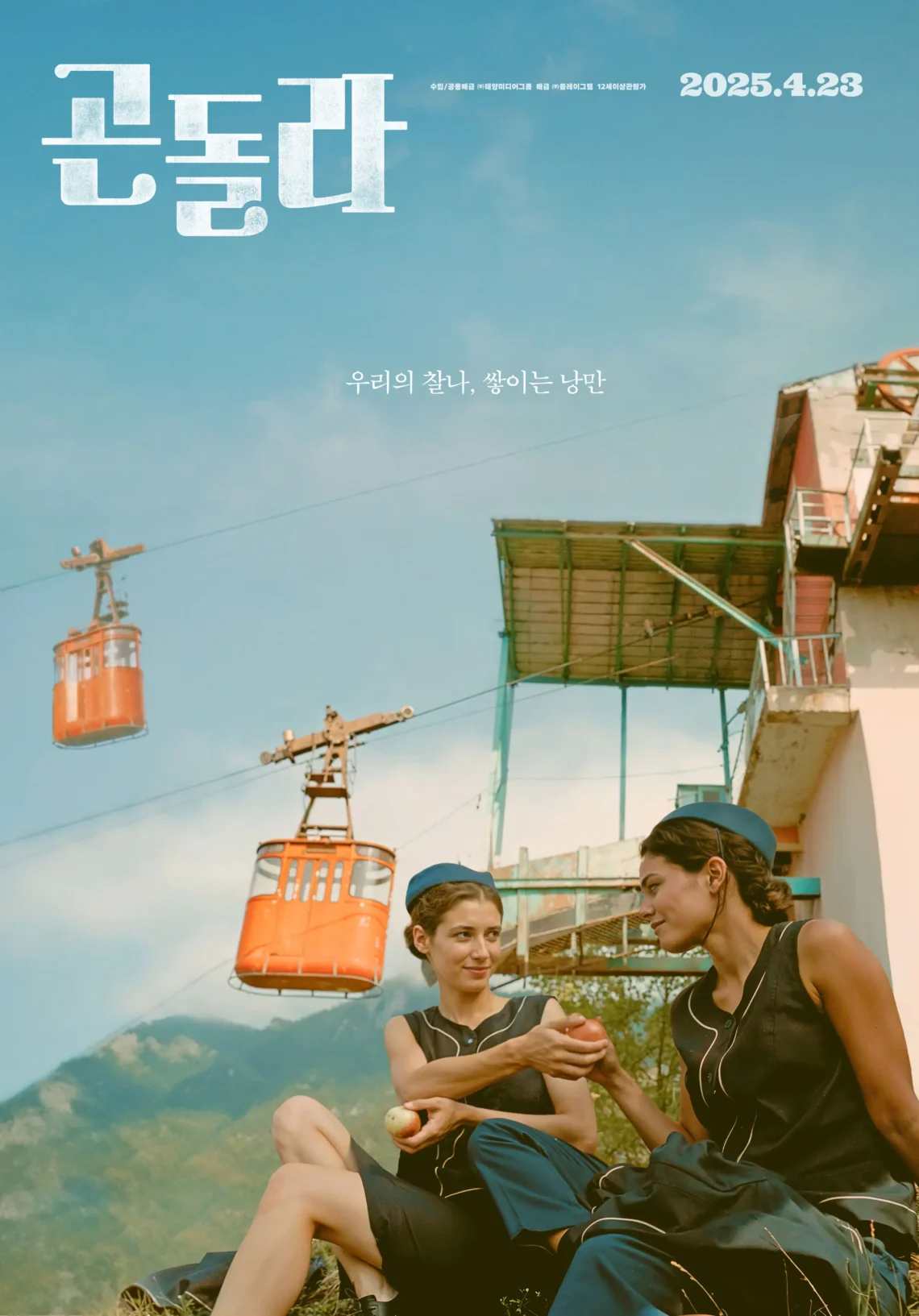
After her father’s death, Iva returns to a remote mountain village in Georgia and finds work as an attendant on the gondola—the village’s only means of transportation. Donning an old uniform, she boards her orange gondola and begins transporting the villagers’ daily lives and peculiar cargo.
On the opposite track is Nino, an experienced attendant operating a red gondola. The two pass each other in mid-air once every 30 minutes, exchanging brief greetings. Their encounters, which began as mere glances, gradually evolve into creative forms of communication: chess games, water gun fights, and musical duels.
However, as the surveillance of an authoritarian boss obsessed with Nino intersects with Nino’s personal dream of heading out into the wider world, their short but intense “aerial intersection” faces a phase of unexpected conflict and change.
🚡 Interpretation of the Silent Language and Visual Rhythm Painted by Gondola
The most noteworthy aspect of this film is that it uses the physical constraint of having almost no dialogue as a tool for emotional expansion. Instead of speaking to one another, Iva and Nino utilize the cramped space of the gondola as a stage.
The chess moves they exchange, the slice of pomegranate, and the costumes they lean out the window are symbols of pure play that secular language cannot capture. By allowing the audience to “witness” their expressions and rhythms instead of “hearing” their dialogue, the director proves that the essence of romance lies not in sophisticated confessions, but in the “response toward one another.”
Particularly, the communion achieved in those brief moments when the gondolas pass makes us question what “true connection” is amidst the excessive communication of modern life. Silence does not act as a disconnection, but as the cleanest channel through which emotion can flow, imbuing the entire work with the colors of magical realism.
💞 A Utopia for Two Women Meeting in the Air, Leaving the Deficient Earth
The gondola in the film is more than a simple means of transport; it is a space of liberation separated from earthly oppression. While the conservative gaze of the village community and a cynical, predatory boss exist on the ground, Iva and Nino can focus solely on each other while gliding through the sky suspended by cables.
They construct their own microcosm by decorating the gondolas like spaceships or boats. This is a manifestation of a resistant imagination seeking to escape the fixed orbits or the roles of women defined by mainstream society. In particular, Nino’s dream of becoming a flight attendant contrasts with her current job as a gondola attendant, projecting a woman’s desire to soar to higher and further places.
The relationship between the two moves beyond a simple romance toward a conspiratorial solidarity, supporting each other’s dreams and standing together against the boss’s violent jealousy. The humorous disturbances that occur in this process possess the power to transform a tragic social context into a delightful aesthetic victory.
🔎 Reinterpreting the Gondola Ending: Gravity of Love Finally Completed by Deviating from the Orbit
While the ending of Gondola superficially takes the form of poetic justice, structurally it suggests that the two women have either completely seized control of the “system’s orbit” or have leapt beyond it. The climax, where the obsessed boss is punished by a ruin he brought upon himself, is a clear point of interpretation showing that traditional patriarchal authority cannot defeat their creative bond.
Nino’s plan to leave the village and the resulting temporary conflict with Iva eventually conclude in a new form of reconciliation: moving forward “separately yet together.” Despite being destined to move along a fixed track, they have mastered the art of maximizing the density of freedom within it.
What the protagonists have gained is not just the achievement of love, but the dignified capacity for play—knowing how to treat one’s own life as a plaything. After the ending, they may still be atop the gondola, but it will no longer be a workplace; it will be an eternal playground for the two of them. The orbit of the gondola is no longer a line of restraint, but an infinite parallel where the freedom of two souls intersects.
❓ Deep FAQ on the Narrative and Direction of Gondola
1. Does the near-absence of dialogue hinder narrative immersion?
Of course, it may feel unfriendly to audiences accustomed to traditional dramatic structures. However, this film’s purpose is “emotional experience,” not “information delivery.” From a critical perspective, one could say the narrative is thin, but the director intentionally erased logical cause-and-effect to fill that space with visual metaphors. This is an aesthetic choice that provides the pleasure of deeper interpretation by allowing the audience to surmise the characters’ psychology.
2. What are your thoughts on the criticism that the patriarchal boss character is too one-dimensional?
The boss in this film serves as a symbol of a barrier to be overcome rather than a multi-dimensional human being. His flatness actually serves as a device to highlight the colorful vitality of Iva and Nino. Since the tone of the work is close to a fable, the simplicity of the antagonist allows the sense of liberation brought by the women’s solidarity to become even clearer without disrupting the rhythm of the play.
✨ Gondola: The Cheerful Audacity of Love that Defies Gravity
This film rescues us from the obsession that love must be a heavy responsibility or a serious agony. The aerial play shown by Iva and Nino tells us that a relationship is ultimately the act of willingly “going to play” in each other’s worlds.
Ultimately, the issues of identity and passion do not reside within the labyrinth of complex language, but within the small paper airplanes we toss toward each other or the clumsy melodies we play together. Amidst the fatigue of modern society, this film offers the weightiest comfort in the lightest manner.
True freedom does not come from destroying the orbit, but from the courage to dance one’s own dance upon it.
🚡 “How will you fill those short 30 seconds as you pass by someone?”
Love is determined not by physical distance, but by the imagination you mobilize to bridge that distance. If it were you, what kind of prank would you prepare as the other person’s gondola approached?
📽 Violet Screen Recommendations: Female-Led Narratives with a Similar Hue
- 《Her Hobby》(2023) Reason for recommendation: It deals with the relationship between two women in a closed-off rural village who bond over a shared oppressive gaze. While Gondola is Fairytale-like, this work offers a colder, more intense catharsis of revenge and liberation.
- 《Joyland》(2022) Reason for recommendation: It resembles Gondola in its exploration of forbidden desires and relationships within a patriarchal order. Through brilliant colors and sensuous direction, it beautifully captures the moments when repressed characters finally breathe on stage.
To provide a more stable publishing environment, multilingual content, and better communication with our readers, we have moved our official publication to Substack.
All new film reviews and critical essays will be published on our new platform. This website will be closing down soon, so we would greatly appreciate it if you subscribed to our new space.
TODAY'S QUESTION
If you could say one thing to someone today, what would it be?
Your answer isn't saved. Feel free to share it in the comments below.


You May Also Like

To Each, Her Own (2018) Review: Immense Desire Between Jewish Tradition and Polyamory

My Mother Likes Women: The Shattering of a Rigid Illusion Called Family by a Midlife Lesbian Declaration