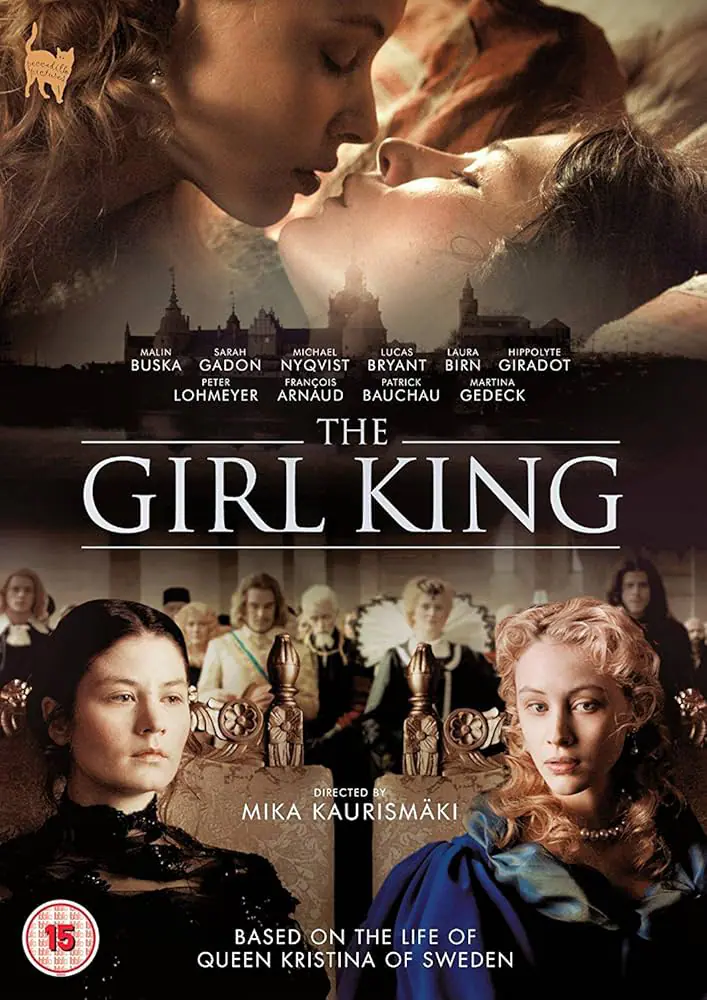
[The Girl King] Interpretation of a Queen’s Longing, Isolation, and Abdication: Breaking the Taboos of an Era
The agony of a human being attempting to prove their own existence under the weight of an isolated crown pierces the heart, regardless of the era. In 17th-century Sweden, at the pinnacle of power—a realm then considered the exclusive domain of men—what Queen Christina faced was not the glory of the state, but the fragments of desires constantly clashing with a “gender role” defined by others.
This film does more than merely recreate history; it offers a sensory experience akin to moving a woman’s fierce internal diary onto the big screen—a woman who craved salvation in the name of love and liberation in the name of intellect.
🌿 Moments when this film resonates deeply:
- For those who have spent sleepless nights wandering between intellectual longing and physical instinct.
- When the frame of “femininity” demanded by the world feels suffocatingly restrictive.
- Moments when you need the courage to turn the entire world into an enemy to keep a loved one by your side.
The reason to read until the end is to witness the visceral thrill found in the conclusion: the “weight of freedom” gained only by relinquishing power.
🎞 Note Before Viewing
This work captures the emotional turbulence of characters contrasted against the rigid discipline of a 17th-century royal court. While there is a metaphorical and aesthetic level of intensity in physical contact and emotional depiction, these serve as essential devices to express the spiritual and physical union and liberation of the two protagonists, rather than being pornographic in intent.
🎬 Film Information
- Title: The Girl King (2015)
- Director: Mika Kaurismäki
- Screenplay: Michel Marc Bouchard
- Countries: Finland, Germany, Canada, Sweden, France
- Genre: Drama, Romance, Period Piece
- Running Time: 106 minutes
- Platforms: Wavve, Google TV, etc.
- Cast: Malin Buska (Christina), Sarah Gadon (Ebba Sparre), Michael Nyqvist (Axel Oxenstierna), Martina Gedeck (Maria Eleonora)
📖 <The Girl King> Synopsis: The Narrative of a Queen Who Sought to Subvert a Kingdom with Knowledge and Love [No Spoilers]
In 1632, amidst the whirlpool of the Thirty Years’ War, six-year-old Christina ascends to the Swedish throne after losing her father. Isolated from her mother, who is consumed by madness, she is raised under the strict guidance of Chancellor Oxenstierna, receiving an education thoroughly intended for a “prince.” Growing into a young monarch proficient in swordsmanship, horsemanship, multiple languages, and philosophy, Christina begins her personal rule at the age of 18, immediately clashing with the conservative Lutheran court.
While pursuing radical steps toward ending the war and fostering cultural prosperity, she meets her new lady-in-waiting, Ebba Sparre. The irrepressible attraction toward Ebba shakes Christina’s governing philosophy and personal life to their core. Caught between the pressure from the council to produce an heir through marriage, religious dogma, and her burning longing for Ebba, Christina begins to realize that her throne is a massive prison.
Even her communion with her intellectual mentor, René Descartes, fails to fully alleviate her isolation. Ultimately, the Queen finds herself at a final crossroads where her very existence is at stake.
🏛️ Christina’s Masculinity: The Conflict Between Educated Self and Instinctive Resistance
The most intriguing point of interpretation in the film is the manner in which Christina’s identity is formed. Biologically female, she was instilled with the language and skills of a man for the future of the nation. This dual identity manifests in how she relates to Ebba Sparre.
In loving Ebba, she rejects traditional female passivity, instead exercising agency as a monarch and a lover. However, while the court wanted her to “think like a prince,” they branded her “masculine desire” for a woman as immoral once it was revealed.
This contradiction drives Christina into extreme isolation. Her insistence on wearing men’s clothing and riding horses was not merely for convenience; it was a visual resistance against a world trying to define her and a final bulwark to protect her essence.
🕯️ The Intersection of Intellect and Emotion: Descartes’ Philosophy and Ebba’s Skin
Christina invites Descartes, the greatest philosopher of the time, to ask, “How does one control desire?” This reveals her attempt to rationally conquer her feelings for Ebba. Yet, even cold philosophical contemplation cannot defeat the heated communion she shares with Ebba.
The film’s mise-en-scène clarifies this contrast. The dark, cold library and anatomy room symbolize intellectual inquiry, while the Queen’s candlelit bedroom is depicted as a space where suppressed desires erupt.
Ultimately, she seeks to heal a human loneliness that knowledge alone cannot fill through Ebba. However, when Ebba succumbs to court pressure and marries another man, the despair Christina feels transcends a simple heartbreak; it becomes an experience where her very dignity collapses.
🔎 Reinterpreting the Ending — A Sacred Abdication: Choosing the Human over the Crown
At the film’s conclusion, Christina leaves the Swedish throne to her cousin and abruptly departs the country. While losing power is often regarded as defeat, in this film, her abdication is a declaration of the most powerful victory.
Though she may have failed in a physical union with Ebba, she successfully shattered the structural frameworks of Lutheranism and the Swedish monarchy that oppressed her. Her figure, seen from behind as she crosses the snow-covered fields toward Rome, signifies her departure not as the “Girl King,” but as the “Human Christina” in her entirety.
The actual history—where she converted to Catholicism, lived as a patron of artists in Rome, and was buried in the Vatican—proves that the abdication she chose was not a temporary escape, but a subjective life project.
Christina’s abdication is not a loss of power, but an existential resolution to possess herself.
🗳 <The Girl King>: Interpreting Historical Representation and Narrative Ambiguity
Q: How do you view the criticism that the film overly romanticizes Christina’s sexual orientation compared to historical facts?
In truth, Queen Christina’s actual correspondence and historical records indicate that her feelings for Ebba Sparre were incredibly intense and explicit. The film certainly leans into a melodramatic interpretation, which may be a point of contention for audiences who prioritize historical rigor. However, the purpose of this film is not to be a historical documentary, but to reconstruct a character’s internal motivations through the lens of a female narrative. Setting sexual orientation as the core driver of conflict serves as a most effective literary device to explain why she was so thoroughly at odds with the existing system.
Q: Some views suggest that her choice to leave Ebba behind at the end appears irresponsible.
Such an interpretation is certainly possible. However, given the era’s context, there was no space where two women could run away and settle together. Christina’s abdication was a complex decision intended to protect her intellectual freedom and religious convictions, not just a result of her love for Ebba. Leaving Ebba behind was likely the best choice to ensure her practical safety under the protection of the court. This can be seen as a modern interpretation that places more emphasis on the liberation of the self than on the “completion” of a romantic relationship.
✨ The Girl King: The Solitary Flight of a Planet Determining Its Own Orbit
This film depicts the process of a woman finding her true face hidden behind the grand title of King. We often call ascending to a high position “success,” but there are lives that are only completed when one chooses to walk down from that position of their own accord.
Christina demonstrates that failure in a relationship is not a failure of life itself; rather, through that loss, one can move toward a wider world. What she discarded was a gilded chair; what she gained was her own soul, which no one can invade.
True freedom begins only when one has the courage to disappoint the expectations of others.
❄️ Traces of a Fervent Self Found on Cold Snow
Does the Queen’s choice to give up everything for love seem reckless, or do you find yourself envious?
If you were Christina, would you remain Queen by performing a false act to keep a loved one near, or would you venture into the wilderness to live as your true self, even if it meant remaining alone?
🎞️ Violet Screen Recommendations: Other Masterpieces of Female Narrative
- Vita & Virginia (2018): A film covering the actual letters and love between authors Virginia Woolf and Vita Sackville-West, exploring how intellectual communion and artistic inspiration evolve into a romantic relationship.
- Lizzie (2018): Set in 19th-century America, this film heavily portrays forbidden desire and the resulting catastrophic liberation through the story of Lizzie, who finds a connection with a housemaid amidst an oppressive family environment.
To provide a more stable publishing environment, multilingual content, and better communication with our readers, we have moved our official publication to Substack.
All new film reviews and critical essays will be published on our new platform. This website will be closing down soon, so we would greatly appreciate it if you subscribed to our new space.
TODAY'S QUESTION
Which ending has stayed with you the longest?
Your answer isn't saved. Feel free to share it in the comments below.


You May Also Like

[Glück (Bliss)] Solidarity Born of Deprivation in a Workspace of Desire: The Paradox of a Radiant ‘Happiness’

Sappho (2008) Review: An In-Depth Analysis of Liberation and Catastrophe in the Face of Female Desire