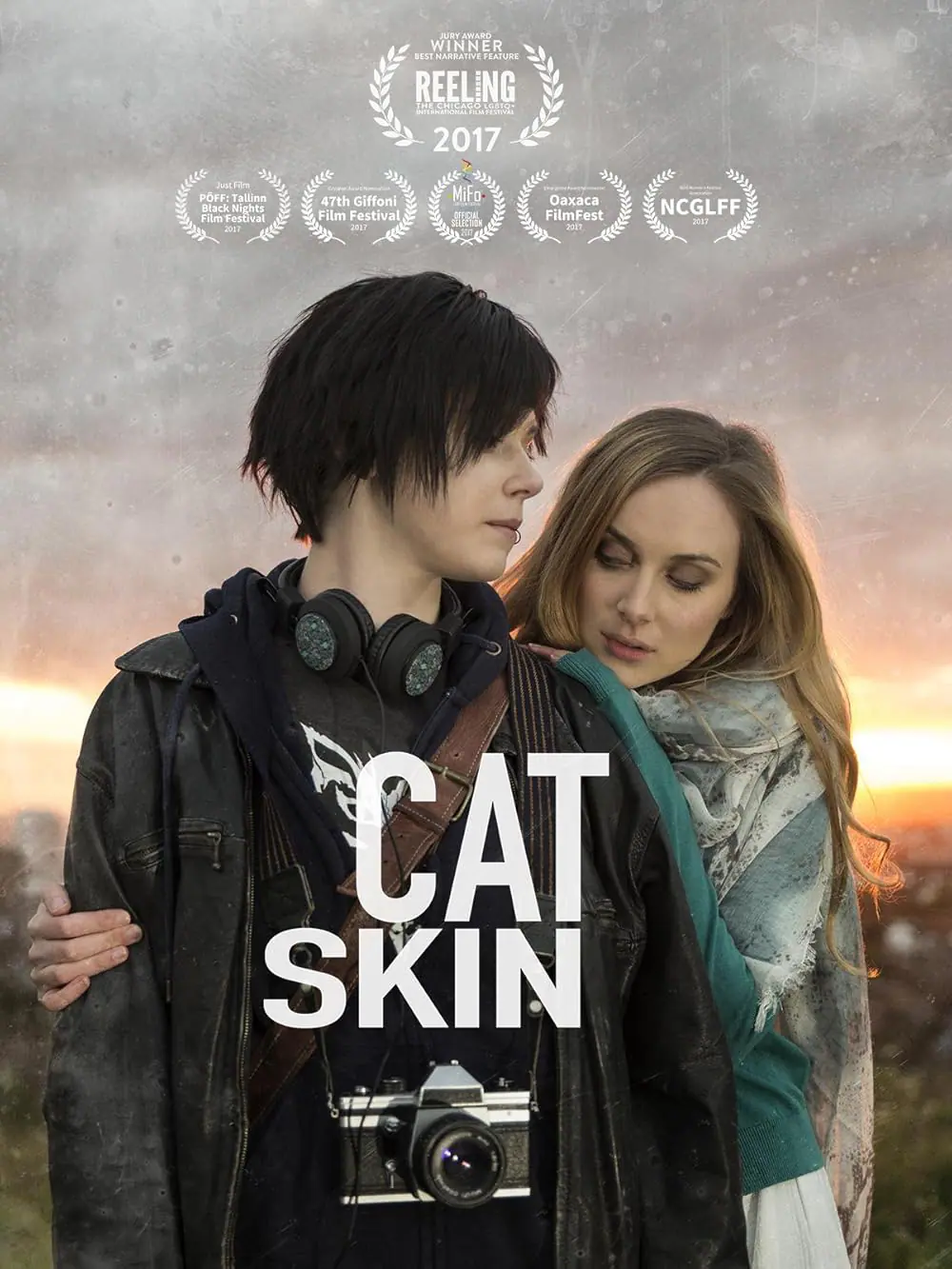
Cat Skin: Transparent Obsession and Salvation Encountered Beyond the Lens of a Deprived Soul
At some point, everyone has tried to fill their own void by observing the lives of others. Is the act of capturing another’s radiant moments within a frame a manifestation of possessiveness, or a sorrowful longing for a world one cannot reach?
The film Cat Skin (2017) depicts the painful growth of a girl hidden behind the shield of a camera as she sheds that skin for the first time and steps into the warmth of another. This is not merely a romance; it is a hauntingly beautiful process of an isolated self finding its own form through the mirror of another person.
🌿 Moments When This Film Deeply Permeates
- To the lonely souls who breathe only through a viewfinder, having disconnected themselves from the noise of the world.
- To the anxious youths who lose sleep, unable to discern whether their feelings for someone are “admiration” or “love.”
- To those who fear more than death the possibility of someone discovering their most vulnerable and unsightly parts.
- The reason you should read to the end of this piece is to uncover what kind of liberation is offered to us by that moment of “rupture”—the moment Cat finally puts down her lens and looks April directly in the eye.
🎞 Note Before Viewing
This work deals with identity confusion and emotional conflict during adolescence, and includes a certain level of coercive relationship depictions and emotional violence. It is an atmospheric drama that focuses on the taut tension and psychological pressure between characters rather than explicit imagery.
🎬 Film Information
- Title: Cat Skin (2017)
- Director: Daniel Grasskamp
- Screenplay: Daniel Grasskamp
- Country: UK
- Genre: Drama, Romance, Queer
- Running Time: 80 minutes
- Platform: Amazon Prime Video (Availability may vary by region)
- Cast: Jodie Hirst (as Cat), Caspian Faye (as April), Theo Berman (as Steven)
📖 Cat Skin: The Journey of an Isolated Observer Swept into the Storm of Love [No Spoilers]
Cat, a photography student, is a thoroughly isolated existence both at school and at home. To her, as she spends time with her cat—her only sanctuary—while caring for her ailing mother, the camera is the sole window through which she observes the world and a sturdy fortress that protects her. Instead of mingling with people, Cat maintains a safe distance, capturing their lives as if peeking at them from behind her lens.
One day, April, a vibrantly bright music student, enters Cat’s lens. Captivated by April’s lively presence, Cat begins to photograph her with an obsessive intensity, treating her as a subject. Meanwhile, April, who leads a suffocating daily life in a relationship with her controlling boyfriend Steven, feels a strange sense of liberation toward Cat, who looks at her with such a unique gaze.
The accidental meeting of Cat, who dwelt in the shadows, and April, who stood at the center of the light, gradually develops into a deep relationship that delves into each other’s deficiencies. However, as external pressures—Steven’s obsession with possessing April and societal prejudices—intensify, the quiet world Cat has maintained begins to crack.
🐱 The Collapse of the Lens Shield and a Transparent Interpretation of the Ending
The most central symbol in Cat Skin is the camera that Cat never lets go of. Analyzed deeply, the camera represents a duality for Cat: a “refusal to communicate” and simultaneously a “longing for connection.” Instead of touching April directly, she attempts to possess her by developing her into photographs. This is a defense mechanism intended to control another without exposing her own vulnerable interior.
However, the series of violent events Cat experiences toward the end forcibly strips away the protective shield she wore, akin to the “Cat Skin.” The patriarchal violence embodied by April’s boyfriend, Steven, slashes through the relationship between the two girls; yet, paradoxically, it is through this destruction that Cat finally steps out from behind the lens.
A point to note in the interpretation of the work is the fact that Cat is no longer an observer but becomes an actor. The lingering resonance felt in the final scene lies not so much in whether the two achieved a physical or emotional union, but in the growth marked by Cat breaking her isolation and fully exposing herself to another.
The ending of this film declares that the isolated self, having sustained a massive blow from the existence of another, has finally come to exist truly in the world.
📸 A Duet of Light and Shadow: Cat as the Mirror April Faces
On the surface, April appears to be a being of “light” who lacks nothing, but in reality, she is a passive figure trapped by the expectations of those around her and the control of her boyfriend. To her, Cat is not just a lover, but a mirror that reflects her true self. In Cat’s photographs, April is reborn as a subject with her own inherent beauty, rather than Steven’s property.
An indispensable point in the review of these two is the reversal of the power structure. Initially, Cat seems to hold power as she observes April through her camera, but as emotions deepen, Cat becomes the vulnerable one, collapsing at a single reaction from April. Conversely, April gains the courage to affirm her desires and break away from her oppressive environment through Cat.
The director maximizes the contrast between the two through mise-en-scène. While Cat’s space is dark and filled with fragmented light, the space April occupies is bright yet somewhat artificial. The process of these two worlds colliding and blending perfectly realizes the chaotic chemical reaction of adolescence searching for a queer identity.
🔎 Is the Ambiguous Progression of Cat Skin a Directorial Intent or a Narrative Limitation?
Q1. There are points made that the film’s pacing is excessively slow and the dialogue is sparse, making it difficult to grasp the characters’ motivations. Is this intentional?
A: Yes, while this can be a point of criticism, it appears to be an intentional aesthetic choice by the director. Emotions during one’s teens are like a “mist” that is difficult to define clearly with words. Cat Skin describes unspoken desires through the characters’ gazes, camera angles, and silence rather than dialogue. By choosing sensory sensitivity over narrative kindness, the film invites the audience to directly sense the characters’ inner worlds.
Q2. How do you view the criticism that the conflict and violence occurring in the ending are somewhat abrupt and provocative?
A: The progression of the latter half of the film may feel jarring compared to the lyrical tone of the first half. However, this serves as a device to show how easily a marginalized relationship can be exposed and shattered by external physical violence (homophobia, possessiveness). It is interpreted as an intent to highlight the value of the “dignity” the protagonists have earned through these tragic devices more clearly.
✨ Cat Skin: The Sublimity of Shedding the Shell and Touching Each Other’s Skin
Cat Skin shows the arduous map of a relationship progressing from “looking” to “being seen,” and finally to “being together.” We all hide inside our own shells to observe others and seek safety, but true growth is only possible through the pain of that shell being stripped away to reveal the raw flesh.
This work goes beyond the framework of a queer narrative to ask how dangerous and beautiful a gamble it is for a human to open their heart to another. The courage shown by Cat and April poses a valid question for us living today.
A true relationship begins not by praising each other’s perfection, but by transparently sharing each other’s broken crevices.
💬 Sharing the Abyss vs. Comfortable Distance: The Intensity of Exposure that Completes a Relationship
Do you believe that love truly begins only when you show someone your most pathetic rock bottom? Or do you believe it is wisdom to maintain a certain distance to sustain a relationship?
📽️ Violet Screen Curation: Women’s Narratives of Deficiency and Solidarity
- The World to Come (2020): Set in the 19th-century American frontier, this is an intense and aesthetic drama where two women in an isolated environment experience the liberation of their souls through letters.
- Water Lilies (2007): An early work by director Céline Sciamma, it captures the longing, jealousy, and fever of first love among young girls through sensory mise-en-scène. One can feel a strange commonality in the way it handles the birth of identity.
To provide a more stable publishing environment, multilingual content, and better communication with our readers, we have moved our official publication to Substack.
All new film reviews and critical essays will be published on our new platform. This website will be closing down soon, so we would greatly appreciate it if you subscribed to our new space.
TODAY'S QUESTION
What's your favorite line from a WLW movie or show?
Your answer isn't saved. Feel free to share it in the comments below.


You May Also Like

Moonlit Winter Ending Interpretation and Plot: Reclaiming Desire from Frozen Time

An In-Depth Analysis of Body of Deceit: An Interpretation of Deception and Solidarity Blooming within the Labyrinth of Memory