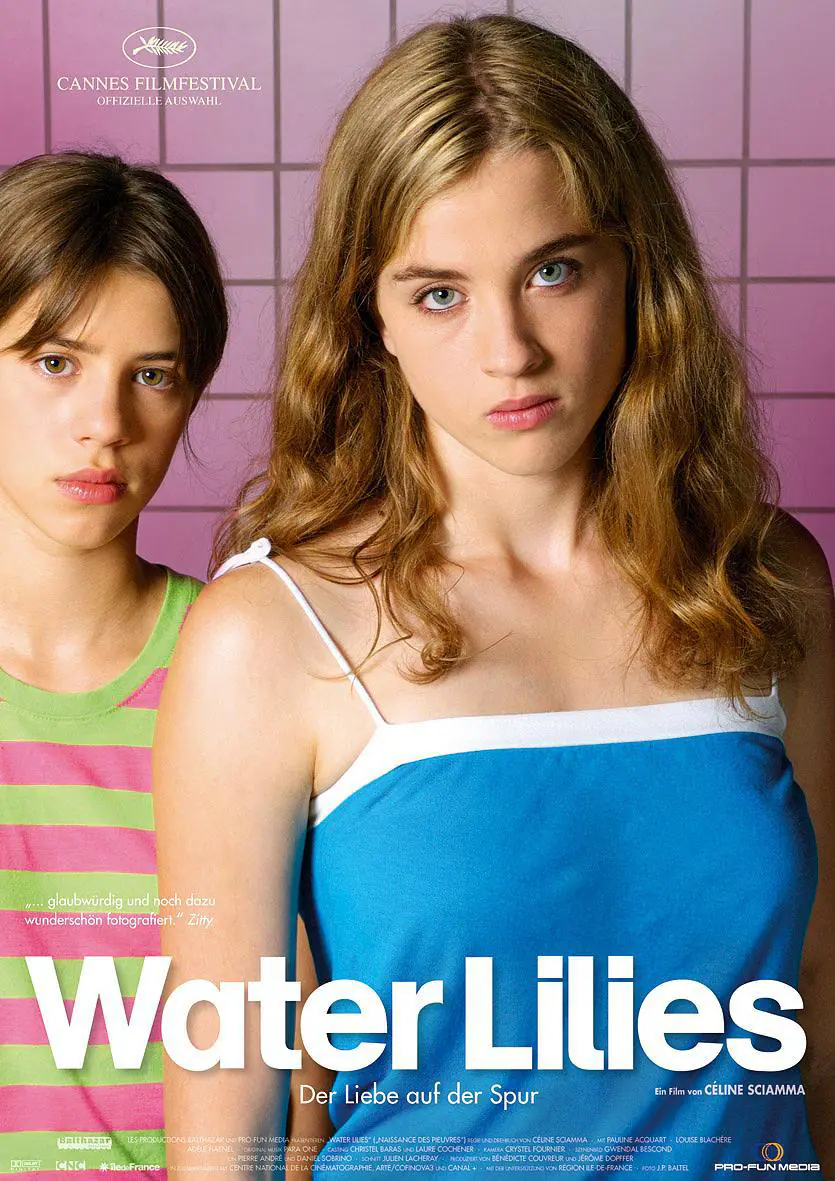
Water Lilies: Refracted Desire and the Sense of Growth Forged in Subaquatic Isolation
Every first love is, in fact, less a longing for another person and more a desperate search operation to find a “self” whose identity remains unknown. A gaze sliding over another’s skin, an unfamiliar heat rising wherever that gaze lands, and the chilling solitude left where that heat has cooled. We have all, at least once, traversed that swamp of desire where the boundary between wanting to resemble someone and wanting to possess them becomes blurred.
This work, where director Céline Sciamma’s cinematic universe began, does not merely depict teenage wandering; it tenaciously tracks the dissonant fractures that occur when a human being confronts their true self through the mirror of another.
🌿 Moments when this film deeply permeates the soul
- When the memory of a visceral unrequited love—where you collected even the most trivial traces of someone like jewels—becomes vivid.
- When the uniform of “femininity” demanded by the world feels like a ready-made garment that does not fit your body.
- When you wish to decipher the power structures and the subtle air of jealousy hidden behind the name of friendship.
- The reason you must read until the end: Because the truth beneath the surface, struggling while holding its breath, resembles our lives more closely than the elegant gestures displayed above the water.
🎞 Note Before Viewing
This work deals with physical changes and sexual curiosity during adolescence and includes some physical exposure and sexual depictions. However, these are not devices for provocation; they serve as essential narrative tools to reveal the psychological dynamics between characters and the formation of self-identity.
🎬 Film Information (2007)
- Title: Water Lilies (Naissance des Pieuvres)
- Director: Céline Sciamma
- Screenplay: Céline Sciamma
- Country: France
- Genre: Queer Coming-of-Age Drama, Psychological Drama
- Running Time: 105 minutes
- Platform: Naver Series On, Google Movies
- Cast: Pauline Acquart (as Marie), Adèle Haenel (as Floriane), Louise Blachère (as Anne)
📖 Water Lilies, A Trajectory of Twisted Attachment Starting Behind the Synchronized Swimming Showcase [No Spoilers]
One summer in France, against the backdrop of a quiet swimming pool, the parallel worlds of three girls begin to collide. Marie, an introverted girl, is captivated by the overwhelming brilliance of Floriane, the captain of the synchronized swimming team. Floriane is an object of both envy and jealousy, yet she lives precariously, performing a heteronormative script to maintain her reputation as a “loose girl.” Meanwhile, Marie’s friend Anne pursues François, a boy at the pool, with awkward advances, revealing a different direction of longing. As admiration turns into obsession and curiosity into disillusionment, the girls question whether what they truly want is another’s body or the social position that person symbolizes. Like the cold rules of synchronized swimming, where one must press down on another’s shoulders to rise above the surface, their relationships gradually subside, predicated on sacrifice and submission.
🌊 Water Lilies Interpretation: Elegance Above Water and the Struggle for Survival Beneath
Synchronized swimming is the most significant symbol permeating this film. The audience sees the girls’ disciplined movements and smiles above the water, but the camera immediately plunges beneath the surface to capture legs convulsing as they hold their breath. This visualizes the “internal labor” adolescent women must endure to perform the “typical femininity” required by society.
The emotion Marie feels for Floriane is an “ontological longing” that transcends simple homoerotic attraction. Marie rummages through the trash Floriane has discarded and obsessing over objects her breath has touched. This is a process of fetishization, an attempt to internalize the power (beauty and popularity) possessed by the object through possession. Céline Sciamma directs this masterfully through a tenacious camera gaze, showing how the observer deconstructs and reassembles the observed.
🎭 Cracks in the Persona: The Fear Hidden Behind the Mask of a “Loose Girl”
Floriane is the character who embodies the most multi-dimensional tragedy in this film. She appears to enjoy the male gaze, but in reality, she secures her safety by imprisoning herself within that gaze. Paradoxically, the rumor of being “sexually promiscuous” acts as a defense mechanism to hide her fear and ignorance regarding actual sexual intercourse.
The scene where she confesses her virginity to Marie and asks for help with a “fake experience” is the point where the power structure of the relationship is reversed. Floriane, once the object of envy, becomes integrated into Marie’s world by exposing her most vulnerable secret, and Marie gains a psychological footing equal to or greater than Floriane’s by sharing that secret. Their solidarity is less a pure friendship and more a precarious symbiosis driven by each other’s deficiencies.
🔎 Reinterpretation of the Ending: Spilled Milk and the Remnants That Won’t Wash Away
At the conclusion of the film, the moment Marie and Floriane face each other is a confirmation of an “eternal fracture” rather than “total unity.” Floriane eventually returns without having completed the relationship with François, and Marie feels a strange sense of relief mixed with futility by her side. Floriane’s failure in the heteronormative rite of passage she attempted to perform is her instinctive resistance and proof that the secret, abnormal intimacy she shared with Marie cannot be translated into the grammar of this world.
In the final scene, the act of the girls dancing together or jumping into the water suggests a cycle of isolation that will continue to repeat, rather than liberation. By “possessing” Floriane, Marie realizes she is an “unstable being” no different from her, and Floriane recognizes through Marie that her performance has ended. This ending is a record of the pain of learning to stare directly into one’s own darkness, rather than a process of moving toward a brilliant light.
❓ Water Lilies Interpretation and Critical Issues: Queer Cinema or Adolescent Ghost Story?
Q1: There is criticism regarding Marie’s obsessive behavior, such as rummaging through Floriane’s trash, labeling it as “stalking” or a “toxic relationship.” How do you view this?
Certainly, Marie’s actions contain elements that could provoke discomfort when viewed through modern ethical standards. However, this work is not a textbook exhibiting “correct relationships” but aims to capture raw desire as it occurs during the immaturity of the self. While the criticism is valid, one should note that through Marie’s obsession, the director shows that the desires of adolescent women can be just as destructive and intense as those of men, elevating the female character to a “subject of desire” rather than a mere recipient.
Q2: What is your take on the opinion that Floriane’s way of using Marie is excessively selfish?
Floriane uses Marie as a tool to maintain her social mask. This can be seen as clear emotional exploitation. However, structurally, Floriane is also a victim trapped in the binary frame of “saint or whore” imposed by patriarchal society. Her selfishness is a struggle for survival, and the vulnerability she shows Marie is the only piece of truth she has allowed. The reader needs to understand this relationship not as a struggle between good and evil, but as a malformed mode of communication created by an oppressive environment.
✨ Water Lilies, A Solidarity of Solitude Beginning Atop Ruined Illusions
This film does not beautify a teenage summer. Instead, it spreads the raw face of desire—humid, sticky, and sometimes smelling of brine—across the screen. What the girls gain at the end of their relationship is not the fruit of love, but the cold truth that another person can never be one’s salvation. Yet, in the moment they share that despair, they become, paradoxically, most powerfully connected.
Identity is a fortress that is finally completed when one escapes the prison of the other’s gaze and chooses their own isolation.
🌌 What is hidden beneath your surface?
Do you believe love is about completely understanding another person, or do you believe it is about protecting each other’s misunderstandings until the very end? In the moment you longed for someone most intensely, was what you truly wanted that person, or was it the version of yourself standing beside them?
📽 Violet Screen Curation: Gazes Exploring Other “Abysses of Relationship”
- Portrait of a Lady on Fire (2019): A work by the same director that deals with the “permanence of memory” rather than the completion of love through observation and the gaze.
- Shiva Baby (2020): A high-density work that uses black comedy to show how a woman’s social relationships and secrets turn into a sense of pressure within a confined space.
To provide a more stable publishing environment, multilingual content, and better communication with our readers, we have moved our official publication to Substack.
All new film reviews and critical essays will be published on our new platform. This website will be closing down soon, so we would greatly appreciate it if you subscribed to our new space.
TODAY'S QUESTION
Which ending has stayed with you the longest?
Your answer isn't saved. Feel free to share it in the comments below.


You May Also Like

Embrasse-moi! (2017) – A Romantic Trajectory Where Clumsy Desire Attains Mature Solidarity

November Moon (1985): A Record of Survival and Fierce Love Blooming in an Age of Tragedy