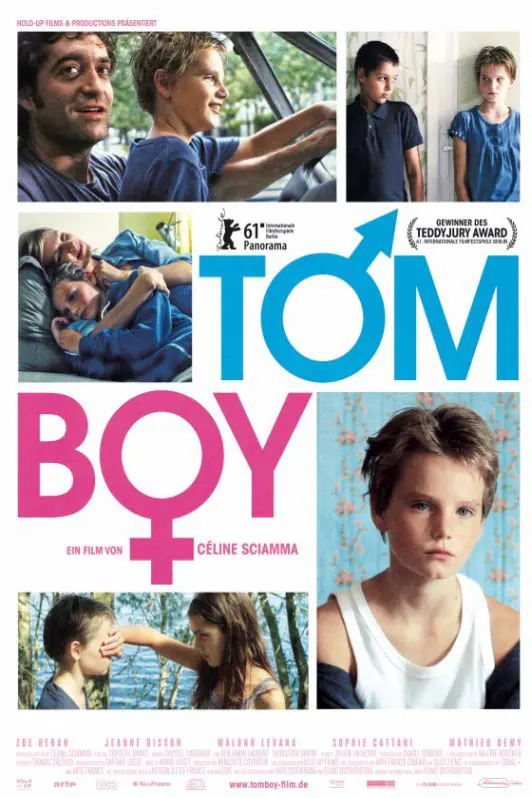
Tomboy (2011) Film Review: A Piercing Coming-of-Age Interpretation of Confronting the Self Beyond the Gaze of Others
The experience of wandering in confusion because one cannot fit into the external molds defined by the world is universal. Director Céline Sciamma’s film Tomboy (2011) does not treat the grand discourse of gender identity as a sharp, weaponized tool, but rather captures it through the exceptionally transparent and delicate gaze of a ten-year-old child.
This work is not merely a lighthearted caper about a child concealing their sex; rather, it explores the isolation and yearning that bloom within the chasm between the “me” defined by others and the “me” I desire to be. Through the eyes of the child on screen—who is both Mickaël and Laure—we vividly reconstruct our own moments of deficiency and solidarity that we all must have confronted at least once during childhood.
🌿 Moments When This Film Deeply Permeates
- For those who have felt suffocated by the standards of normalcy demanded by society.
- For those who appreciate the emotional resonance conveyed through quiet expressions and gestures rather than dialogue.
- For those who wish to confront the sharp edge of a chilling reality hidden behind the innocence of youth.
- Why You Must Read Until the End: Because it lucidly unpacks, through a critic’s lens, the essence of structural liberation carried by the protagonist’s final smile in the forest, where the boundary between falsehood and truth collapses.
🎞 Notes Before Viewing the Film
Devoid of physical or provocative sensationalism, this drama densely captures the identity confusion and relational dynamics experienced by young children. As the narrative unfolds through shifts in perspective and emotional contours rather than violent depictions, it is recommended to focus on the psychological distance between the characters while viewing.
🎬 Film Information
- Title: Tomboy (2011)
- Director: Céline Sciamma
- Screenplay: Céline Sciamma
- Country: France
- Genre: Drama, Coming-of-age
- Running Time: 82 minutes
- Platforms: Watcha, Wavve, Naver SeriesOn, etc.
- Cast: Zoé Héran, Jeanne Disson, Malonn Lévana
📖 Tomboy, the Secrets and Conflicts of a Summer Day Faced by a Child Who Changed Their Name [No Spoilers]
Ten-year-old Laure, who has just moved to a new apartment complex, naturally possesses sharp features and a boyish appearance. During an exceptionally hot summer vacation, while watching the neighborhood boys from the window, Laure happens to meet a local girl named Lisa. When Lisa notices Laure’s androgynous appearance and asks, “Are you a boy?” along with their name, Laure introduces themselves as ‘Mickaël’ after a brief moment of hesitation.
This minor choice opens up an entirely new world for Laure. Under the name Mickaël, they integrate into the boys’ group to play football, alter a one-piece swimsuit into male trunks, and fashion male genitalia out of mud, actively executing a masculine gender performance. As the relationship between Mickaël and Lisa deepens and they share their first kiss, leading to happy days, a fracture develops in Mickaël’s interiority when Lisa applies makeup on them and remarks, “You look pretty even when you act like a girl.”
Although younger sister Jeanne shares this secret and becomes a dependable ally, Mickaël’s double life is eventually discovered by their mother after getting caught in a physical altercation with another boy. Enraged and bewildered, the mother forces Laure into a dress and heads to Lisa’s house to compel an apology, placing the sturdy summer night’s dream built by the child onto the ruthless crucible of reality.
🎨 Gender Performativity Disguised as Childhood Play and the Power Structure of the Gaze
Tomboy demonstrates that the world of children is by no means looser than that of adults; rather, the rules within the peer group operate with greater stringency. Director Céline Sciamma depicts the process of Laure becoming Mickaël not through grand ideology, but through the format of ‘summer vacation play.’
The core concept here is gender performativity. Laure observes their own body in the mirror, cuts their hair short, and learns the rough behavioral patterns of the boys. The most compelling aspect of this film is that it visualizes the philosophical discourse—that gender is not innate but completed through acquired mimicry and performance—via the body of a ten-year-old child.
Particularly in the swimming pool sequence, Laure’s act of ‘manufacturing’ an identity out of mud is an aesthetic direction suggesting that even the physical conditions determining sex can become malleable materials within the realm of childhood play.
🌲 The Forest as a Liberated Space and the Costuming of Oppression
Throughout the film, space and clothing function as key symbolic elements representing the psychology of the characters. If the ‘home’ is an oppressive space where the rules of gender operate for Laure, the ‘forest’ is a liberated mise-en-scène where they can exist fully as Mickaël.
When Laure walks down the street forced into a dress by their mother, that blue dress acts not as a blessing, but as a massive stigma and a prison. Laure’s act of fleeing into the forest, violently tearing off the dress, and returning to their usual tank top and shorts is a vehement rejection of the femininity imposed by society.
However, the moment even the sanctuary of the forest is invaded by the ideology of the peer group, the film faces an acute escalation of tension. The mocking sequence where the children pull down Laure’s pants to forcibly verify their anatomical sex unreservedly exposes the violent nature inflicted by the majority onto the minority to police the boundaries of normalcy, presenting a heavy ethical question to the audience.
🔎 Reinterpretation of the Ending — A Declaration of Structural Growth Left by the Final Smile
The film’s finale captures a peculiar stillness that arrives after a cruel storm. Exposed to their friends and rejected by Lisa, Laure is isolated and deeply wounded, yet faces the window once again at the end of the vacation. There stands Lisa, who had previously turned away.
Breaking the taut silence stretching between the two, Lisa asks the question, “What’s your name?”—the most destructive yet beautiful question permeating the entire film. To this, Laure does not flee or hide, but answers calmly, “I’m Laure,” while offering a faint smile.
Laure’s final smile is the establishment of an autonomous self that refuses to return to the falsehood of the past, as well as a testament to human dignity achieved by personally breaking through societal stigma.
This ending speaks neither of a simple restoration of the relationship nor of total ruin. Laure has lost the fictional boy ‘Mickaël,’ but has gained the internal strength to validate their authentic self even amid the prejudices manufactured by the gaze of others. Lisa’s question erases the illusion of Mickaël and opens up the possibility of a new relationship, one that confronts the raw reality of ‘Laure’ as an independent individual. Laure’s life after this ending cannot be the same as before, but the child will now encounter the world with dignity, wearing their own clothes rather than a dress imposed by others.
💬 Tomboy: On the Gaze of the Other and Contemporary Modes of Gender Representation
Q1. Isn’t the mother’s action in the latter half—forcing Laure into a dress and executing the outing—subject to excessively harsh criticism?
From a contemporary perspective, the mother’s behavior is clearly legible as emotional violence and a forced outing of a minority, leaving many viewers uncomfortable and creating a point of divergence in audience reception. However, this cruel staging is a device that unreservedly exposes how structurally incapable the societal and familial systems of the time were of accommodating a child’s identity. Rather than portraying the mother as a villain, the director transparently projects the fear and limitations of the older generation trying to maintain a heteronormative society, forcing the audience to recognize that the root of this tragedy lies in the structure rather than the individual.
Q2. As per director Céline Sciamma’s intention, can this film be interpreted as a general coming-of-age movie outside of a transgender narrative?
Yes, it is entirely possible, and that is precisely the aesthetic extensibility of this work. As seen in Lisa aligning with the peer group’s rule by declaring, “It’s disgusting that I kissed a girl,” this film moves beyond gender issues to deal with ‘the public’s exclusion of a minority who deviates from the collective group.’ Therefore, Laure’s journey can be read as a yearning to achieve masculinity, the initial identity confusion experienced by a lesbian in a heterocentric society, or simply a universal declaration of independence by anyone who refuses to fit themselves into existing gender role templates. The judgment remains open to the reader.
✨ Tomboy, the Firm Gaze of One Who Has Shattered the Prison of Appearance
In concluding this review of Tomboy, what we must pay attention to is what kind of questions these childhood memories pose to our adult selves today. Are we not still editing our images as reflected in the mirror of the gaze of others? The film proves through Laure’s small shoulders how lonely and sublime a struggle it is for a human being to protect their essence within rigid social templates of gender, age, and identity.
What proves my existence is not the name tag attached by others, but my own voice pronouncing my being without omission or addition.
🪵 Confronting Silence: What is your real name?
The memory of living under a fictitious name while concealing one’s true self to meet the expectations of surrounding environments and societal gazes exists for almost everyone at least once.
If someone most precious to you approached and asked that fundamental question, “What’s your name?”, what choice would you make? Do you have the courage to reveal your hidden, authentic self and smile like Laure, or would you hide back behind a safe mask? Please share your deep inner stories in the comments.
🎥 Female Narrative Solidarity Recommendations Chosen by Violet Screen’s Discernment
- Shiva Baby (2020): A contemporary female-centric masterpiece that unpacks the identity confusion experienced by a young female protagonist and the suffocating tension of her secrets bordering on exposure through a humorous yet sharp psychological battle.
- Water Lilies (2007): As Céline Sciamma’s directorial debut, this film deals with the uncontrollable desires and gazes of adolescent girls in a manner more unrefined than Tomboy. Its depiction of motivation and deficiency is exceptional.
To provide a more stable publishing environment, multilingual content, and better communication with our readers, we have moved our official publication to Substack.
All new film reviews and critical essays will be published on our new platform. This website will be closing down soon, so we would greatly appreciate it if you subscribed to our new space.
TODAY'S QUESTION
Is there a film whose ending you wish had gone differently?
Your answer isn't saved. Feel free to share it in the comments below.


You May Also Like

La Luciérnaga Film Analysis: Salvation in the Name of Desire Found at the Edge of Loss

Bandaged (2009) Analysis: Tearing Through Suppressed Oppression Hidden Beneath Bandages—Two Women’s Destructive Indulgence and Its Ultimate Conclusion