Albert Nobbs: The Fortress of Survival and the Melancholy Freedom Built Upon an Erased Name
To exist is to dwell within the gaze of others, yet sometimes a life can only persist by becoming utterly transparent. We follow the trajectory of a figure who erased themselves amidst the cold air of 19th-century Dublin.
This film is not a life lived for the display of others, but rather a solitary confessional of a soul who cloistered themselves solely to survive. Through this quiet struggle, we come to realize anew how heavy a privilege the phrase “ordinary happiness” truly was.
🌿 Moments When This Film Deeply Permeates
- For those who have experienced disguising themselves because they could not find a place within the social order.
- For those who yearn for “a small room of one’s own” and “the solace of a cup of tea” more than a grand revolution.
- For those who wish to decipher the massive waves surging behind Glenn Close’s restrained expressions.
- For those who want to understand the dissonant friction that occurs when an isolated individual dreams of connecting with another.
- This is why you must watch until the end to see how this tragic silence eventually becomes a light in the lives of others.
🎞 Note Before Viewing
This work deals with the poor human rights of 19th-century women and the extreme choices made for survival, focusing on the psychological pressure and emotional bonds between characters. It is a period drama that captures internal isolation and the deficit of relationships with density, rather than relying on provocative depictions.
🎬 Film Information
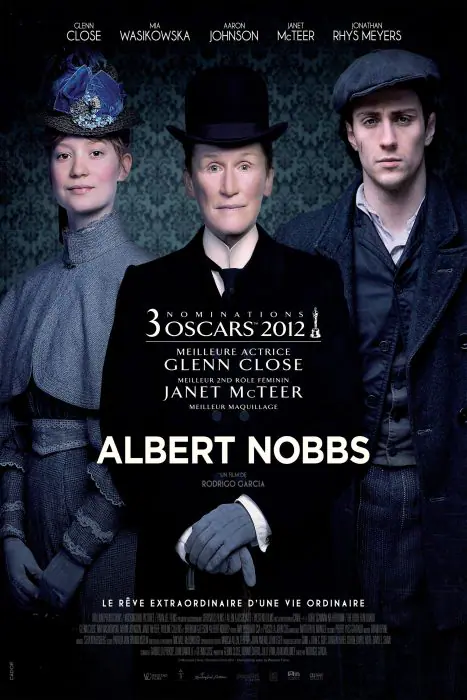
- Title: Albert Nobbs (2011)
- Director: Rodrigo García
- Screenplay: Glenn Close, John Banville, Gabriella Prekop
- Original Work: The short story The Singular Life of Albert Nobbs by George Moore
- Country: Ireland, United Kingdom
- Genre: Drama, Period Piece
- Running Time: 113 minutes
- Platform: VOD and major streaming services
- Cast: Glenn Close, Janet McTeer, Mia Wasikowska, Aaron Taylor-Johnson
📖 Albert Nobbs, Cracks in a Disguised Life and a Precarious Courtship Toward the Ordinary [No Spoilers]
In the late 19th century at Morrison’s Hotel in Dublin, Ireland, there is Albert Nobbs, who has lived as the perfect butler for 30 years. Behind an expressionless face and meticulous service, Albert hides the fundamental secret of being a “woman,” dreaming of opening a small tobacconist shop by hiding coins under the floorboards every night.
One day, Albert’s rigid world begins to crack when forced to share a room with Hubert Page, a painter who arrives for hotel repairs. The existence of Hubert—who shares the same secret yet confidently maintains a household—visualizes for Albert a possibility of “life” that transcends mere survival.
To realize this dream, Albert begins a clumsy and cautious courtship of the maid Helen Dawes. However, the greed of Helen’s lover, Joe Mackins, intervenes, tangling the relationship into a complex web. As the walls of class, the shackles of gender, and a belatedly awakened desire collide, Albert’s quiet life gradually descends into an uncontrollable vortex.
🗝️ An Interpretation of Albert Nobbs’ Erased Self and Survival Instinct Hidden Beneath the Armor of Male Attire
For Albert, men’s clothing is less an expression of gender identity and more a social armor to protect the self from hunger and violence. Guarding against the historical contradictions where women could not survive independently, Albert replaced the self with a functional identity as a “butler” over the course of 30 years.
The money collected is not mere wealth; it is the price of solitude earned through a divorce from the world. Paradoxically, however, that money draws Albert back out into the world, fostering ordinary desires for a “family” and a “shop.” From the perspective of interpretation, the clumsy emotional expressions revealed in this process can be described as the belated manifestation of a humanity that had long been divested.
🪞 The Other as a Mirror: The Hopeless Hope of Albert Nobbs Encountered Through Hubert Page
Beyond being a mere colleague, Hubert Page is an ideal and a mirror—an image of what Albert’s future could have been. Despite choosing the same disguise, Hubert is a “redefined” individual who knows how to maintain identity and bond with others. The confident life and warm home Hubert displays instill in Albert—who has lived “erasing” the self—a fatal hope that “I could be like that too,” serving as the psychological engine for the obsession with Helen.
However, Albert, having lived a life fossilized by discipline, was not as flexible as Hubert. Albert approached even love like a business contract; this atrophy of communicative ability ultimately yields the tragedy of an asymmetrical relationship where sincerity fails to reach its target.
The point where their contrasting trajectories converge is the scene of running along the beach in dresses. The skirt hems fluttering in the wind, replacing tight corsets and suits, symbolize their sovereign bodies and the dazzling liberation reclaimed for a fleeting moment. Yet, the act of returning to male attire after this brief freedom poignantly demonstrates the weight of historical gravity that an individual could not ultimately overcome.
🏚️ Questions Left by the Ending: The Sorrowful Legacy of a Man Who Vanished for the Freedom of Others
In the film’s ending, Albert’s death arrives in an utterly quiet and hollow manner. Fitting for one who lived holding their breath, even death is quietly buried amidst the clamor of others. The scene where the money saved over a lifetime eventually falls into the hands of the greedy hotel owner starkly exposes the cold structure of this world.
Yet, the traces Albert left do not disappear. The small fissure left by this death opens possibilities for a new solidarity for Helen, her child, and Hubert. Although Albert failed to achieve the dream, that very existence became a spark of liberation for others.
The life of Albert Nobbs is the loneliest and most sublime record of silence, sustaining the lives of others by erasing one’s own.
❓ Debates on the Ending of Albert Nobbs and the Representation of Women
Q1. What is your view on the criticism that Albert’s death is too futile?
The hollow death of Albert is the most cruel yet realistic aesthetic of this film. By rejecting the fantasy of a grand reward for a character who lived in silence, it proves how thoroughly the class society and gender oppression of the time eroded an individual. This simultaneously evokes anger and sadness in the audience, suggesting that the survival of the socially marginalized can never be completed through individual effort alone.
Q2. Isn’t Albert’s courtship of Helen potentially seen as obsession or deception?
From a modern perspective, there is room for it to be interpreted as deception, but for Albert, Helen was the final puzzle piece required to construct a “normal form of life” before she was ever a “lover.” Because Albert never learned how to form relationships, sincerity could only be expressed through material rewards and role-playing. It is more accurate to view this not as a moral flaw, but as the tragic clumsiness of a human being who has been stripped of the language of connection.
✨ Albert Nobbs: The Melancholy Aesthetics of Solidarity Wrought by the Nameless
We often forget the faces of those who vanished without a name in the grand sweep of history. Albert Nobbs is one of those countless anonymous figures, and this life represents all ordinary people struggling for “tomorrow’s safety” rather than grand values.
The new relationship Helen and Hubert will form after this death may be another form of the “family” Albert so desperately wanted. The fact that the seeds of solidarity sprouted where individual desire was frustrated suggests that human dignity is transmitted to the next generation in some way.
In the end, what remains after the fierce struggle for survival are the small traces of warmth we bestowed upon others.
💬 Some secrets become clearer when they are never told.
If you were Albert, which would you choose first: the dream of opening a tobacco shop with money hidden under the floorboards, or the courage to tell someone your real name?
🎬 Curation of Women’s Narratives to Continue the Resonance
- Vita & Virginia (2018): Deals with the complex and fascinating relationship between writers Virginia Woolf and Vita Sackville-West. It depicts the dense communion between women, where artistic inspiration and destructive desire intermingle, through sophisticated mise-en-scène.
- The World to Come (2020): Set in the 19th-century American frontier, it explores the emotional liberation felt by two women living isolated lives as they discover one another. It is a masterpiece highlighting a delicate yet resilient solidarity blooming in a harsh environment.
To provide a more stable publishing environment, multilingual content, and better communication with our readers, we have moved our official publication to Substack.
All new film reviews and critical essays will be published on our new platform. This website will be closing down soon, so we would greatly appreciate it if you subscribed to our new space.
TODAY'S QUESTION
Which film feels like your 'first love' story?
Your answer isn't saved. Feel free to share it in the comments below.


You May Also Like

Zomer (Summer, 2014): The Fever of Identity, Interpreting Desire Awakening in an Isolated Paradise

Bound (1996) Review: The Essence of Queer Noir Demonstrated by a Perfect Female Narrative