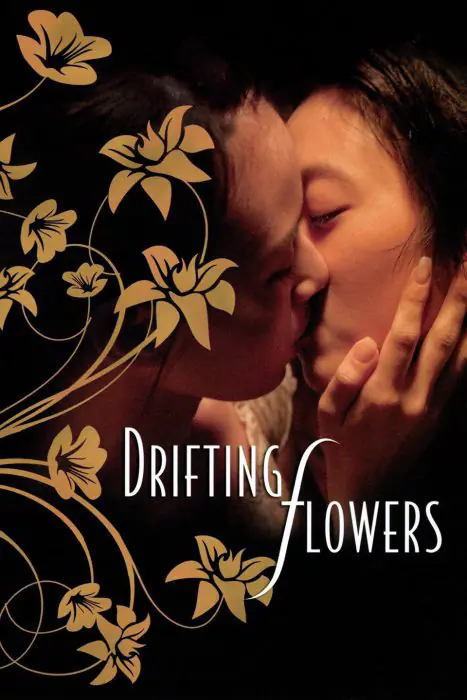
Drifting Flowers (2008): Three Streams of Queer Narratives, Our Wandering Youth Burdened with Sorrow
Isolation can sometimes build walls that confine us, but it is only when we tear down those walls and step outside that we truly and fully encounter the existence of others. Loving someone deeply is an act of exposing one’s own deficiency, while simultaneously choosing to embrace the wounds of another. This film captures those clumsy, precarious moments of love with a calm, steady gaze.
🌿 The Moments This Film Sinks Deepest
- For those who want to believe in a fleeting connection when a hand, reached out from the depths of loneliness, touches another’s warmth.
- For those fighting solitary battles to affirm themselves amidst the confusion of identity.
- For those wishing to witness the essence of a love that remains unmarred, even as memories fade.
- For those who want to experience the structural aesthetics of three fragmented lives converging at last into a singular, profound solace.
🎞 Note Before Viewing
This work centers on deep romantic bonds between women and the struggle with gender identity. Physical contact and explicit representations are highly restrained; instead, it is an emotionally driven, profound narrative focusing on inner conflicts, relational collapse, and the subsequent process of realignment.
🎬 Film Information
- Title: Drifting Flowers (Original Title: 漂浪青春, 2008)
- Director: Zero Chou (周美玲)
- Screenwriter: Zero Chou (周美玲)
- Country: Taiwan
- Genre: Drama, Romance, Identity
- Running Time: 97 minutes
- Platform: DVD and specialized Asian cinema streaming platforms (subject to regional availability)
- Cast: Serena Fang (as Jing), Chih-Ying Pai (as May), Yi-Lan Chao (as Chalkie/Diego), Lu Yi-Ching (as Lily), Sam Wang (as Yen)
📖 Three Paths of Youth Crossing Paths Beyond Loss and Discovery [No Spoilers]
Eight-year-old May, who lives alone with her visually impaired older sister Jing, feels a strange admiration and a crush toward Diego, a gender-nonconforming accordionist who joins her sister’s band. However, after witnessing her sister and Diego falling deeply in love, May is consumed by intense anxiety and jealousy, fearing she might lose everyone she holds dear.
Meanwhile, years later, Lily—a middle-aged woman locked within her own past memories due to Alzheimer’s—is visited by her old friend Yen, with whom she once entered into a lavender marriage to evade social prejudice. Both facing their own devastating limitations, the two embark on a singular journey, comforting each other’s wounds.
The narrative then travels further back in time, focusing on Diego’s high school years as she struggled with her identity, rejecting her female body and tightly binding her chest. The lives of these three individuals pass each other by at a train station, a spatiotemporal medium that ultimately weaves their fragmented paths into one vast, wistful stream.
🌸 Three Portraits of Love Drawn by Fragmented Youth
🎹 Jing, Diego, and May: The Contradictory Crevice Born of an Alliance of Deficiencies
The first chapter delicately captures the process of individuals with their own respective deficiencies filling one another’s warmth. The mutual attraction between Jing, a singer who cannot see, and Diego, who breathes through music under the prejudiced gaze of the world, feels inevitable.
Their bond goes beyond mere romantic sentiment; it aims for a complementary salvation that fills each other’s existential voids. However, their unified connection breeds a fracture in the form of young May’s jealousy as she watches them from the margins, foreshadowing a relational breakdown and leaving a sorrowful resonance.
🥀 Lily and Yen: An Eternal Lavender Friendship Realized in the Fade of Memory
The second chapter gazes unblinkingly at the loneliness of old age survived through the cruel history of queer existence. The reunion between Lily, whose Alzheimer’s keeps her anchored to the memory of her past lover “Ocean,” and Yen, who has lost his life energy to illness, is both desolate and beautiful.
The lavender marriage they contracted in the past was a defense mechanism against social oppression, but it ultimately elevates into a platonic alliance stronger than any blood tie. This narrative demonstrates that even when all memories are wiped away, the capacity for compassion and the physical memory of love remain engraved, refusing to disappear.
🎗 Diego’s Youth: A Journey of Self-Acceptance Beyond the Cage of the Body
The third chapter depicts Diego’s rite of passage as she confronts her gender dysphoria and establishes her identity. The chest binder that constricts her chest is both a refusal of the femininity demanded by a patriarchal society and a visual mise-en-scène of the internal agony of not being able to stand as her true self.
Diego’s decision to leave her hometown and board the train is not a mere escape, but an active declaration to finally live as herself. Through this choice, the narrative loop closes, showing how the accomplished accordionist Diego from the first chapter came to be.
🔎 Reinterpreting the Ending: A Metaphorical Connection Left at the Edge of Diverging Paths
The ending of this film does not offer an artificial reconciliation where all characters gather to resolve their conflicts. Instead, by capturing the moments where characters existing in different time periods cross paths at a symbolic train station, it reveals that our youth, after all, flows along the same track.
Within the non-linear flow of time, the characters become each other’s past and future, and their physical parting signifies a new form of spiritual empathy rather than the complete dissolution of their relationship.
Diego found her identity by leaving home but lost a peaceful family; Lily lost her memories but preserved her dignity in the embrace of her most genuine friend. The film delivers a saving message: even in the merciless flow of life, the traces of love we leave behind on one another never truly wear away.
💬 Critical Debates & Interpretations of Drifting Flowers
🙋♀️ What is the structural intent behind organically connecting these three distinct stories?
This work boldly departs from traditional chronological narrative, choosing instead to fragmentarily arrange the past, present, and future of the characters.
The core of this interpretation is to show that although the lives of marginalized individuals seem to exist in isolation, they ultimately act as mirrors reflecting one another’s wounds. Like train tracks running parallel, it is a directorial choice to aesthetically construct the chronicle of a queer community connected by invisible threads despite misaligned and crossed relationships.
🙋♀️ What are the symbolic meanings of the ‘accordion’ and the ‘train’ in the film?
The accordion played by Diego is an instrument that produces sound by breathing in air and expanding and contracting its pleats. This mirrors Diego’s trajectory of identity, hiding (folding) her suppressed self and expanding it back out into the world.
The train, on the other hand, represents the relentless flow of time and the wandering nature of youth. The characters board trains to leave or wait for someone at the station, serving as a visual metaphor for the drifting journey of life itself.
✨ A Transparent Imprint Etched on Each Other’s Souls by Wandering Youth
This film does not obsess over the expiration date or the specific form of love; rather, it pays attention to the very warmth that once brushed past. Despite illness, oblivion, and identity confusion, the characters never stop reaching out and choosing solidarity. Even if it does not culminate in a perfect happy ending, the memory of having held one another provides the strength to live through a lifetime far beyond youth.
Love is not possession or settlement, but a continuous transfer of warmth that flows and drifts toward each other’s lives.
💌 Where does the piece of youth that shook your heart currently linger?
Everyone has a time when their own existence felt so unfamiliar that they tightly bound their hearts, or a memory of crumbling helplessly before the fracture of a relationship they thought would last forever.
- Knowing you might get hurt, will you choose a life of solidarity by reaching out to another, or will you remain in a safe silence to protect yourself from pain?
🎥 Violet Screen’s Curated Recommendations: Female-Centric Narratives
- Summer’s Camera (여름의 카메라, 2025)
- Why Recommend: A refreshing coming-of-age narrative of a high schooler, Yeoreum, who experiences her first love while capturing the daily life of the school soccer ace, Yeonu, through a film camera left by her late father. Set in a safe and tender world for queer youth, it beautifully depicts the clumsy flutters and acceptance of teenage identity with a clear, analog texture.
- Spider Lilies (刺青, 2007)
- Why Recommend: Another representative work by Director Zero Chou, who directed Drifting Flowers. It uses the sensory themes of tattoos and virtual reality to depict the deep trauma and romantic healing of two wounded women through dreamlike mise-en-scène.
To provide a more stable publishing environment, multilingual content, and better communication with our readers, we have moved our official publication to Substack.
All new film reviews and critical essays will be published on our new platform. This website will be closing down soon, so we would greatly appreciate it if you subscribed to our new space.
TODAY'S QUESTION
When did you first feel fully accepted for who you are?
Your answer isn't saved. Feel free to share it in the comments below.


You May Also Like

Film The Venus Effect Review: An Interpretation of Existential Awakening and Solidarity Beyond the Boundaries of Queer Identity
Who’ll Stop the Rain: An In-Depth Analysis of Two Women’s Inner Revolution and Queer Narrative Born of an Oppressive Era