Arrow, Sara and Nyssa: A Brutal yet Transparent Salvation of Isolated Souls; An Interpretation of ‘The Beloved’
Every human being inevitably faces a shipwreck at some point in life. Even if it is not a physical shipwreck, one may fall into a cold sea named the loss of identity or moral bankruptcy.
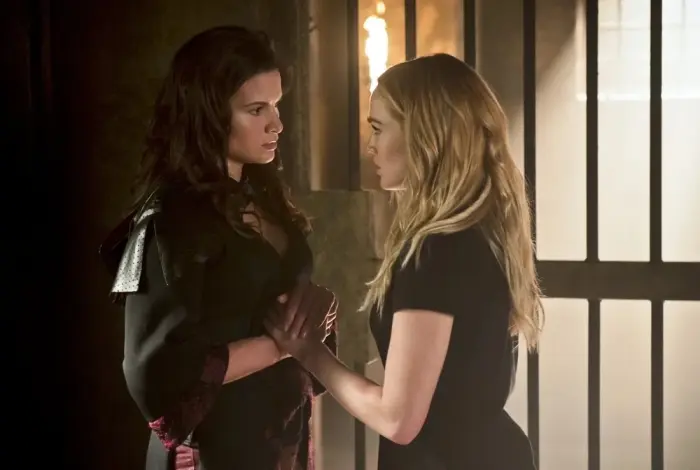
The relationship between Sara Lance and Nyssa al Ghul in Arrow begins in those very depths. Within the extreme isolation of the League of Assassins, where death is the only language, the narrative of these two women—who had to prove their existence by learning to destroy others—attains a sense of “existential sublimity” that transcends mere romance.
🌿 Moments When This Drama Deeply Resonates
- When you find yourself imprisoned by the belief that a scarred past defines who you are.
- When you wish to feel the weight of a love that protects a person’s essence rather than seeking to possess them.
- When you enjoy the narrative tension created by the collision of cold discipline and burning emotion.
- Because it proves the structural necessity of how their relationship, born within the heartless worldview of assassins, became a modern symbol of female solidarity.
🎞 Note Before Viewing
Due to the nature of the hero-action genre, this work includes physical strikes and combat scenes; however, the core of the work is a relationship-centered narrative focused on complex emotional lines and ethical dilemmas between characters.
🎬 Drama Information
- Title: Arrow (2012–2020)
- Director: John Behring, Michael Schultz, et al.
- Screenplay: Greg Berlanti, Marc Guggenheim, Andrew Kreisberg
- Country: 🇺🇸 USA
- Genre: Superhero, Action, Drama
- Running Time: Approx. 42 minutes per episode (8 seasons total)
- Platform: Netflix
- Cast: Caity Lotz (Sara Lance), Katrina Law (Nyssa al Ghul), Stephen Amell, Katie Cassidy
📖 Arrow: Sara and Nyssa, Inevitable Longing and Liberation Born from the Quagmire of Death [No Spoilers]
Sara Lance, shipwrecked after turning her back on her family and the world, is rescued by the League of Assassins—a harsh fortress where survival is permitted only through murder. There, she meets Nyssa, the daughter of the League’s leader Ra’s al Ghul, and earns the name ‘Canary,’ signifying she is no longer a mere expendable tool.
The story begins as Sara returns to her hometown, Starling City, to wash away the guilt of her past. However, the League’s code does not permit traitors, and Nyssa descends to the surface to reclaim Sara. At the point where love and obsession, discipline and freedom collide head-on, the fates of these two women begin to swirl once again.
⚔️ An Emotional Interpretation of ‘The Beloved’ that Melted the League of Assassins’ Cold Code
The space known as the League of Assassins is a place that erases the individual self to produce mechanical humans who only obey orders. Nyssa al Ghul was a figure standing at the pinnacle of that system, but through meeting Sara Lance, she experiences a fracture in the system.
The title Nyssa uses for Sara, ‘Ta-er al-Sahfer,’ or ‘The Beloved,’ is not a term that simply refers to a romantic relationship. It was a unique password to confirm each other’s humanity on the battlefield of slaughter.
Nyssa taught Sara how to use a blade, but Sara taught Nyssa the ‘heart that cares for someone’—both a fatal weakness and a human strength. The core of this relationship interpretation is the subversion of the power structure. The process in which the teacher (Nyssa) becomes emotionally subjugated to the student (Sara) is the most thrilling paradox of this narrative.
🏹 An Analysis of the Ending: Self-Sacrificial Liberation Beyond the Desire for Possession
While many hero narratives attempt to tie up relationships through ‘possession’ or ‘settlement,’ Sara and Nyssa in Arrow reach the pinnacle of their relationship through ‘liberation.’ The scene where Nyssa releases Sara from the League’s shackles is the most important emotional turning point that penetrates the entire drama.
What we must observe through this reinterpretation of the ending is Nyssa’s maturity. Breaking the rigid, patriarchal order (the laws of the League) established by her father and honoring the autonomous will of her loved one by letting her go is, in itself, Nyssa’s own declaration of independence from her father’s shadow.
After the conclusion, Sara evolves into a legendary team leader, and Nyssa becomes the protector of Sara’s family. This signifies an evolution into a higher dimension of emotional unity—a ‘solidarity sharing each other’s values’—rather than merely being physically together as lovers. The separation of Sara and Nyssa is not the termination of a relationship, but the completion of dignity that recognizes each other as independent subjects.
🔎 Questions Regarding Arrow’s Female Narrative and Ending Interpretation
Q1. There is criticism that the process of Nyssa training Sara’s sister, Laurel, lacks plausibility. How should this be interpreted?
From a critical perspective, the setting of helping a lover’s family may feel excessively contrived. However, structurally speaking, Laurel is Sara’s ‘legacy’ and ‘alter ego’ to Nyssa. When Sara faced death (during Season 3), the method of mourning Nyssa chose was not to sink into sorrow, but to pass on the values Sara so desperately wanted to protect to Laurel. This is an aesthetic device showing that Nyssa’s love embraced Sara’s entire worldview beyond personal desire.
Q2. Doesn’t the fact that their relationship ultimately ended in ‘separation’ constitute a limitation as a female narrative?
From a traditional romance perspective, it may be a limitation, but in terms of the scalability of female narratives, it is actually an achievement. Sara later became the captain of Legends of Tomorrow, moving out into a wider world, and Nyssa disbanded the League to forge her own path. A narrative where each helps the other grow and willingly lets go holds great modern significance in that it supports the process of a woman standing tall as an independent hero rather than remaining as someone’s partner.
✨ Arrow: A Grand Interpretation of Two Women Who Crossed the Darkness into a Solidarity of Light
The narrative of Sara and Nyssa is ultimately an answer to the question: ‘Can we maintain our humanity by loving others even in an environment that destroys us?’ The identity born at the tip of the blade did not deny a blood-stained past but transformed into a power to heal others by stepping over those wounds.
This relationship suggests that love should not be a prison that traps a person, but a lamp that helps one rescue oneself from the deepest darkness. True love is completed not by keeping the other person by my side, but by the courage to send them to the place where they can shine as their truest self.
🗨️ The Depth of Trust Proven in Silence
In your most painful moment, was it tender consolation that rescued you, or was it the blade of someone who silently endured your pain and fought alongside you?
If you had to give up your most precious principles for another, are you prepared to willingly become a ‘traitor’ for them?
📽️ Violet Screen Curation: Another Solidarity of Souls
- Motherland: Fort Salem: A fantasy drama depicting the fierce bond and growth of women from contrasting backgrounds in a world where witches become soldiers.
- Warrior Nun: An intense action narrative where an isolated girl gains supernatural powers and fights evil alongside the women of a religious order.
To provide a more stable publishing environment, multilingual content, and better communication with our readers, we have moved our official publication to Substack.
All new film reviews and critical essays will be published on our new platform. This website will be closing down soon, so we would greatly appreciate it if you subscribed to our new space.
TODAY'S QUESTION
Which film feels like your 'first love' story?
Your answer isn't saved. Feel free to share it in the comments below.


You May Also Like

Fulfill Ending Interpretation: Humanistic Insights from Realistic Solidarity and the Birth of a Family
Perry Mason: A Radiant Noir Interpretation Crafted by Della Street’s Ambition and Desire