True Detective: Night Country, Frozen Revenge and the Obsession with Female Solidarity
Silence is sometimes the loudest scream. When we turn away from the suffering of others, that pain does not vanish; it becomes preserved beneath the permafrost, waiting for the day someone finally cracks the ice. True Detective: Night Country is not merely a procedural chasing a killer. It is a harrowing record of how suppressed voices gain physical force in the chill of the great wild to be transmuted into vengeance, and how isolated women find each other’s warmth in the process.
🌿 Moments When This Drama Deeply Permeates
- When you must find your way at the edge of the world, in the pitch-black darkness of Alaska, relying solely on the sound of your own breath.
- On nights when the sense of loss from a loved one turns into a rage that feels as though it is consuming you from within.
- When you crave a ‘comrade’—the only one who might understand you—amidst the feeling of having your roots and identity denied.
- To analyze the deep-seated structure of why the true protagonist behind the superficial mystery of the ‘Annie K’ case, and the conclusion reached by Liz and Navarro, signifies something far greater than mere justice.
🎞️ Notes Before Viewing
While this work includes elements of visual horror, including bodily mutilation, its core lies in the psychological tension and emotional solidarity between characters. It is an authentic mystery drama that focuses on tracing the fractures in relationships left by violence rather than the depiction of violence itself.
🎬 Drama Information
- Title: True Detective: Night Country (2024)
- Director: Issa López
- Teleplay: Issa López, Nambi E. Kelley, et al.
- Country: USA
- Genre: Crime Drama, Mystery, Suspense
- Running Time: Season 4 (6 episodes), approx. 60 minutes per episode
- Platform: HBO / Max
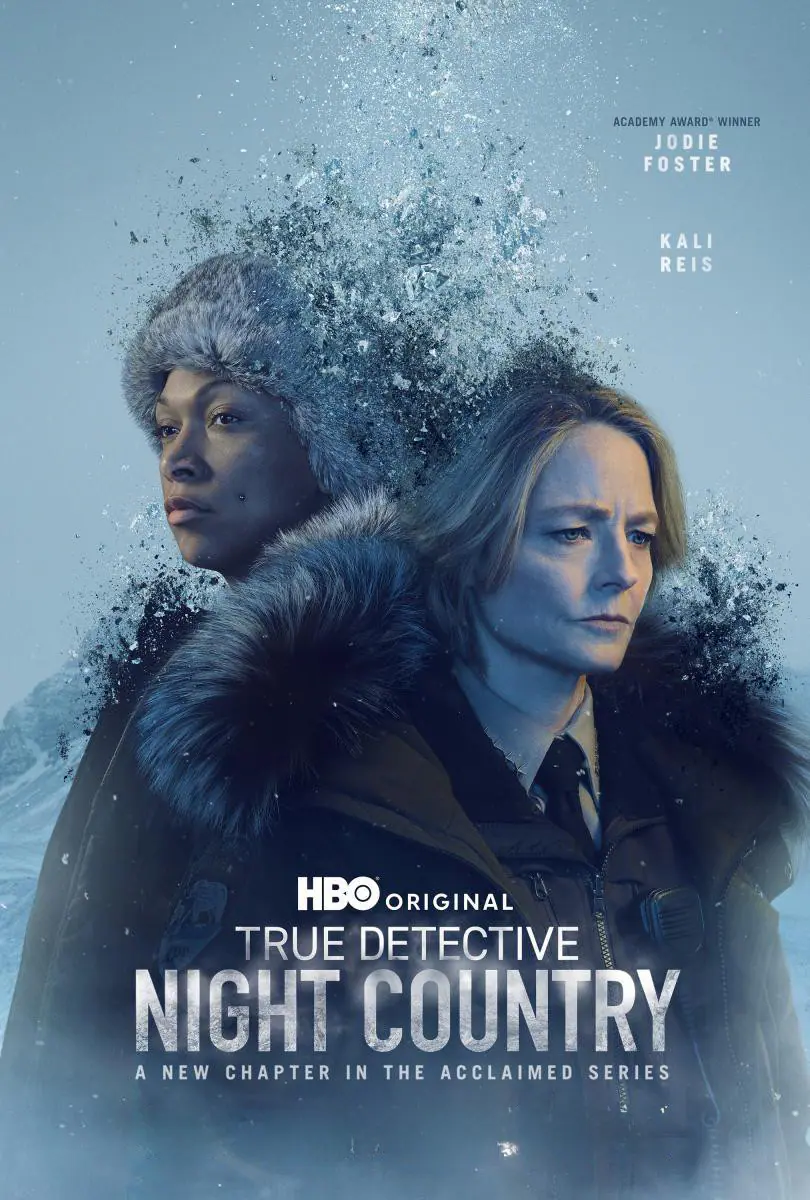
- Cast: Jodie Foster (Liz Danvers), Kali Reis (Evangeline Navarro), Isabella LaBlanc (Leah Danvers)
📖 True Detective: Night Country – An Arctic Scream Breaking Six Years of Silence [No Spoilers]
In the northernmost Alaskan town of Ennis, on the day the ‘Polar Night’ begins—a time when the sun never rises—eight scientists working at the Tsalal Arctic Research Station vanish without a trace. Police Chief Liz Danvers, assigned to the case, intuitively senses through clues found at the scene that this disappearance is linked to the unsolved murder of an indigenous woman, ‘Annie K,’ from six years ago.
Detective Evangeline Navarro, who was previously demoted after clashing with Liz over her obsession with the Annie case, instinctively returns to the field. The two begin an uneasy collaboration, putting aside mutual distrust and long-standing resentment. Amidst endless darkness and lashing blizzards, they confront supernatural phenomena while tracing a trail of ugly truths concealed by the mining corporation’s massive capital and the town at large. This process transcends a simple investigation, becoming a painful journey that shatters the glaciers of trauma harbored by each woman.
❄️ Mise-en-scène of the Polar Night: The Interiority of Characters Projected onto Isolated Space
In this work, the Alaskan darkness operates not as a mere backdrop but as a physical entity that exerts psychological pressure on the characters. The period of the Polar Night, where even the sun turns its back, is a time when the civilizational systems of law and order lose their power, replaced by primal instincts and spiritual intuition.
Director Issa López renders the snow and ice not as a cold white, but as an auditory stillness that devours everything. Liz Danvers’ cold rationality repeatedly slips upon the frozen earth, while the supernatural calling felt by Evangeline Navarro sounds like the most truthful voice within this isolated space. The claustrophobia of the setting leads directly to a density of relationship, functioning as a visual device that forces the audience to focus solely on the rhythm of these two women without external intervention.
🔗 Liz and Navarro: The Inevitability of a Finale Forged by a Chronology of Loss
Liz and Navarro are two sides of the same coin. While Liz attempts to overcome her past sorrow (the death of her family) by ‘forgetting,’ Navarro tries to break through by ‘confronting’ her family’s medical history and her suffering as an indigenous woman. The clash between them is a confrontation between rational investigation and spiritual justice.
However, as the drama progresses, these boundaries collapse. Liz breaks down her own walls by acknowledging the identity of her stepdaughter, Leah, whom she tried to keep under control; Navarro hones the blade of revenge against a concrete perpetrator instead of an intangible fear. The most critical point in this review is the moment they realize Annie K’s death was not an individual crime, but an act of structural violence. The tears they shed as they witness each other’s Achilles’ heels serve as a sacred ritual of mutual recognition between two women isolated within a patriarchal police organization.
🔎 Reinterpreting the Finale: The Stern Verdict of Silent Nature
The conclusion of True Detective: Night Country goes beyond the legal procedure of apprehending a criminal to reach a mythical resolution of community self-purification. The deaths of the scientists were a judgment executed by the collective will of the village women—those who died alongside Annie K on the day her tongue was left severed and abandoned. Liz and Navarro witness this truth, but instead of reporting it to the system, they choose ‘silence,’ thereby completing true justice.
This ending leaves a powerful unification between the two: a permanent sense of being accomplices. Navarro finds her name and walks into the spiritual world, while Liz finally escapes the grief of losing her son and begins to affirm her current life. This suggests that the protagonists have attained not a legal victory, but a salvation of the soul.
This finale is not a failure of legal justice, but a structural shift that deconstructs the concealed narratives of the perpetrators and restores the agency of the victims.
🧊 Interpreting Issues in the Night Country Finale and Female Representation
Q1. Isn’t the ending, where women take collective revenge, excessively unrealistic or biased?
This work follows the structure of a dark fairy tale or myth rather than a realistic procedural. From a critical perspective, one might point out the neutralization of public power; however, this is a metaphor for the ‘last resort’ that indigenous women (MMIW), unprotected by society, were forced to choose to defend themselves. In an aesthetic context, it provides a catharsis where the solidarity of the oppressed explodes.
Q2. Does Navarro’s disappearance at the end signify her death?
The work does not explicitly define Navarro’s whereabouts. Her walking onto the ice can be interpreted not as suicide, but as a transition into a transcendent being who has fully embraced her identity and spiritual roots. Her silhouette appearing beside Liz suggests that Navarro still exists as a guardian in Ennis—a space where the boundaries between life and death have collapsed—leaving a lingering open-endedness for the audience.
✨ When the Screams of the Forgotten Bloom Through the Ice
This drama reminds us once again of the series’ maxim: “You’re asking the wrong question.” The important thing is not “who killed them,” but “why did their deaths have to remain submerged in silence for so long?” Reflecting the recurring hatred, environmental destruction, and alienation of minorities in modern society within the Alaskan cold, this work insists that responding to the suffering of others is the only way we can live humanely.
Solidarity is a survival technique that is only completed when the wounded bear witness to each other’s pain.
🌊 A Question to Awaken Your Inner Self in the Deep Night
Sometimes, even when we know the truth, we choose silence for the sake of the community’s peace. But if that silence is erasing someone’s very existence, do you have the courage to willingly become the ‘uncomfortable witness’ who shatters that peace?
💜 Violet Screen Curation: Other Narratives of ‘Them’
- Swarm (2023): Sensuously portrays the twisted bonds of modern society through an obsession called fandom and the madness of an isolated woman.
- The Power (2023): Explores the complex relationships blooming among women as a sudden, powerful force granted to girls worldwide subverts existing power structures.
To provide a more stable publishing environment, multilingual content, and better communication with our readers, we have moved our official publication to Substack.
All new film reviews and critical essays will be published on our new platform. This website will be closing down soon, so we would greatly appreciate it if you subscribed to our new space.
TODAY'S QUESTION
Which film feels like your 'first love' story?
Your answer isn't saved. Feel free to share it in the comments below.


You May Also Like
Rebelde, Andi and Emilia’s Imperfect Trajectory: An In-Depth Interpretation of Desire and Growth

Trigonometry (2020): A New Geometry of Love Beyond Desire and Isolation