The Fear Street Trilogy: A History of Queer Solidarity and Salvation Breaking the Cycle of Brutal Witch Hunts
We may all be living in a cursed city. The experience of having one’s entire life stigmatized—not due to any personal fault, but solely by virtue of birth, class, or a love that deviates slightly from the norm—is a more universal form of despair than one might think.
While the Fear Street Trilogy wears the outer shell of a blood-splattered, brutal slasher horror, its essence is a fierce and beautiful chronicle of two women directly confronting a history of marginalization and hatred prescribed by society. In a world where the ghosts of the past continuously pull one downward, this series demonstrates, in the most brutal manner, the sheer wonder of discovering someone willing to walk into hell to save you.
🌿 Moments When This Film Deeply Resonates
- When you are alone in an isolated room, turning away from the world, ruminating on past wounds
- On a heavy night when you desperately long for the existence of just one person who sees you exactly as you are
- When you feel a sense of helplessness before a massive social system of hatred and discrimination
- When you wish to witness the perfect synthesis of slasher genre gratification and a deeply moving queer narrative
The reason to read this text to the end is that it allows one to fully comprehend the essence of this structural narrative: how a love between two women spanning 300 years transcends a massive, class-based curse to emerge victorious, moving beyond the boundaries of a simple horror film.
🎞 Notes Prior to Viewing
This work belongs to the slasher genre, featuring a considerably high level of physical mutilation and gore. However, this does not merely serve as superficial stimulation; all brutality functions as a device to maximize the desperate conflicts and emotional bonds enveloping the characters. It is recommended to appreciate the film by focusing on the deep relationality that lies beneath the visual horror.
🎬 Film Information
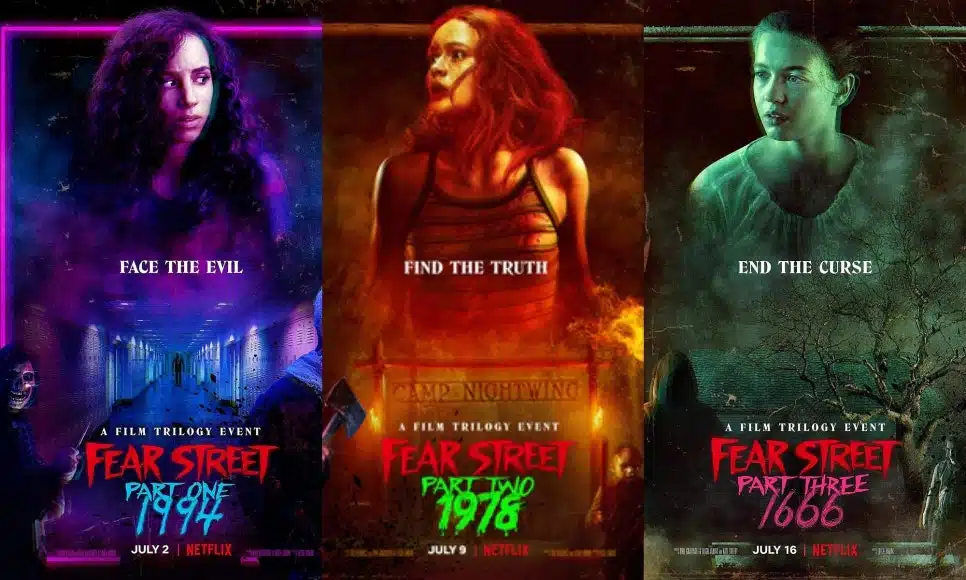
- Title: Fear Street: Part One – 1994, Fear Street: 1978, Fear Street: 1666
- Director: Leigh Janiak
- Screenplay: Leigh Janiak, Phil Graziadei, Kate Trefry
- Original Work: The novel series of the same name by R.L. Stine
- Country: United States
- Genre: Horror, Slasher, Mystery, Queer
- Running Time: Part 1 (107 minutes), Part 2 (110 minutes), Part 3 (114 minutes)
- Platform: Netflix
- Cast: Kiana Madeira, Olivia Scott Welch, Sadie Sink, Emily Rudd
📖 Fear Street: The Tragedy of a Cursed Town and the Beginning of a Blood-Stained Love [Spoiler-Free]
Deena, a high school student in Shadyside—a place branded as America’s worst murder capital—agonizes over her breakup with her ex-girlfriend Sam, who left her after moving to a wealthy neighboring town. One night, amidst an explosion of conflict between the two towns, a mysterious car accident occurs. Sam unknowingly desecrates the grave of Sarah Fier, a witch allegedly executed in 1666, leaving a stain of blood behind.
Subsequently, the town’s most notorious historical serial killers resurrect, tenaciously pursuing Sam alone, forcing Deena and her friends into a desperate struggle to break the curse. In this process, they secure the testimony of Ziggy Berman, the sole survivor of the 1978 Camp Nightwing massacre, linking themselves to the tragedies of the past.
Ultimately realizing that Sam can only be saved by confronting the truth of 1666, where the curse originated, Deena opens a massive secret door that transcends time and space, coming face-to-face with the hideous power structure of the town.
👁️ The Decalcomania of 1666 and 1994: The Mechanism of Hatred Transcending Time and Space
The most outstanding achievement of the Fear Street Trilogy lies in the directorial intent that overlaps the relationship between Deena and Sam in 1994 with that of Sarah Fier and Hannah Miller in 1666, much like a decalcomania. The structural choice to have the same actors portray characters across the past and present intuitively illustrates how social perceptions and persecutions directed at sexual minorities have been modulated and repeated over three centuries.
In the 1666 settlement of Union, the secret love between two women became the perfect scapegoat for the disaster that befell the town—a witch hunt. The ruling class of the system branded minority identity as a “devil’s curse” to conceal their own hideous desires and greed. This structure aligns precisely with the class discrimination inflicted upon the impoverished area of Shadyside in 1994.
The romance between Deena and Sam extends beyond a simple teen romance, expanding into a highly political and revolutionary narrative that fractures the distorted power structure governing the world.
🪵 The Architect and Scapegoats of the System: The Prosperity of the Goode Family and the Deprivation of Shadyside
The mise-en-scène and spatial contrast in this film are deeply classist. The boundary between the affluent, safe Sunnyvale and the crime-ridden, despairing Shadyside is a thoroughly artificial and engineered outcome.
For generations, the Goode family has bartered with the devil, sacrificing the marginalized residents of Shadyside to secure their own prosperity. Here, the killers pursue Sam not simply because she touched the witch’s bones, but because her actions created the possibility of witnessing the truth behind the “falsified history” designed by the Goode family.
Ultimately, Sarah Fier, passed down through history as a witch, was not the instigator of the curse but the first victim sacrificed at the frontlines of patriarchal and class power. Deena’s journey to confront the truth of the past resembles a humanistic inquiry aimed at restoring a woman’s voice that had been erased and distorted by history.
🔎 Reinterpreting the Conclusion — Absolute Liberation Met at the End of a Narrative Written in Blood
The final resolution of the film concludes with Deena executing the true culprit, Nick Goode, thereby dismantling the 300-year-old cartel of the Goode family. By reuniting Sarah Fier’s severed hand with her remains, Deena consoles the soul of the past and ultimately rescues Sam, who had been possessed and driven to attack her in the present.
This ending carries a powerful structural significance that goes beyond the catharsis of poetic justice; it signifies that two oppressed women have finally struck the heart of the patriarchal system to achieve victory. While Sarah Fier in the past marched to the gallows under the false accusation of witchcraft to save Hannah, Deena in the present protects both herself and Sam, entirely severing the chain of historical tragedy.
The sorrowful fracture left by Sarah Fier’s sacrifice attains complete closure and healing through the survival of Deena and Sam.
Once the truth is revealed to the world, the air of Shadyside finally begins to brim with vitality. The protagonists no longer flee, holding each other’s hands beneath the sunlight. This conclusion demonstrates that no matter how deep the history of oppression may run, the future can ultimately be subverted if the will of solidary individuals exists.
❓ The Fear Street Trilogy: Between Genre Gratification and Narrative Leap
Q1. Does the brutality and high level of gore characteristic of the slasher genre disrupt the emotional arc of the female-centric narrative?
Some viewers criticize the horrific deaths of characters depicted in Part 1 and Part 2 (particularly Kate’s grocery store scene) as excessively sensational, leading to polarized responses. This generic excess occurs in the process of faithfully adhering to the traditional grammar of slasher movies.
However, this work diverges from conventional slashers that stop at meaningless slaughter. As Part 3 clarifies that the agent of brutal violence ultimately stems from the “exploitation of the ruling system (the Goode family),” the preceding horror is sublimated into narrative aesthetics. In other words, the level of gore functions as an inevitable device that visually maximizes the harshness of the reality confronting the characters, thereby multiplying the sense of emotional liberation in the latter half.
Q2. How do you view the criticism that the 1666 setting in Part 3 abruptly shifts genres, thereby hindering immersion?
For audiences who enjoyed the 90s contemporary slasher and 70s camp slasher styles, the sudden transition to a 17th-century Puritan society can feel like a polarizing element that disrupts narrative continuity, as the diction and tone grow abruptly heavy.
Yet, this is the very point that breaks the loop of indispensable narrative repetition. The director intended to pinpoint exactly where the roots of this entire curse lie, even if it meant temporarily suspending generic entertainment for the audience.
The 1666 segment performs a pivotal role in redefining the horror elements of the previous two entries not as mere ghost stories, but as a socially contextualized “man-made disaster,” prompting the audience to reflect on modern variations of historical witch hunts.
✨The Fear Street Trilogy : Love as the Most Sophisticated and Sharpest Weapon
This series broadens the horizons of the genre by shifting the object of fear from supernatural entities to human greed and systemic contradictions. The cries of Deena and Sarah Fier resonate across eras, sharply exposing how the identities of the marginalized are consumed as tools of power.
Moving beyond a simple horror homage, this film utilizes queer romance as the core engine of its narrative to subvert the system, serving as a masterpiece that passionately validates the magnificent power of structural solidarity.
Love is stronger than the system’s curse, and survival is the most absolute revenge.
🪵 Where Lies the Distance of Solidarity Sustaining Your Life?
No matter how deep the despair and curse may be, if there is the gaze of just one person who believes in us entirely, we gain the strength to tear down the world.
When faced with a massive wall, do you tend to maintain a safe distance from others, or do you, like Deena, choose solidarity until the very end, even at the risk of ruin? Looking at the 300-year-old traces left by Sarah Fier, I invite you to reflect on the hand of that precious existence fighting alongside you right now. What are your thoughts? Please feel free to share your stories in the comments.
🍇 Violet Screen Recommendations: Cult Female-Centric Narratives with Alternative Nuances
<Lucky, Apartment> (2024)
- Reason for Recommendation: This is a Korean queer independent film that deeply captures the fractures and love blossoming between two women within the highly realistic space of a home secured through maximum financial overextension (“Yeong-kl”). The financial pressure and invisible social prejudice faced by Sun-woo and Hee-seo resemble the poverty and shackles of stigma encountered by the characters of Shadyside in Fear Street. While it lacks grandiose horror, the emotional arc of two people attempting to break through realistic anxieties embedded in daily life with solidarity and warmth delivers a profoundly moving resonance.
Love Letters <Des Preuves d’Amour> (2025)
- Reason for Recommendation: A French queer drama that delicately illuminates the relationship between Celine and Nadia, two women preparing for motherhood, from the perspective of the non-gestational partner. The struggle of characters who must validate their family against a social system comprised of biological limitations and bureaucratic barriers gives the impression of a contemporary transposition of Sarah Fier’s history, which resisted the frames of mainstream society. Departing from the sensationalism of major horror, it captures the rights of relationship and intimate emotional shifts through a calm, humanistic lens, stimulating deep contemplation.
TODAY'S QUESTION
What genre or mood do you always reach for when you're alone?
Your answer isn't saved. Feel free to share it in the comments below.


You May Also Like
Flat Girls Review: Female Narratives Blocked by Class Barriers, the Collapse of First Love, and Interpretation of the Hidden Ending
Moonlit Winter Ending Interpretation and Plot: Reclaiming Desire from Frozen Time