The First Girl I Loved (喜歡妳是妳): A Chronicle of Isolated Attachment Born of an Oppressive Era
If you have ever experienced the sensation of a feeling being defined as a “taboo” before it could even be established as “love,” this film will touch your most vulnerable parts. Amidst the humid air of early 2000s Hong Kong and the closed order of a Catholic girls’ school, two girls learned about the world by using each other as mirrors, becoming adults by wounding one another.
This work is not merely a film that stimulates nostalgia for “first love.” It is closer to a sorrowful report on how one castrates and compromises their purest desires in the face of the realities of social achievement and survival.
🌿 Moments When This Film Especially Permeates the Soul
- For those who remember fleeing because the truth within was more terrifying than the gaze of others.
- For those who have experienced willingly yielding their own dreams for the sake of someone else’s growth.
- For those who understand the agonizing paradox of having to be the “maid of honor” at the wedding of the person they loved most.
- The reason you must read to the end of this piece is that it makes us realize that what we lost was not the other person, but “myself, who loved that person.”
🎞 Note Before Viewing
This work deals with the relationship between two women spanning from their high school years to adulthood, focusing on emotional exchange and psychological conflict arising from social pressure rather than physical contact. It is a relationship-centered drama characterized by lyrical and restrained direction rather than provocative depiction.
🎬 Film Information
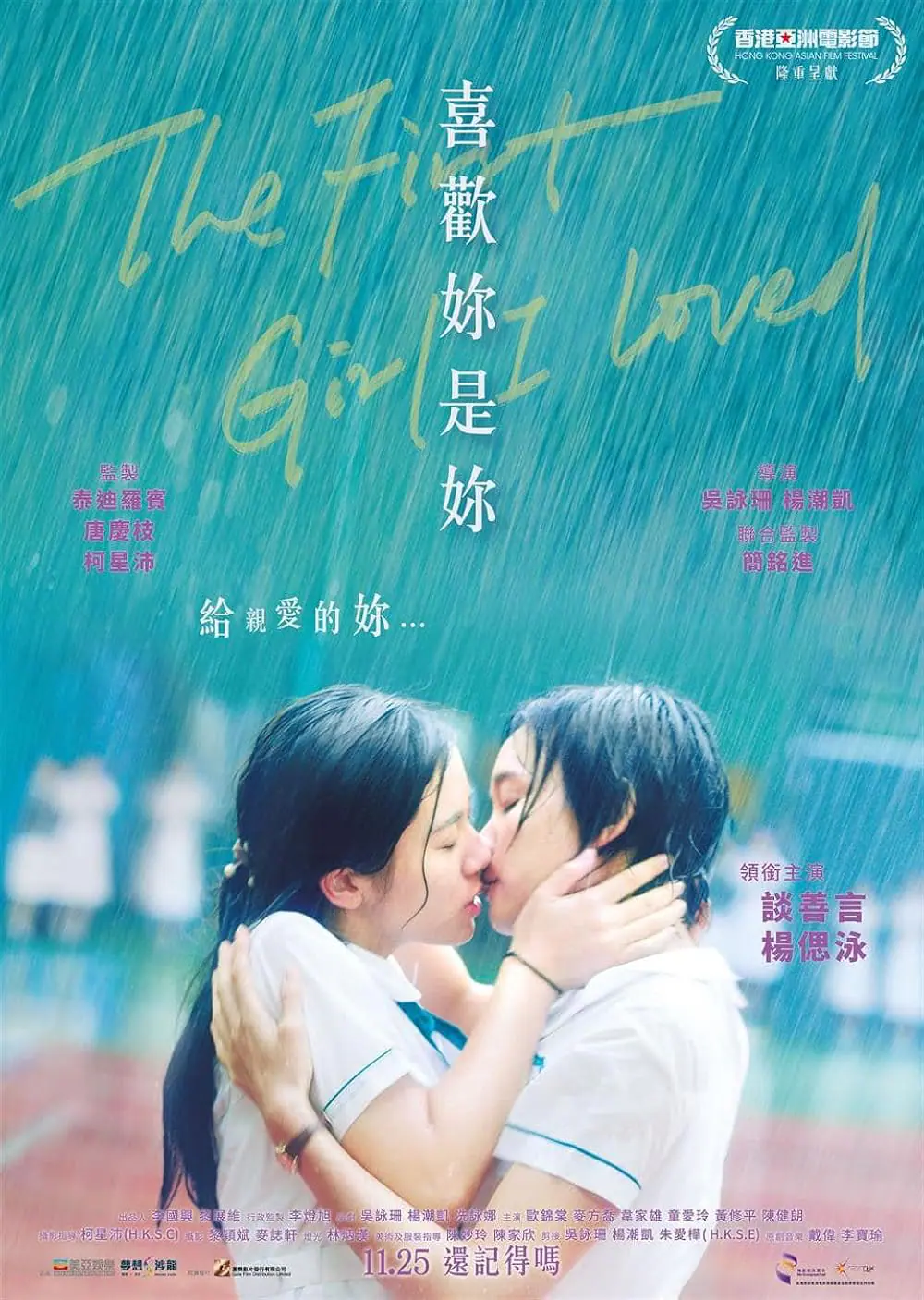
- Title: The First Girl I Loved (喜歡妳是妳, 2021)
- Director: Yeung Chiu-hoi, Candy Ng
- Screenplay: Yeung Chiu-hoi, Candy Ng
- Country: Hong Kong
- Genre: Romance, Drama, LGBTQ+
- Running Time: 94 minutes
- Platform: Naver Series On, various VOD services
- Cast: Hedwig Tam as Wing, Renci Yeung as Sylvia
📖 The First Girl I Loved: The Divergent Ten-Year Trajectory of Wing and Sylvia [No Spoilers]
Hong Kong, 2001. Wing and Sylvia, students at a strict Catholic girls’ school, are inseparable best friends. When a letter Wing wrote to a teacher she had a crush on is delivered through Sylvia’s playful intervention, a strange emotional current begins to flow between the two. Between Sylvia’s sudden confession and the subsequent excuse that it was a prank, Wing confirms her own sincerity, and the two grow rapidly closer through the shared goal of filmmaking.
The first kiss they share while reenacting a scene from the film Days of Being Wild becomes a decisive turning point where friendship transforms into love, but the conservative school system does not leave them in peace. Discovered by a social worker, the two are placed before the harsh tribunal of reality: the principal’s office and their parents.
Sylvia, crushed by economic deprivation and anxiety about the future, eventually pushes Wing away and bids farewell; Wing refuses this, attempting a final kiss of resistance in front of the entire student body. With this incident, Sylvia leaves the school, and the worlds of the two are completely severed. Years pass, and Sylvia reappears before Wing, now a university student—but another person is already by her side.
🔗 A Duet of Deficiency and Desire Manifested within an Oppressive System
The most noteworthy point in this work is how the macro-structures of school and home mutilate individual identity. Hong Kong in the early 2000s was in a wave of change, but the space of a Catholic school still maintained a rigid moral fortress.
When Wing and Sylvia’s love is “discovered,” the attitude taken by the adults is horrifying. Wing’s father stands by in silence, while Sylvia’s father controls his daughter’s emotions using her “scholarship” and “economic survival” as collateral. The self-censorship Sylvia chooses here is not a simple change of heart, but a desperate survival strategy to escape the visceral pain of poverty.
In contrast, Wing replaces Sylvia’s absence with her own identity. Her majoring in sociology at university and subsequently taking over Sylvia’s dream of film directing is a process of internalizing the lost “other” into her own life. This goes beyond simple love, taking the form of a compensatory solidarity that seeks to restore the frustrated dreams of the partner.
🎥 Mise-en-scène and Symbolism: Variations on ‘Days of Being Wild’ and Frozen Time
The film utilizes director Wong Kar-wai’s Days of Being Wild as a vital metaphor. The “one minute” dialogue that Wing and Sylvia recite is a tragic device implying that their relationship cannot be eternal. The contrast between Sylvia’s unstable life—like a “bird without legs” that can never settle anywhere—and Wing’s devotion—wanting to be the only tree that bird could rest upon—is clearly highlighted through the mise-en-scène.
In particular, the school auditorium is “the stage where they were most free” and simultaneously the place where “the most shameful stigma” was branded. The scene where an adult Wing returns to that auditorium to dance alone is a ritualistic act of liberating herself from past wounds. In this scene, the camera emphasizes Wing’s solitude, visually proving that she has finally stepped out from Sylvia’s massive shadow to stand as a complete individual.
🔎 Reinterpretation of the Ending — A Complete Farewell Performed upon the Altar of a Wedding
Many define the ending of this film as a sad failure of unrequited love, but in fact, this conclusion shows the most sublime form of union that the relationship between the two could reach. At the moment Wing stands as the maid of honor at Sylvia’s wedding and mouthed “I do” in response to the priest’s question, Wing finally becomes the subject who “liberates” Sylvia from the desire to “possess” her.
Sylvia answering “I do” to the groom while shedding tears is both a surrender to social normalcy and a final courtesy toward Wing, who loved her so intensely. Wing’s act of transferring to film school and making their story into a movie is a recording of a relationship that cannot exist in reality as an eternal specimen of art.
Sylvia survived by choosing reality, and Wing completed art by choosing memory. After the conclusion, Sylvia will live the life of an ordinary wife, but a corner of her soul will eternally be trapped within Wing’s film. Ultimately, the separation of the two was not the end of the relationship, but an inevitable path to remember each other eternally in their own ways.
❓ Is Wing’s Devotion Love, or an Obsession Born of Guilt? [Interpretation]
The most debated point among audiences watching this film is the segment where Wing changes her career path to fulfill Sylvia’s dream. Some critics criticize this as a self-sacrificial narrative lacking agency.
However, such criticism overlooks the class-based limitations women faced in Hong Kong society at the time. Sylvia had no choice but to give up her dream because she had to support her family as the breadwinner, and Wing volunteered to be the surrogate for that dream within the environment that was at least permitted to her. This should be interpreted not as mere obsession, but as a successional solidarity where the desire of a woman castrated by the system is taken up and brought to bloom by another woman.
The ambiguity inherent in their relationship forces the audience to ask: “If it were me, could I have protected that love until the end in that situation?” Instead of providing a clear answer, the work suggests through Wing’s final dance that each individual’s choice is a weight of life that must be respected in itself.
✨ The First Girl I Loved, a Silent Confession Crossing Eras
Although this film is set in the specific space-time of 2000s Hong Kong, the sentiment flowing within it resonates with us today. We still hide our love, distort our sincerity, and live with our precious people locked in a drawer called “memory” to avoid deviating from the tracks set by society.
The narrative of Wing and Sylvia is not limited to a queer story. It is a record of the “price we had to pay to become adults.” Anyone who has loved someone deeply will know well how the pain experienced in that process grew them, even if that love remained incomplete.
Love is completed not at the moment of achievement, but in the process of clearing away the wreckage left behind after its loss.
🎙️ What are you prepared to discard for your “one minute”?
We sometimes abandon our most precious promises, pushed by the waves of reality. Will you turn away from love for survival like Sylvia, or will you create a new world using that pain as an engine like Wing?
🎞 Violet Screen Recommendations: Other Perspectives to Deepen the Relationship
- SoulMate (2016)
- Reason for recommendation: A masterpiece depicting the process where two women, Qiyue and Ansheng, project themselves onto each other and exchange lives amidst the hardships of time, much like the relationship between Wing and Sylvia. It deeply explores the theme of the “other who lives on my behalf.”
- Blue Is the Warmest Color (2013)
- Reason for recommendation: Deals with the fever of first love and the inevitable cracks caused by class differences. It is a work that forms an excellent contrast with The First Girl I Loved in terms of emotional explosiveness.
To provide a more stable publishing environment, multilingual content, and better communication with our readers, we have moved our official publication to Substack.
All new film reviews and critical essays will be published on our new platform. This website will be closing down soon, so we would greatly appreciate it if you subscribed to our new space.
TODAY'S QUESTION
Which ending has stayed with you the longest?
Your answer isn't saved. Feel free to share it in the comments below.


You May Also Like
Siebzehn (Seventeen) Review: The Precarious Female Narrative and Emotional Fractures of a 17-Year-Old Youth
Zwischen Sommer und Herbst Plot Review — Wavering Between Desire and Growth