Siebzehn (Seventeen) Review: The Precarious Female Narrative and Emotional Fractures of a 17-Year-Old Youth
There is a time in life when a longing, unsure of its destination, dominates the entire body. The summer of a seventeen-year-old, where the gaze of others and internal desires violently collide, is bound to remain unstable and shaken.
Set against the backdrop of a quiet Austrian village, the film Siebzehn (2017) delivers a highly realistic portrayal of the precarious steps taken by youth wandering in search of identity confusion and the essence of love.
🌿 Moments When This Film Sinks Especially Deep
- For those who have wandered after suddenly confronting a vortex of unfamiliar emotions within an intimately familiar daily routine.
- For those who wish to revisit the memories of a first love—clumsy and sharp, yet entirely transparent for that very reason.
- For those who want to follow the meticulous psychological shifts of characters blossoming amidst an oppressed rural landscape.
Why you must read to the end: It transcends a simple coming-of-age film, persistently unearthing the power structures and emotional fractures hidden within the characters’ relational web through the unique analytical lens of Violet Screen.
🎞 Notes Before Viewing
In the process of addressing the sexual orientation and emotional wandering of adolescents, this work includes somewhat bold, realistic depictions of relationships and situations of emotional crisis (such as suicide attempts). However, these are not employed as mere devices for provocation; rather, they function as essential narrative context to illustrate the internal deficits and the absence of communication experienced by the characters.
🎬 Film Information
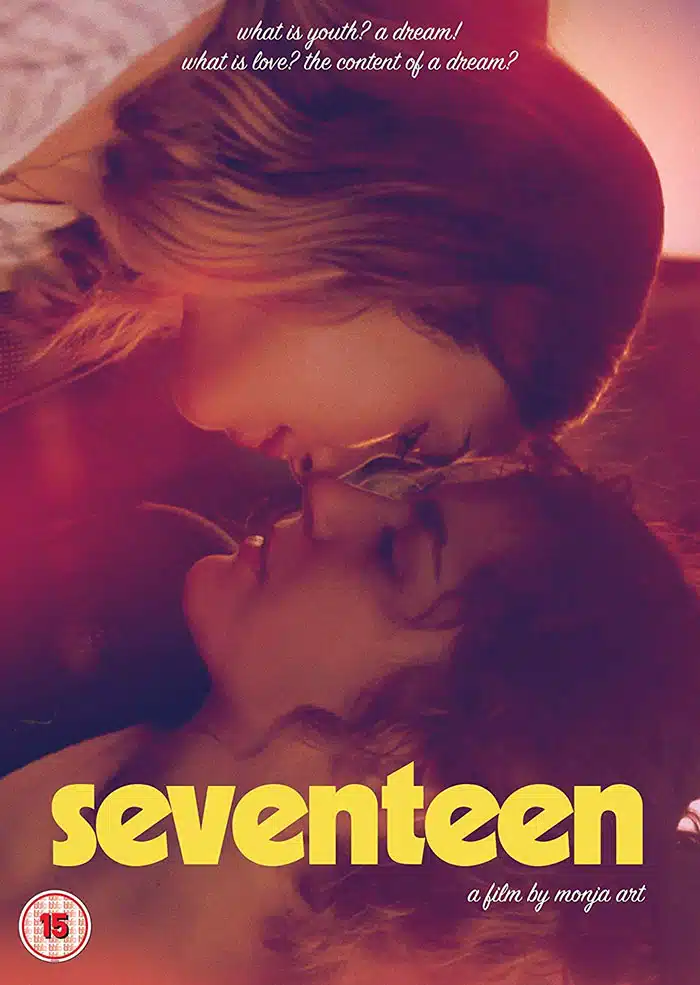
- Title: Siebzehn (Seventeen, 2017)
- Director: Monja Art
- Screenplay: Monja Art
- Country: Austria
- Genre: Drama, Romance
- Running Time: 104 minutes
- Platform: VOD services, etc.
- Cast: Elisabeth Wabitsch (Paula), Anaelle Dézsy (Charlotte), Alexandra Schmid (Lilli)
📖 Siebzehn: A Season of Age 17, Intertwined with the Longing of First Love and Provocative Fascination [Spoiler-Free]
Set against the backdrop of a peaceful, static rural village in Austria, Paula, a 17-year-old girl boasting excellent academic performance, harbors a secret she cannot share with anyone. Her gaze is perpetually fixed on her classmate Charlotte, but unable to approach Charlotte—who already has a boyfriend—she nurtures her love solely within the confines of her internal imagination.
To conceal her identity, Paula begins a clumsy relationship with her classmate Tim, who harbors feelings for her. However, this relationship, entirely devoid of sincerity, ultimately leaves deep scars on Tim and spirals toward a rupture. Meanwhile, Charlotte also awakens to a subtle attraction toward Paula, ending her existing relationship in an attempt to seek change.
Yet, seizing that fleeting interstice, Lilli—a provocative and free-spirited youth—intrudes upon Paula’s life. As Paula sways under Lilli’s dangerous temptation and makes an irreversible choice, the emotional conflicts among the characters begin to race toward an uncontrollable catastrophe.
🌊 In-Depth Analysis of Siebzehn: The Triangular Power Structure of Three Girls Blossoming in a Space of Lack
🌾 The Spatial Isolation of a Rural Village and the Amplification of Emotion Bred by Youthful Lethargy
The small rural village in Lower Austria that serves as the film’s backdrop operates not merely as scenery, but as a closed space that oppresses the inner worlds of the characters. The regularly echoing sounds of the brass band and the monotonous drone of agricultural machinery stand in stark, dramatic contrast to the desires swirling inside the teenagers.
For these adolescents, who cannot escape to the city and must board the exact same bus every day, others become the sole escape route as well as an object of cruel voyeurism. This spatial isolation renders the confusion surrounding Paula’s sexual orientation even more solitary, acting as a catalyst that maximizes her first love for Charlotte, an affection bordering on obsession.
🎭 The Psychological Triangle of Desire and Defense Mechanisms Formed by Paula, Charlotte, and Lilli
The excellence of this film lies in the distinct modes of subjectivity and lack displayed by the three female characters. Paula is a figure who flees into fantasy or utilizes Tim as a defense mechanism to conceal her own emotions.
Conversely, Charlotte demonstrates an ambivalent psychology; while she desires protection within a stable, institutionalized relationship (her boyfriend), she simultaneously finds herself fascinated by the uncharted territory that is Paula. Lilli, entering this dynamic, is a provocative seducer seeking to heal her own internal deficits by monopolizing the attention of others.
The relationship among the three does not culminate in a simple love triangle, but unfolds as an incessant psychological power struggle over who dominates whose desire. The impulsive sexual encounter with Lilli represents an ego-deviation for Paula, but once discovered by Charlotte, it instills a profound sense of repulsion and betrayal, sounding a sharp note of rupture in their relationship.
🔎 Reinterpretation of the Ending: The Scream by the Lake, an Autonomous Growth Confronted After Cruel Fractures
The emotional explosion in the latter half of the film at the lake, where Paula nearly drowns Lilli, is an act of shattering the passive self that had been swayed by the desires of others. Failing to achieve complete communion with Charlotte, yet falling short of an absolute catastrophe, this ending leaves an eternal fracture in their relationship while simultaneously establishing a foothold for growth.
What the protagonist gains after passing through the tunnel of youth is the courage to look her true emotions squarely in the eye; what she loses is the spotlessness of an immature era. The ending of this film is not a perfect union with another, but a cruel declaration of independence during adolescence, wherein one learns how to stand alone. The process of discovering oneself through the mirror of another boundlessly entails wounds.
❓ On the Narrative of Siebzehn and the Modes of Female Representation
Q. What is the directorial intent behind the near-total absence of adult presence in the film?
Adults, such as teachers and parents, are treated thoroughly as background elements or appear in states of alienation. This is an aesthetic choice by director Monja Art, who sought to populate the world of these teenagers entirely with their own dialogue and gazes, free from external intervention. By excluding the moral yardsticks of the older generation, the film effectively highlights the pain adolescents experience as they navigate and collide with their own identities with greater realism.
Q. Isn’t the way Lilli seduces Paula and manipulates her emotions a replication of the stereotypical ‘femme fatale / wicked woman’ frame?
Some viewers critique Lilli’s provocative behavior as a functional antagonist utilized merely to generate narrative conflict. However, beneath Lilli’s exaggerated actions lies a profound childhood deficit—an inability to feel a sense of existential value unless she is the center of attention. Rather than consuming her as a flatly wicked woman, the film portrays her as another subject wandering out of a desire to be loved, much like Paula, thereby achieving complexity in its female characterization. The judgment is ultimately left to the audience observing their loneliness.
✨ Siebzehn: The Beautiful Solidarity Found in the Scars of a Clumsy Season
This film is not a sweet romance celebrating solely the beauty of youth. Rather, it is a cruel yet beautiful record that excavates the essence of relationships among women who struggle not to lose themselves, even as they inflict and sustain wounds amidst the confusion of identity. The emotion of love is at times selfish and destructive, but in the process of piecing together those fragments, these girls finally become adults.
Only when confronted with a desire that destroys the self does a human being finally earn the qualification to love another completely.
💭 Silence versus Explosion: Which Side Was Your Age 17 Closer To?
We sometimes choose silence to avoid being hurt, or conversely, we destroy our surroundings when unable to control our emotions. Just as Paula finally faced herself through an emotional explosion by the lake, did you also have a moment of fierce wandering to break through a suppressed self? Please share your own summer story of finally discovering the true self within, through the cycle of hurting and being hurt by others.
🔮 Violet Screen Recommendations: Further Narratives Between Women Imprinted on the Screen
- 《Love Lies Bleeding》(2024)
- Reason for Recommendation: Set against the bleak fringes of the 1980s American Dream, this is a well-made queer noir thriller depicting a destructive and obsessive love between a gym manager and a female bodybuilder.
- 《Blue Jean》(2023)
- Reason for Recommendation: Set in 1988 Britain during the passage of Section 28, this period drama closely follows the interiority of Jean, a physical education teacher living while concealing her identity. It captures the psychology of a woman walking a tightrope between social oppression and individual dignity through a deeply static and delicate lens, proving the value of solidarity that finally blossoms in an isolated environment with a calm, lingering resonance.
To provide a more stable publishing environment, multilingual content, and better communication with our readers, we have moved our official publication to Substack.
All new film reviews and critical essays will be published on our new platform. This website will be closing down soon, so we would greatly appreciate it if you subscribed to our new space.
TODAY'S QUESTION
Is there a film whose ending you wish had gone differently?
Your answer isn't saved. Feel free to share it in the comments below.


You May Also Like
An In-Depth Interpretation of Loving Annabelle: Female Narrative Love Blooming Under Oppression and Its Eternal Resonance

When We Met (2025) Review | A Poignant GL Interpretation Born at the Intersections of Shared Loss and Reality