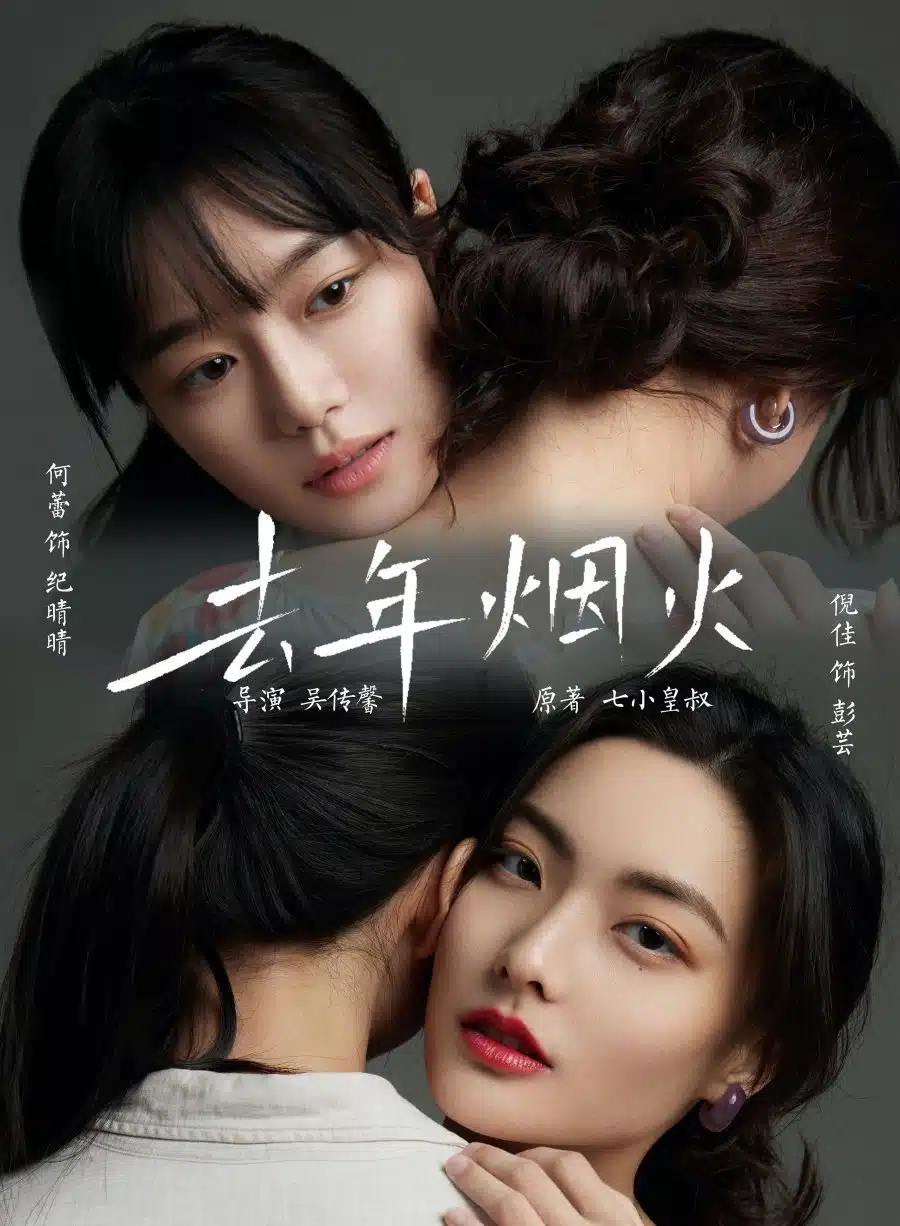
When We Met (2025) Review | A Poignant GL Interpretation Born at the Intersections of Shared Loss and Reality
We often validate our own existence through the warmth of others. The paradox that the sole remedy for the wounds inflicted by one person is, ultimately, the tender gaze of another is what continuously compels us to walk into relationships throughout our lives.
The Chinese short GL film 《去年烟火》 (When We Met) is a work that captures, with a calm yet piercing gaze, the process through which two women sharing the deepest of losses gradually permeate each other’s worlds.
🌿 Moments Where This Film Permeates Especially Deeply
- The quiet tremor when individuals carrying similar deficiencies—past betrayal and abandonment—recognize one another in a harsh world.
- The fleeting instant where an emotion initiated under the guise of curiosity evolves into an uncontrollable realization of love.
- The poignant divergence between the one who hesitates before the colossal wall of reality, citing age and trauma, and the one who extends her hand regardless.
The reason to read until the end is that, moving beyond the seemingly ordinary grammar of melodrama, this review provides a deep psychological analysis of the wounds left on women by a patriarchal society and the unique solidarity of a female narrative that heals them.
🎞 Notes Before Viewing
This piece is a psychologically-driven work revolving around subtle shifts in emotion and relationships. While emotional communion and physical intimacy between the characters are expressed through delicate visual aesthetics, the focus remains on the internal narrative and connection of the two protagonists rather than provocative or sensational depictions.
🎬 Film Information
- Title: 去年烟火 (When We Met, 2025)
- Director: Xen (Wu Chuanxin)
- Screenplay: Xen
- Original Work: The spin-off of the novel 《都什么年代了啊》 (What Era Is It Anyway)
- Country: China
- Genre: Drama, Romance (GL)
- Running Time: Approx. 34 minutes
- Platform: Micro-film online release platforms
- Cast: 何蕾 (He Lei as Ji Qingqing), 倪佳 (Ni Jia as Peng Yun)
📖 《去年烟火》, From a Step Taken in Curiosity to True Love [No Spoilers]
Preparing to leave for a metropolis upon her impending university graduation, 22-year-old Ji Qingqing learns of the existence of Peng Yun—the woman whose past affair dismantled her own family—before departing her hometown. Captivated not by a desire for revenge, but by a strange curiosity and investigative urge, Qingqing conceals her identity and begins selling meat skewers in front of the small grocery store run by Peng Yun, deliberately approaching her structured daily routine.
Following her divorce, 32-year-old Peng Yun has lived a thoroughly solitary, cloistered life in the small town, locking away her heart. However, she finds herself gradually unsettled by the refreshing, direct energy of Qingqing, who appears before her eyes every day, and slowly unlocks the latch to her emotions. In the heat of summer, the two individuals sharing a common denominator of loss grow rapidly intimate. Realizing that this exceeds mere curiosity and has become a profound love, Qingqing confesses her feelings and suggests leaving for the city together.
Yet, the oppressive gaze of the small town and the weight of their realistic age difference cause Peng Yun to hesitate. Just as their relationship deepens physically, an unexpected, decisive phone call rings out, and the secretive balance they have painstakingly constructed begins to shatter in an instant.
🎐 The Mise-en-scène of Space and the Relational Structure Formed by the Solidarity of Deficiency
In When We Met, the spaces where the characters reside function as core mise-en-scène that directly reflects the internal states of the two women, transcending mere backgrounds. The small grocery store managed by Peng Yun is a sanctuary of safe isolation she built for herself to quarantine from her ex-husband’s past betrayal and social mockery. Conversely, the wobbling tricycle driven by Ji Qingqing visualizes the fluidity and potential of youth—unstable, yet capable of moving forward anywhere.
Ji Qingqing’s act of crossing the boundaries of the enclosed space defined by Peng Yun is not merely a physical approach. It represents a process of psychological transference wherein two women, deeply scarred by patriarchal violence and ill-fated ties, confront each other’s deficiencies and seek mutual salvation. Although Qingqing initially approached with the objective of confirming the wounds of her father’s infidelity, what she discovered there was not an object of revenge, but a devastating solitude mirroring her own.
🎇 Affirmation of Existence and Denial as a Defense Mechanism
The most beautiful psychological turning point in this film occurs when Peng Yun senses Qingqing’s homosexual orientation through her search history. Instead of stigmatizing or averting her eyes from this, Peng Yun soothes her by saying, “This feeling is normal, and it is not a sickness,” affirming it as a valid mode of existence. While this inclusivity demonstrates the depth of Peng Yun’s interiority, ironically, when their relationship transitions into physical communion, Peng Yun reactivates a powerful defense mechanism.
The oppression inherent in the space of a small town and the dread of gossip compel Peng Yun to deny her own homosexuality and push Qingqing away. This narrative, where the curve of emotional liberation initiated by shared wounds is blocked by the wall of reality, chillingly illustrates the lonely struggle that women’s solidarity and love must inevitably confront within an enclosed social structure.
🔎 Reinterpretation of the Ending — Dignity Passing Through Loss and Eternal Connection
The ending of When We Met projects a point one year after Qingqing leaves for the city alone, presenting an aesthetic achievement that goes beyond a simple farewell. Before the wall of reality, the two appear to suppress their emotions outwardly by claiming they are “just friends,” seemingly choosing separate lives. However, the moment Peng Yun still eats barbecue in the manner Qingqing taught her, and gazes at the very doorframe Qingqing first lifted the curtain to enter, the audience realizes that this conclusion is not a ruin of the relationship, but an extension of their emotional communion.
The message and waves of longing sent by Peng Yun to Ji Qingqing in the city prove that, though physically distanced, they have left a profound imprint on each other’s interiors. Ji Qingqing gained autonomous love and growth through the process of investigating the root of her wounds, while Peng Yun escaped her isolated fortress and reclaimed the dignity of having her existence affirmed exactly as it is.
By borrowing the format of a realistic parting, the film’s ending paradoxically places a structural period that declares their souls have been eternally bound to one another.
💬 Deep FAQ on the Ending and Narrative Structure of When We Met
Q. Compared to the provocative subject matter of the parental generation’s past affair, some reviews express regret that the narrative flows somewhat quietly after the midpoint. How do you interpret this?
When We Met makes a directorial choice to thoroughly exclude the grammar of sensational soap operas or revenge dramas. Utilizing the initial setup not as a driving force for vengeance, but solely as a fatal catalyst and a link of deficiency that forced the two women to meet, is the aesthetic achievement of this work. The quiet flow of the narrative serves to build an emotional density akin to the summer air and the minute shifts in the characters’ expressions rather than dramatic incidents. Through this, the audience becomes completely immersed in the internal collapse and restoration of the characters rather than external events.
Q. How should we interpret Peng Yun’s choice to remain in the small town from a modern perspective, even while acknowledging her feelings for Qingqing?
Modern society has frequently regarded passionate love that throws everything away as the only correct answer. However, as highlighted in this review, Peng Yun’s choice represents the defensive attitude of a modern individual prioritizing ‘self-survival and well-being’ over ‘love.’ The film respects that a woman whose life’s foundation was shattered by past betrayal possesses the right to choose safe solitude over a love fraught with risk. Critically viewed, it may amount to mere complacency within reality, but structurally, it leaves room to be interpreted as another autonomous decision by a woman seeking control over her own life.
✨ When We Met — The Splendid Liberation of Solitude Reached by Those Who Shared Wounds
Through the deep solidarity of two women who insisted on recognizing and embracing each other’s grief despite the absurd, ill-fated ties of the past, When We Met offers modern implications on how to face life after loss. Even before the walls of restrictive moral codes and oppressive reality, the emotional salvation they left behind becomes an invisible force sustaining their entire lives, transcending physical separation.
The act of looking into and confronting another’s deep solitude is, ultimately, the most dignified journey toward seeking liberation within oneself.
📬 On the Stigma That Remains Undenied Even in Silence
A love that fiercely resists and breaks reality apart, and a silent love that acknowledges the weight of reality yet keeps the other eternally in the depths of the heart.
Which of these leaves a longer resonance in your life and makes you believe in eternity?
🍇 Violet Screen’s Curation for Greater Depth
- Movie:What a Feeling (2024)
- Reason for Recommendation: Directed by Austrian filmmaker Kat Rohrer, this work depicts the trajectory of Marie-Theres, a middle-aged woman living a stable but tedious life, as her world is completely upended after meeting Fa, an independent and confident Iranian woman. If When We Met deals with defense mechanisms born of wounds and subsequent parting, this piece explores identity confusion arriving late in life with both wit and depth. It stands as a warm queer melodrama proving that one can write a new narrative of liberation and love at any later stage of life.
- Movie:Drip Like Coffee (2024)
- Reason for Recommendation: An independent film by director Anaïs Cisco set against the backdrop of Brooklyn, New York, it captures through delicate mise-en-scène the intense emotional awakening experienced by Kali, a barista repeating the same daily routine, after she encounters Mel, a vibrant photographer. Standing out with its sensory visuals and sound design that depart from mainstream grammar, the film beautifully captures the psychological intimacy and growth between women who confront and expand internal desires they themselves were unaware of through an encounter with an unfamiliar presence.
To provide a more stable publishing environment, multilingual content, and better communication with our readers, we have moved our official publication to Substack.
All new film reviews and critical essays will be published on our new platform. This website will be closing down soon, so we would greatly appreciate it if you subscribed to our new space.
TODAY'S QUESTION
What genre or mood do you always reach for when you're alone?
Your answer isn't saved. Feel free to share it in the comments below.


You May Also Like

Love, Classified: How a Wounded Heart Reclassifies Love

Bad Girl (2016): A Thriller of Isolation Wrought by Twisted Deprivation and Mimicked Desire