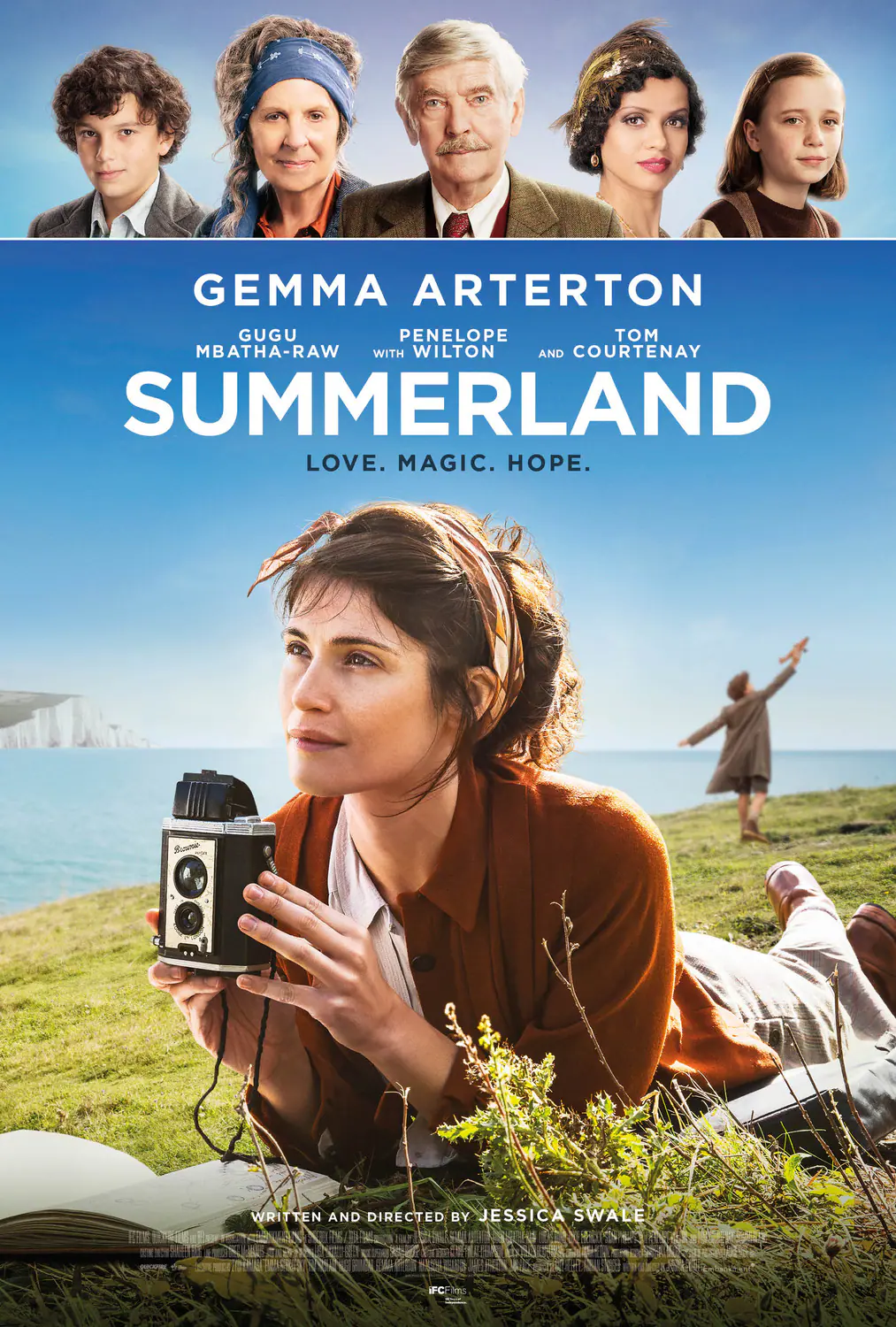
Summerland, The Absolute Zero of Tender Solidarity Found in the Sea of Loss
Human beings often escape to their own solitary islands, carrying their respective losses. There are those who isolate themselves to avoid being hurt by others, locking the doors to their hearts and living with cold rationality as their shield.
is a record of both the fracture and the healing that occur when an unrefined, pure existence intervenes in the cold daily life of a woman who has chosen isolation in a desolate cottage on the British coast after losing her soulmate.
This film poses questions in the most tender voice about how hospitality and solidarity toward others can salvage a withered life once again, and in what form the love we believed we had lost remains by our side.
🌿 Moments When This Film Deeply Permeates
- When you are fiercely contemplating the possibilities of alternative relationships, breaking away from the framework of the normal family defined by society
- On a lonely night when you are immobilized by past loss and cannot find the courage to face a precious connection in the present
- When you want someone to discover the vulnerable, fragile heart hidden behind cold intellect and cynicism
- When you want to trace the affectionate and deep trajectory of love between two women who ultimately never let go of each other despite the oppression of the era
- Why you must read to the end: Because it moves beyond a simple period romance to clearly interpret the structural essence of women’s solidarity across generations and the narrative of salvation that blossomed amidst the tragedy of a great war.
🎞 Note Before Watching the Film
Despite the tragic historical backdrop of World War II, this work focuses on the subtle psychological shifts of the characters and the density of their relationships rather than provocative depictions of wartime situations. Void of violent or overt sensationalism, it is a deeply emotionally centered drama that builds its narrative solely through the exchange of glances and emotions between characters, alongside memories of the past.
🎬 Film Information
- Title: Summerland (2020)
- Director: Jessica Swale
- Screenplay: Jessica Swale
- Country: United Kingdom
- Genre: Drama, Romance
- Running Time: 99 minutes
- Platform: Naver Series On, Wave
- Cast: Gemma Arterton, Gugu Mbatha-Raw, Lucas Bond, Penelope Wilton
📖 The Unfamiliar Companion of an Isolated Witch and an Evacuated Boy [No Spoilers]
In 1940, at the height of World War II, Alice Lamb, a writer immersed in the study of myth and folklore, lives alone in a secluded cottage on the Kent coast. Into her daily life—as she is known to the villagers as a blunt and eccentric ‘witch’—arrives Frank, a young boy evacuated from the London Blitz, completely unannounced.
With absolutely no intention of caring for a child, Alice reluctantly begins their companionship on the condition that she will endure one week before sending him elsewhere. However, Frank’s harmless innocence and curiosity begin to subtly shake the latches of the door Alice had firmly shut.
Just as the distance between the two narrows as they share conversations about ‘Fata Morgana’, a mirage phenomenon, and ‘Summerland’, an ideal afterlife, Alice confronts the ghost of her own harrowing past hidden behind Frank’s existence, sweeping her into an unexpected emotional storm.
🎞 Psychological Structures of Characters Passing Through Loss and the Variations in Relationships
On the surface, adopts the plot of a growth drama between a gruff adult and an innocent child, but beneath it lies a deep bond and mourning shared by two women bound by past loss. The reason the protagonist built walls against the world is not simply due to a cranky personality, but a defense mechanism stemming from her separation from Vera, the lover she once adored most passionately.
Through cross-cutting, the film juxtaposes the protagonist’s present with memories of the past, revealing the true nature of the psychological prison in which she is trapped. The boy who infiltrates this arid space is not merely an object of care; he functions as an emotional bridge mediating between the past lover and the present protagonist. Sharing the deficiency of having lost a father or a lover respectively, the characters create a space of healing through metaphorical means instead of digging into each other’s wounds.
🌅 The Mise-en-Scène of Space and the Healing Language of Mythological Symbols
In the film, the Kent coastline goes beyond a simple geographical backdrop to operate as a massive mise-en-scène representing the psychological state of the character. The rugged, desolate cliffs and the endlessly stretching sea visualize the protagonist’s loneliness, severed from the outside world, while simultaneously evoking the womb of Mother Nature capable of embracing anything.
In particular, the work’s core symbols, Fata Morgana and Summerland, sit on the boundary between scientific phenomenon and mythological belief. The mirage, appearing like a virtual castle floating on the sea, serves as a metaphor for the reality of a ‘love’ that cannot be seen but is firmly believed to exist.
The pagan concept of the afterlife that the protagonist obsessively researches is a sad yet beautiful protective wall constructed by humans who have lost their cherished ones in the cruel reality of war. Ultimately, it embodies the directorial intent that the very act of believing in an unseen, eternal connection delivers humanity.
🔎 Reinterpretation of the Ending: Achieving Perfect Oneness on the Unlatched Beach
The film’s ending does not stop at a one-dimensional happy ending showing the simple conclusion of the war or the reunion of those who were scattered. The moment it is revealed that Vera, who dramatically survived the danger of bombings, actually sent her son to Alice—the only savior she could trust—in preparation for the possibility of her own death, the narrative unleashes a powerful emotional tidal wave.
This proves that the clash of values regarding ‘motherhood’ and ‘family’, which was the cause of their past separation, has sublimated over time into absolute trust and responsibility toward each other. The conclusion, where the two women in their old age finally grow old peacefully in the same space and the grown boy comes to visit them, deconstructs the traditional patriarchal, blood-tied family and demonstrates the completion of an ‘alternative women’s community’ bound solely by love and trust.
If the past separation was an eternal fracture left between them, this reunion is the achievement of perfect oneness, filling the gap of that fracture with each other’s presence. The protagonist has lost the solitude of her youth, but in return, she has gained dignity and true inner growth obtained by welcoming another.
Opening the door of one’s heart toward another is not proof of weakness, but the most courageous declaration that expands one’s world.
💬 Deep FAQ on Women’s Narratives and Alternative Families
Q. When the film deals with conflicts between same-sex lovers, are there any limitations in making ‘children’ the core conflict rather than societal pressures?
Considering the grim historical background of the 1940s, bringing the internal difference in values between the two people (the desire to become a mother versus the psychology of refusing it) to the forefront of the conflict, instead of the social persecution or external violence commonly found in queer narratives, can polarize opinions.
Some might criticize it for overly romanticizing historical reality, but structurally, this choice prevents the relationship between the two women from being confined simply to a ‘victim narrative.’ By taking a path where they part by their own subjective desires and choices, and unite again through subjective trust, rather than being passive figures torn apart by external oppression, the work grants full narrative agency to the female characters.
Do you, the readers, view this adjustment as a limitation reflecting the era, or as a character-centered aesthetic choice?
✨ The Horizon of Solidarity Reached Beyond the Waves of Loss
This work is a warm answer to how scarred souls heal each other and invent new modes of living amidst an era of massive wartime violence.
The relationship between Alice, Vera, and Frank depicted in the film lightly leaps over the conventional concept of family guaranteed by bloodlines or institutions. It is the most sublime form of mutual salvation that human beings can bestow upon one another, one that cannot be fully encapsulated by words like romantic love, motherhood, friendship, or solidarity.
Retaining a heart that ultimately refuses to give up on welcoming others, even amidst a convoluted history and personal loss, is the real reality we must live through. What breaks down the most stubborn isolation is not a massive miracle, but the tender warmth of offering a place by one’s side.
🌊 A Contemplative Perspective Leaving a Deep Aftertaste
To believe in an unseen existence is a quiet pledge that you will not deny the warmth left inside you, even after that existence has vanished.
What is the wall you have built around your heart to protect yourself from past wounds? Do you have the courage to fling the door open toward others once again, even at the risk of being hurt, or would you prefer to guard your own island within a safe isolation?
🎬 Violet Screen’s Cinema Curation
- Portrait of a Lady on Fire (2019)
- Reason for Recommendation: While tenderly embraces solidarity after loss and the possibilities of an alternative family, this work precisely dissects the artistic communion and memories of love between two women that burned briefly but intensely within an oppressive era. It is recommended for those who desire a deep, profound analysis tracking the trajectories of glances and memories.
- Ammonite (2020)
- Reason for Recommendation: Set against the rugged British coast, it depicts the process of a female paleontologist living an isolated life who meets another wounded woman and dismantles her internal walls. The surge of emotion blooming within the calm yet chilly mise-en-scène of the sea strangely resembles the desolate yet beautiful sentiment of , making it excellent for comparative viewing.
To provide a more stable publishing environment, multilingual content, and better communication with our readers, we have moved our official publication to Substack.
All new film reviews and critical essays will be published on our new platform. This website will be closing down soon, so we would greatly appreciate it if you subscribed to our new space.
TODAY'S QUESTION
Which film feels like your 'first love' story?
Your answer isn't saved. Feel free to share it in the comments below.


You May Also Like
When Time Got Louder: Choosing Yourself Between Love and Care
North Star Analysis: Sisterly Solidarity Rising Above Loss and the Hesitation Named Commitment