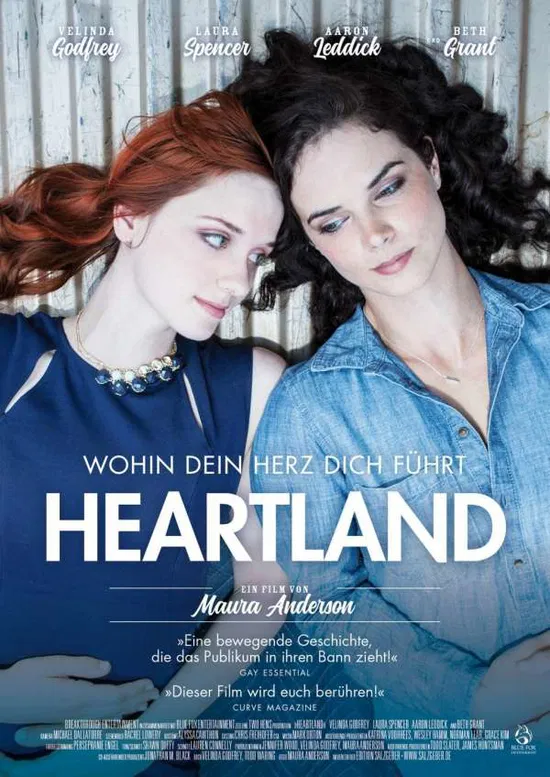
Heartland: The Aesthetics of Forbidden Liberation Blooming Over the Callus of Loss
The most immense and multi-dimensional grief in life often arrives in the flattest, quietest spaces. The sense of loss that follows the passing of a cherished soul does not merely signify someone’s absence. It means total isolation—the complete collapse of the entire world that once existed alongside that person. The film Heartland begins within this state of profound emotional bankruptcy.
In the vacant space where a love that fully validated your identity once stood, the suffocating atmosphere of a conservative hometown—where your grief is left entirely misunderstood—tightens around your throat. When a soul that has long suppressed itself to conform to the gaze of others and social norms encounters a different kind of thirst at the peak of loss, relationships begin to fluctuate in unexpected directions. Moving beyond simple ethical frameworks, this film is an immersive human drama that relentlessly tracks how individuals reconstruct their sense of vitality through the touch of each other’s skin in the very midst of loss and mourning.
🌿 Moments When This Film (Drama) Deeply Permeates
- It extends profound consolation to those experiencing emotional isolation due to a complete lack of validation for their grief and identity, even from their closest family.
- It stirs the hearts of those who wish to confront the authentic desires and freedom their inner selves yearn for, even if it means deviating from the safe trajectory prescribed by others.
- It captures the attention of cinephiles who wish to closely observe loss, mourning, and the intimate psychological shifts of characters along the textures of emotion, transcending conventional moral judgments.
- You must read this article to the end to encounter a resilient narrative of a woman’s growth, who ultimately saves herself despite the catastrophic collapse of her relationships.
🎞 Notes Before Watching the Film
This work meticulously portrays the deep depressive state stemming from loss, alongside the emotional violence embedded within a conservative community. While scenes of physical intimacy between the characters exist, they eschew sensationalized direction. Instead, these moments are densely expressed through an emotion-driven narrative that fills an internal void, capturing the characters’ profound sense of liberation.
🎬 Film Information
- Title: Heartland (2017)
- Director: Maura Anderson
- Screenplay: Velinda Godfrey, Todd Waring
- Country: United States
- Genre: Drama, Romance, Queer
- Running Time: 98 minutes
- Platform: Amazon Prime Video, Tubi TV, Google Play
- Cast: Velinda Godfrey (as Lauren), Laura Spencer (as Carrie), Beth Grant (as Crystal), Aaron Leddick (as Justin)
📖 Heartland, A Trajectory of Deviation Blooming from the Swamp of Loss and Fractures of Conflict [No Spoilers]
Lauren, an Oklahoma-born painter, returns home after suffering emotional and financial ruin following the death of her long-term partner from cancer. However, her devoutly Christian mother, Crystal, remains a bystander to Lauren’s identity and grief, continuously demanding that she pursue a “normal” life.
Amidst a solitude where even uncompromised mourning is denied, Lauren encounters her brother Justin and his big-city girlfriend, Carrie. Prompted to design wine bottle labels for Justin’s winery, Lauren begins spending time with Carrie, and within this oppressive environment, the two share a sudden, volatile emotional turbulence.
At a critical moment when a tornado strikes, the two enter an uncontrollable, passionate relationship inside a cramped storm shelter, filling each other’s respective voids. Carrie, too, begins to unleash through Lauren her long-standing dissatisfaction with her relationship with Justin and her suppressed sense of self.
However, once Justin returns and the trail of their secret relationship is uncovered, the structural conflicts of religious non-communication and betrayal—long hidden deep within the seemingly placid family community—begin to detonate beyond control.
🌪 In-Depth Interpretation of the Aesthetics of Emotion Portrayed in Heartland
🌪 The Aesthetics of Emotional Destruction and Liberation Inherent to the Space of the Tornado
In the film, the tornado does not function merely as a visual device to showcase the natural environment of Oklahoma. It serves as a definitive space of liberation where the emotions and identities suppressed within the characters’ inner selves explode due to an external, physical crisis. The cramped, enclosed bathroom shelter acts as the sole sanctuary, completely severed from the moral codes of the outside world and the surveillance of family members.
For Lauren, the intimate whispers shared within this space act as a primal breath that reawakens a sense of vitality frozen by death and loss. For Carrie, it functions as a moment of experiencing her authentic internal identity by deviating from the standardized trajectory of life, thereby deepening the film’s mise-en-scène.
🍷 The Visualization of the Self Projected Through Wine Label Design
The wine bottle label design that Lauren and Carrie collaborate on operates as a medium through which the two women look into each other’s inner selves and solidify their bond. For Lauren, who was losing her identity as a painter, this joint project signifies the recovery of artistic inspiration. For Carrie, who had been unable to articulate her own voice, it grants an opportunity for autonomous choice.
Moving beyond simple visual collaboration, this is a precise symbolic device demonstrating the narrowing psychological distance between the two women within the narrative flow. As if drawing lines on a blank canvas, the characters fill each other’s deficient selves, constructing their own distinct narrative within a conservative space.
🔍 The Collision Between the Wall of Religious Silence and the Autonomous Voice
The conservative Christian culture of Oklahoma, embodied by her mother Crystal, acts as an invisible prison that robs Lauren of her language. Crystal persistently refers to Lauren’s deceased partner as merely a ‘friend’ until the very end, attempting to erase her daughter’s identity and grief. This religious silence and passive detachment operate as a form of violence executed under the name of family, effectively isolating Lauren.
Within this suffocating silence, the film meticulously tracks the curve of Lauren’s psychological transformation—how she reclaims her voice through her relationship with Carrie and creates fractures in the wall of taboos erected by her mother to autonomously assert her existence.
🔎 Reinterpretation of the Heartland Ending: The Dignity of Standing Alone Chosen Over Complete Companionship
The film’s ending resolutely rejects Hollywood-style fantasies of a total union between the two characters or a flawless familial reconciliation. Following the ruin of the relationship with Justin, Carrie and Lauren begin to walk their separate paths, and the relationship with her mother also concludes as an open ending, leaving an ongoing emotional tension intact. What this ending leaves behind is not the complete love of two individuals, but rather the hardened calluses and independence of self earned by a human being who has passed through the sorrow of loss.
The intense encounter with Carrie was not a mere affair or a temporary deviation for Lauren; it was a rite of passage to restore her lost sense of vitality and achieve self-salvation. Though there is no settlement into a flawless relationship, Lauren escapes the swamp of grief and acquires the dignity to stand on the earth with her own feet.
The ending of this film is a structural achievement demonstrating the possibility of self-salvation confronted through the mirror of another, rather than the permanence of a relationship. Lauren has not overcome the sorrow of losing a cherished one; instead, she has learned how to move forward while fully carrying that grief, which embodies the very aesthetics of lingering resonance offered by this desolate yet beautiful film.
💬 Regarding the Narrative Devices and Ethical Stance of Heartland
Q. Does the moral limitation of the protagonists’ relationship involving an affair tarnish the value of the work?
A. It is true that the relationship between Lauren and Carrie entails a narrative betrayal that destabilizes a heterosexual engagement, and this element functions as a clear point of divergence for audience preferences. However, the work does not consume this dynamic as a simple hedonistic escape or a sensationalized melodrama.
The director focuses on the collision between the solitude felt by a queer woman whose identity is denied within a conservative family community, and the deficiency felt by a woman whose life has been tailored to meet the expectations of others. Even when acknowledging the validity of moral critique, their relationship reveals its structural value only when understood within the aesthetic context of how individuals confirm and save each other’s existence under conditions of extreme alienation.
Q. Is the ambiguity in interpreting the ending, where the conflicts within the film are not neatly resolved, due to a deficiency in direction?
A. An ending where every character forgives one another and all wounds are completely healed risks committing the error of oversimplifying the complex realities of queer narratives and familial strife. The open ending selected by Heartland is a deliberate piece of direction reflecting the realistic trajectories of life.
The reality that her mother Crystal’s religious values do not transform in an instant, and that her brother Justin’s wounds are not immediately cured, represents this film’s unique, honest attitude of gazing squarely at the scars left behind by life’s fractures. Instead of offering false comfort to the audience, the film encourages readers to judge for themselves the reality that personal growth persists even within un-reconciled relationships.
✨ Heartland, The Frequency of an Existence Called ‘Me’ Finally Discovered Atop the Wasteland of Loss
This film is an emotional topography demonstrating how a human being swept away by an immense wave of loss can raise their head above the surface and breathe once more. Lauren’s journey in Oklahoma was not merely a process of seeking a new object to replace a lost love. It was closer to a stubborn struggle to reclaim her sense of presence and her right to grieve, both of which had been erased by conservative social gazes and religious pressure.
The spark generated by the collision of grief from losing a loved one and a newly awakened desire incinerated all surrounding relationships. Yet, from those ashes, Lauren finally faces her complete self, independent of the gaze of others. True salvation does not stem from a union with another, but from the dignity of the self that one ultimately refuses to lose, even amidst the catastrophic collapse of relationships.
👤 In what shape is the sorrow of loss left behind within you disrupting your own life?
In the solitude that arrives after sending someone away, is your grief being fully validated? Or are you suppressing your emotions, pretending to be fine because of the gazes of those around you? Tell us your thoughts on whether you would choose to breathe as your authentic self even at the cost of a total collapse, or if you would settle into a safe but repressed trajectory.
🔮 Another Intimate Curation of Women’s Narratives Suggested by Violet Screen
- Film: Boy Meets Girl (소녀들의 세계, 2016)
- Reason for Recommendation: A Korean indie film that captures the pure yet precarious emotional textures of adolescent girls. It beautifully and sharply captures the subtle jealousy, longing, and power dynamics that emerge as they become deeply immersed in one another, offering the pleasure of tracking the intimate psychological shifts of the characters.
- Drama: Jeongnyeon: The Star Is Born (정년이, 2024)
- Reason for Recommendation: Set against the backdrop of a women’s traditional Korean opera (Gukgeuk) troupe in the 1950s, this is a major, well-made narrative depicting the intense solidarity and competition among women driven by a fierce passion for performing. The dense emotional exchange and autonomous growth narratives intersecting on and off the stage deliver an overwhelming sense of immersion.
To provide a more stable publishing environment, multilingual content, and better communication with our readers, we have moved our official publication to Substack.
All new film reviews and critical essays will be published on our new platform. This website will be closing down soon, so we would greatly appreciate it if you subscribed to our new space.
TODAY'S QUESTION
When did you first feel fully accepted for who you are?
Your answer isn't saved. Feel free to share it in the comments below.


You May Also Like
Birds of Paradise: The Chilling Aesthetics of Liberation Met at the Edge of Desire
Alice (2002): A Record of Forbidden Bonds and Loss, on Its Destructive Splendor