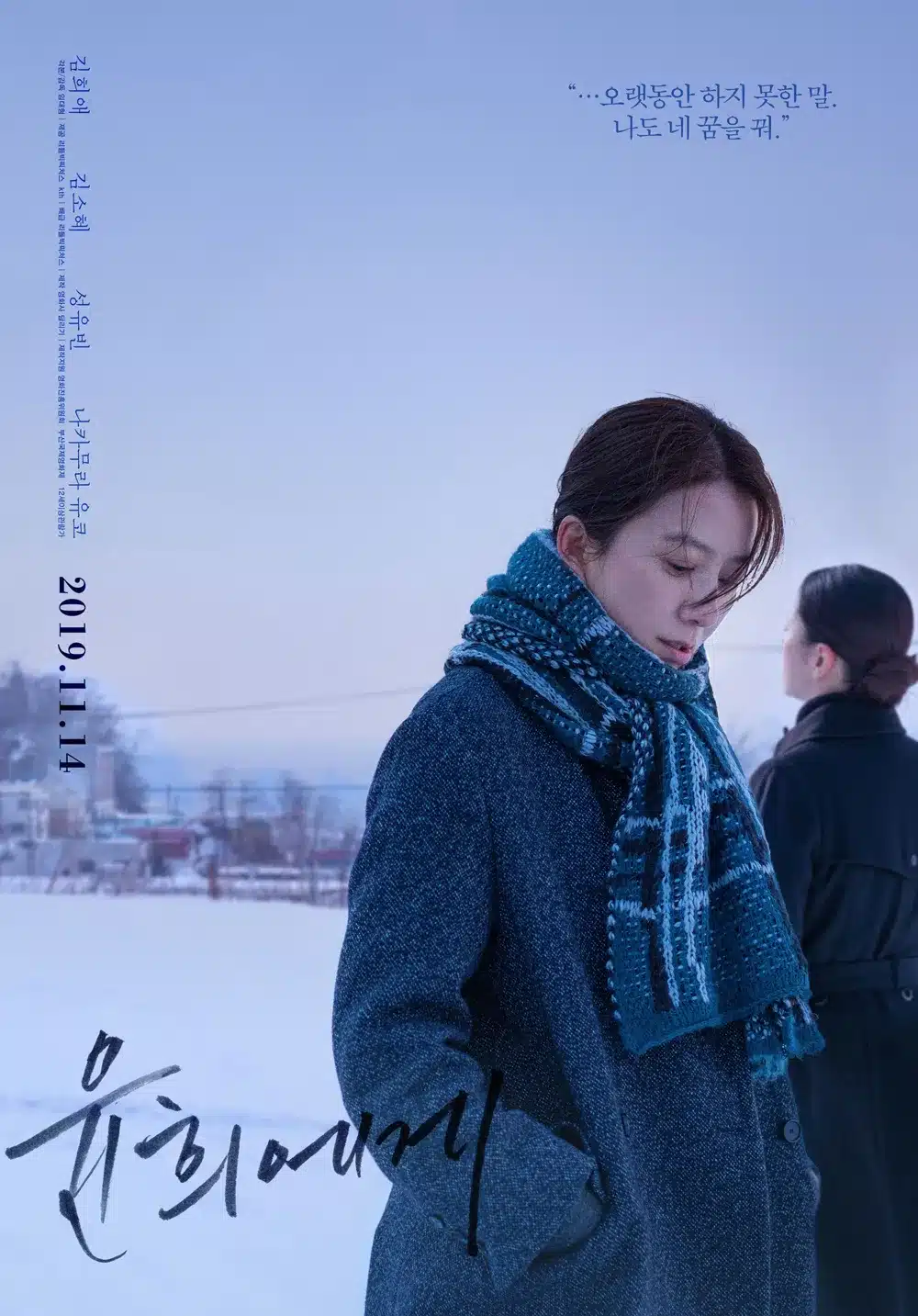
Moonlit Winter Ending Interpretation and Plot: Reclaiming Desire from Frozen Time
Solitude can sometimes become a wall of snow that imprisons us, yet what ultimately collapses that wall is not the gentle touch of another, but the courage to affirm the suppressed voice within oneself.
We all live with an unsent letters tucked away in a corner of our hearts. When such a letter turns yellow, unable to find its recipient, our souls often wear away along with it. The film Moonlit Winter depicts the healing process of taking out that faded heart and spreading it across a white, snowy field.
🌿 Moments When This Film Deeply Permeates
- When one yearns for their existence to become an indelible landscape for someone else.
- When one wishes to confront the passionate history of an individual hidden behind the title of “parent.”
- When one wants to believe in the possibility of warm solidarity amidst a daily life of cold silence.
- Why you should read to the end: Because this is not a mere search for a first love; it analyzes the structural aesthetics of how a middle-aged woman’s recovery of identity and intergenerational solidarity reconstruct a human life.
🎞 Note Before Viewing
Rather than provocative depictions or explosive conflicts, this work explores the essence of relationships through minute changes in facial expressions and the atmosphere of spaces. While it deals with deep emotional bonds between adult women and a queer narrative, it focuses on love as a process of restoring life’s trajectory rather than on sensationalism.
🎬 Film Information
- Title: Moonlit Winter (윤희에게, 2019)
- Director: Lim Dae-hyung
- Screenplay: Lim Dae-hyung
- Country: South Korea
- Genre: Drama, Romance, Coming-of-age
- Running Time: 99 minutes
- Platform: Watcha, Naver Series On, TVING, Disney+
- Cast: Kim Hee-ae, Nakamura Yuko, Kim So-hye, Sung Yu-bin
📖 Moonlit Winter Plot: The Restart of Frozen Time Triggered by a Letter [No Spoilers]
To Yoon-hee, a single mother living a weary life in silence, a mysterious letter arrives from Otaru, Japan. Her daughter, Sae-bom, who happens to read the letter first, senses a secret past hidden deep within her mother’s heart. Using a graduation trip as an excuse, she plans a journey to the snowy Otaru with her mother.
The sender of the letter is Jun, Yoon-hee’s old friend. Twenty years ago, they were each other’s worlds, but they were forcibly separated by social scrutiny and family pressure, leading to isolated lives. Yoon-hee lived a colorless life, denying herself, while Jun maintained a static daily existence, cutting off deep connections with others.
In a foreign landscape where white snow falls endlessly, Yoon-hee comes face-to-face with the desire she had tried to forget. Sae-bom’s thoughtful intervention and the assistance of Jun’s aunt, Masako, gradually guide the two women toward a reunion. The film calmly and beautifully portrays the process of them overcoming past wounds, reconfirming each other’s existence, and gaining a new will to live.
❄️ Yoon-hee’s Isolation and the Manifestation of Identity Trapped in Otaru’s Snow
In Moonlit Winter, the snow of Otaru, Hokkaido, carries a dual meaning. The incessantly falling snow is a tool of oblivion covering Yoon-hee and Jun’s past, while simultaneously serving as a sanctuary protecting their sincerity from the outside world. In Korea, Yoon-hee maintains a dry existence as a factory cook, almost as if punishing herself. This is a defense mechanism against a past where her identity was denied, and the result of submerging herself in the socially imposed role of a “mother.”
From an analytical perspective, Yoon-hee’s life is the “unsent letter” itself. Her isolation stems not from her physical environment, but from her inability to articulate her inner truth. The unfamiliar space of Otaru provides a gap where she can finally breathe as “Yoon-hee” rather than “someone’s mother.” Here, the snow functions not as a cold barrier, but as a canvas where everything can be erased and started anew, visualizing Yoon-hee’s internal growth.
🌕 The Symbolism of the Full Moon and the Structure of Intergenerational Solidarity in Queer Narratives
As suggested by the title Moonlit Winter, the image of the moon is a central device symbolizing the restoration of relationships. The moon Yoon-hee gazed at in Korea was always obscured by clouds or incomplete, but the moon she encounters in the night sky of Otaru takes the form of a full moon. This metaphorizes the process of Yoon-hee’s damaged ego regaining wholeness through her reunion with Jun.
A particularly noteworthy element is the role of Sae-bom. While conventional queer narratives often focus on the suffering of the parties involved, Moonlit Winter demonstrates a structure of solidarity that heals past wounds through the next generation, Sae-bom. She does not criticize or pity her mother’s past; instead, she affirms her mother’s desire and gives her a gentle push forward. This relational setting of a “daughter as a supporter” marks a mature milestone for female narratives in Korean cinema.
🔎 Reinterpreting the Ending: Eternal Unity Left by the Declaration “I Dream of You Too”
At the end of the film, Yoon-hee and Jun finally stand face-to-face after many years. There are no flamboyant embraces or passionate confessions, but the mere act of calling each other’s names fills the crack between them. However, the true conclusion of this film is not the reunion itself, but the scene where Yoon-hee, back in Korea, writes a reply to Jun.
Yoon-hee no longer runs away. She quits her job and prepares for a new life, proudly writing her own name on a resume. The final line of her letter to Jun, “I dream of you too,” is an expression of her will to affirm her past self and narrate her own future. Yoon-hee’s letter is a period that concludes past pain and, simultaneously, a starting signal for a life as an autonomous individual. What she gained was not her lost first love, but the dignity of the self that had cherished that love.
❓ Moonlit Winter: Interpreting the Ending Between Reality and Aesthetics
Q. How do you view the criticism that the reunion of the two protagonists is excessively short and restrained?
A. I acknowledge that the direction may feel somewhat anti-climactic for viewers expecting an explosive emotional release. However, this is an aesthetic choice reflecting the personalities of the two characters and the weight of the era they endured during twenty years of silence. Just as deep sorrow can be conveyed without loud wailing, the brief encounter demonstrates a sober affirmation of the days they will live ahead. The director chose a method that preserves the characters’ dignity over a sensational narrative.
Q. How should we interpret Yoon-hee’s relationship with her ex-husband?
A. The ex-husband possesses a duality; he is both a victim of the patriarchal social structure and a perpetrator who exacerbated Yoon-hee’s pain. His act of visiting Yoon-hee while intoxicated reveals the emptiness of a masculinity that failed to find happiness even within the framework of a “normal family,” rather than a lingering attachment to the past. Through this, the work suggests that a social system suppressing individual identity leaves scars on both men and women, emphasizing that Yoon-hee achieves true independence by completely severing that relationship.
✨ Moonlit Winter: A Warm Affirmation to Those Who Call Their Own Names
The film Moonlit Winter shows the miracle of buried memories becoming present-day courage. It proves that the suppression of identity is not merely blocking a personal preference but stripping away a human’s vitality—and that what restores that vitality is ultimately the kind presence of someone who says, “You are not wrong.”
The completion of love lies not in union with the object of affection, but in the process of fully accepting the self that holds that love.
💬 What kind of letter is lingering in your heart?
Silence is sometimes the most powerful language, yet it can also trap us in a prison of our own making. What is the sincere truth you have kept tucked away in a corner of your heart, unable to send for a long time?
Do you want to bring that heart out now and deliver it to someone, or do you still wish to keep it buried in the snow?
🕵️♀️ Violet Screen Curation: Other Discoveries to Deepen Female Narratives
- The Dream Songs (너와 나, 2023) Reason for recommendation: While Moonlit Winter found a middle-aged woman’s lost time in a snowy field, this film captures the fleeting moments of vivid high school years through dreamlike direction. Dealing with the subtle emotions and the unspeakable weight of love between two high school girls, Semi and Ha-eun, it brilliantly portrays the solidarity of women passing through loss.
- Concerning My Daughter (딸에 대하여, 2024) Reason for recommendation: Based on the novel by Kim Hye-jin, this work feels like an emotional extension of Moonlit Winter. Following the perspective of a mother who takes in her lesbian daughter and her daughter’s partner, it tenaciously digs into the conflicts of hate and understanding within the fence of “family.” Moving beyond a simple queer narrative, it addresses female care labor and the dignity of survival through the daily life of the mother, an elderly caregiver.
To provide a more stable publishing environment, multilingual content, and better communication with our readers, we have moved our official publication to Substack.
All new film reviews and critical essays will be published on our new platform. This website will be closing down soon, so we would greatly appreciate it if you subscribed to our new space.
TODAY'S QUESTION
When did you first feel fully accepted for who you are?
Your answer isn't saved. Feel free to share it in the comments below.


You May Also Like
Extra Terrestres Ending Analysis: A Solidarity of Light Born from the Collision of Isolated Planets

Kiss Me Again (2006) – The Expansion of Desire and the Fracturing of Relationships: The Identity Remaining at the End