Disobedience: A Deep Interpretation of the Clash Between Repressed Desire and Faith, and the Liberation of Taboo Love
Every human being feels a sense of security within the order of the world they inhabit; yet, it is only when that order denies one’s very essence that a fatal longing for “freedom” is born. Against the backdrop of an Orthodox Jewish community—a closed space governed by purity and discipline—Disobedience exquisitely captures how the suppressed desires of two women are transformed into a massive wave of liberation through the spark of a reunion.
Moving beyond simple romance, this work poses philosophical questions about what an individual must sacrifice and choose to preserve their dignity between personal faith and communal values. Witnessing the desperate struggle to exist as one’s true self, escaping the prison of the “other’s gaze,” will awaken the latent instinct for “disobedience” within every viewer’s soul.
🌿 Moments When This Film Sinks Especially Deep
- For those who have denied and left behind the names and places of a past that once defined them, yet still carry a void in a corner of their heart that cannot be erased.
- For those who have experienced moments of losing their true “voice” while living according to the sophisticated frameworks of others’ expectations and social conventions.
- For film fans who love a high-density emotional tension where the heart drops simply through the exchange of glances amidst static silence.
- The reason you must read to the end: This review moves beyond a simple resolution of conflict to provide a humanistic analysis of the meaning of a “true choice” born at the point where religious restraint and individual freedom cannot be reconciled.
🎞 Note Before Viewing
This work deals with the strict laws of an Orthodox Jewish community and the emotional and physical communion between two women occurring within it. Rather than provocative depiction, it focuses on the internal conflicts of the characters and the density of their relationship, maintaining a mature perspective that earnestly reflects on the deep bond between adults.
🎬 Film Information
- Title: Disobedience (2017)
- Director: Sebastián Lelio
- Screenplay: Sebastián Lelio, Rebecca Lenkiewicz
- Original Work: Naomi Alderman’s novel of the same name, Disobedience
- Country: UK, Ireland, USA
- Genre: Drama, Romance
- Running Time: 114 minutes
- Platform: Netflix, Apple TV
- Cast: Rachel Weisz, Rachel McAdams, Alessandro Nivola
📖 Disobedience: A Chain of Reawakening Desire Triggered by Death [No Spoilers]
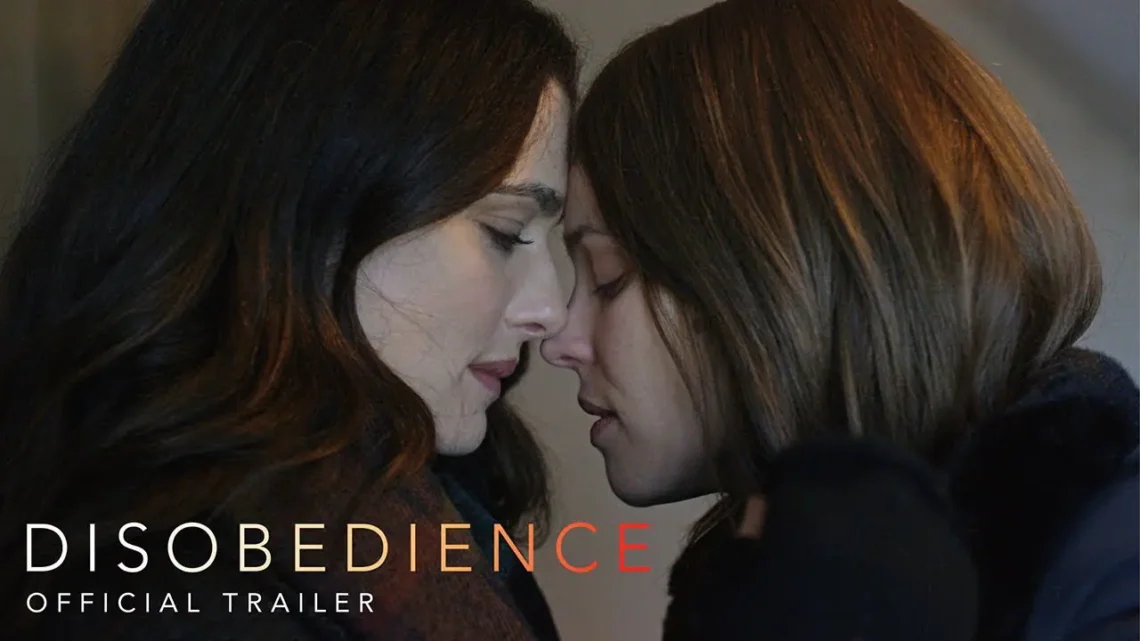
Ronit (Rachel Weisz), living as a free-spirited photographer in New York, returns to her hometown upon hearing the news of the death of her estranged father, a prominent rabbi in an Orthodox Jewish community in North London. In this place governed by strict commandments, Ronit feels a sense of alienation, still being treated as an “unclean entity” or a “heretic.”
She learns that Esti (Rachel McAdams), her childhood best friend and lover, is living as a member of the community, married to Dovid (Alessandro Nivola), who was also their close friend. Ronit’s appearance intensely shakes Esti’s suppressed emotions, and the time that had stopped between the two begins to flow again.
The quiet community becomes restless as it senses the subtle atmosphere shared by the two women, and Esti stands at a massive crossroads of choice between the faith that has sustained her entire life and the irresistible pull toward Ronit. This reunion, begun by death, leads to the most violent resistance toward life.
🕯️ Ronit and Esti: Psychological Contrast and Union of Two Women Breaking Boundaries
The core of the interpretation of Disobedience lies in the difference in how the two protagonists practice their “disobedience.” Ronit is a character who has already attained physical freedom by leaving the community. However, her freedom was an isolated one, the result of denying her father and severing her roots. Conversely, Esti functions as the perfect “rabbi’s wife,” wearing a wig and observing the law within the community, but her interior was burning fiercely, never having forgotten Ronit for a single moment.
The film does not adopt a narrative where Ronit saves Esti. Rather, it focuses on the process of Esti using Ronit’s appearance as a catalyst to break out of her own shell. Desire is substituted here not simply as physical indulgence, but as a political will to reclaim the right to self-determination. The silence and glances the two women share upon reuniting become the most powerful language, shattering the “virtue of silence” enforced by a closed society.
🎥 The Aesthetics of Oppression Revealed Through Mise-en-scène and Space: Achromatic London and Red Lips
Director Sebastián Lelio portrays the landscape of the North London Jewish community in an almost obsessively achromatic palette. Black suits, white shirts, and wigs devoid of individuality visually prove how thoroughly this world erases personal color. Within this background, Ronit’s free-spirited attire and the occasionally trembling gaze of Esti create visual ruptures in themselves.
In particular, the direction utilizing mirrors and glass windows effectively reveals the disconnection and the voyeuristic gaze the characters feel. The encounter in the hotel—an indispensable scene in any review of Disobedience—shows the paradox of revealing one’s true self only within a space completely cut off from the outside world. The director captures the characters tenaciously through close-ups, pulling the density of suppressed emotions to the extreme by ensuring the audience does not miss even the slightest tremor of a muscle.
🔎 Reinterpretation of the Ending — The Most Sublime Prayer in the Name of Choice
At the end of the film, Esti takes a taxi to the airport with Ronit. She declares her “right to choose” and decides to stand alone. The true conclusion reached by this film lies in the acquisition of freedom.
The scene where Dovid releases Esti while preaching about “Free Will” at the synagogue is the structural peak of the film. This suggests that religion can be a support that allows humans to choose for themselves, rather than a shackle that binds the individual. What Esti has gained is an uncertain future, and what she has lost is a peaceful sense of belonging. However, she finally stands before the world, removing her wig and revealing her true hair.
Esti’s choice is not a betrayal of the community, but an act of realizing “will,” the most human right bestowed by the God who created her.
❓ Disobedience: Interpretation of Ambiguous Choices and Modern Controversies
Q: Do Dovid’s sudden change and the ending where he lets Esti go feel excessively contrived or like religious beautification?
A: It may appear so at first glance. Dovid’s display of tolerance, when he seemed destined to remain an oppressive religious leader, is sometimes criticized as narrative convenience. However, looking at it structurally, one can see that Dovid was also a victim of this system. He had lost a friend (Ronit) and was trapped in a loveless duty (his marriage to Esti). Dovid’s decision should be interpreted not as a patronizing act of saving Esti, but as a moment of “mutual liberation” where he himself grows as a human being, breaking away from the rigid role-model of a rabbi. The work focuses on how to recover humanity within religion rather than defining religion itself as evil.
Q: Can the emotions of this film be fully conveyed to an audience without a religious background?
A: The Jewish background is merely a device; the essence is the conflict between the collective and the individual. If we think of the “invisible laws” we encounter in daily life—family expectations, workplace discipline, and social norms—the pressure felt by Ronit and Esti forms a sufficiently universal bond of empathy. Rather, the specific background serves to heighten the emotional density.
✨ Disobedience: Only My Disobedience Defines Me
This film asks us: Is the peaceful fence sustaining you actually a prison trapping your soul? How many truths do we turn away from in the name of love, or in the name of faith? Disobedience captures the most explosive emotional upheaval within a static direction, showing the truth that true salvation is not something given by someone else, but something found the moment one breaks a taboo themselves.
Ultimately, human greatness stems not from obedience, but from the courage to say “no” to what one feels is wrong. To modern individuals wandering amidst the confusion of relationship and identity, this film is a narrative declaration proving that the loneliest choice can be the most brilliant beginning.
👁️ Sincerity Hidden in Silence: How Much Can You Endure?
If you had to turn your back on your entire world to protect the one you love, would you willingly walk the path of “disobedience”? Or would you spend your life acting out someone else’s life inside a safe prison?
📽️ Violet Screen Recommendation: Other Faces of Women’s Narratives
- Water Lilies (2007): An early work by director Céline Sciamma. A masterpiece that explores the subtle competition, desire, and power dynamics of teenage girls through the fascinating subject of synchronized swimming.
- Tell It to the Bees (2018): Set in 1950s Britain, it depicts the love and solidarity of two women standing against social prejudice. It is more lyrical than Disobedience, yet it densely portrays the dignity of individuals clashing against the limitations of the era.
To provide a more stable publishing environment, multilingual content, and better communication with our readers, we have moved our official publication to Substack.
All new film reviews and critical essays will be published on our new platform. This website will be closing down soon, so we would greatly appreciate it if you subscribed to our new space.
TODAY'S QUESTION
Which film feels like your 'first love' story?
Your answer isn't saved. Feel free to share it in the comments below.


You May Also Like

Eileen, a Noir of Suppressed Desire and the Illusory Fissure Named Rebecca (Eileen, 2023)
Notes on a Scandal (2006): An Interpretation of Destructive Desire Left by a Chronicle of Obsession and Isolation