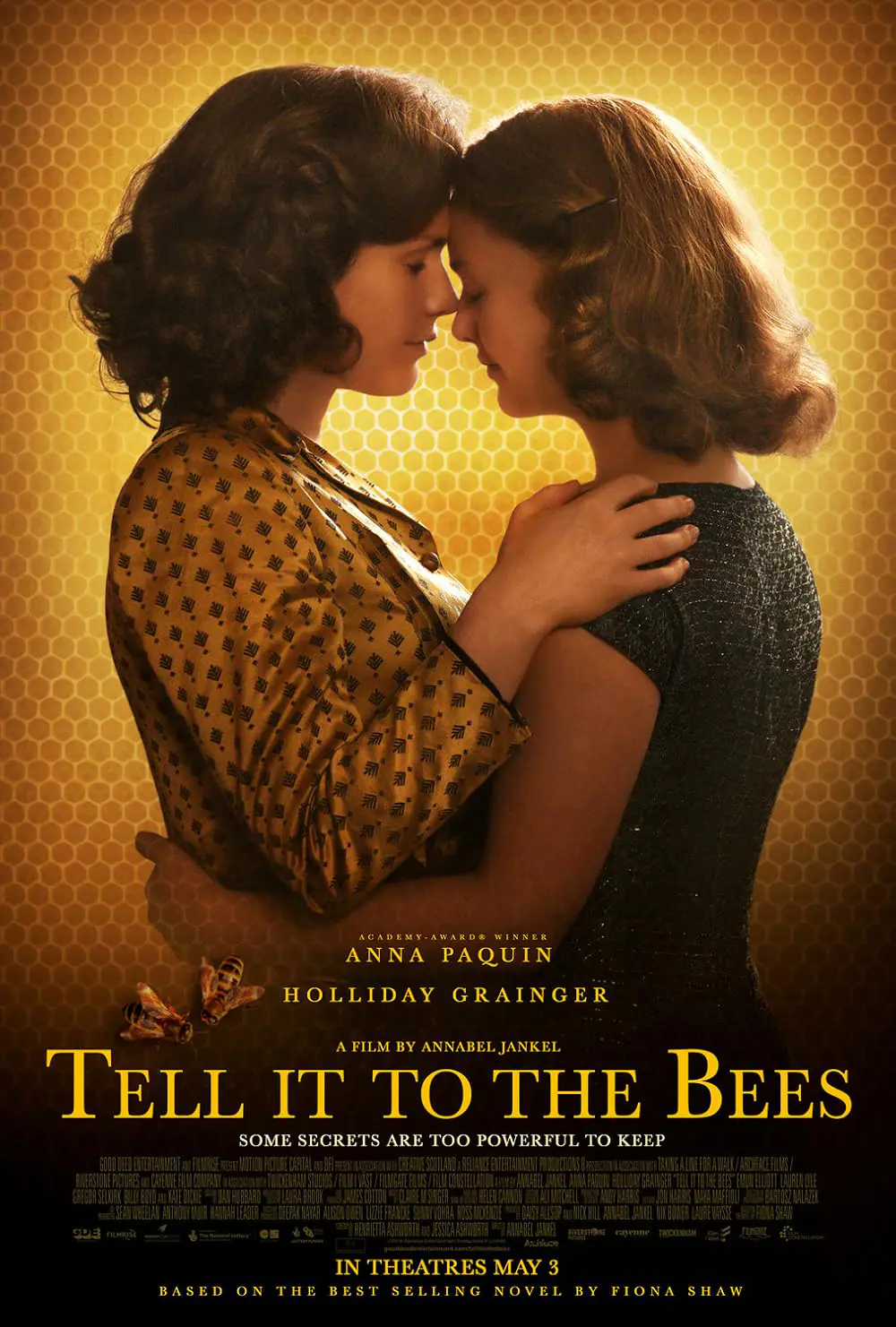
Tell It to the Bees: Whispers of Bees Crossing a Season of Oppression, the Solidarity of Two Isolated Women
In an era when love was deemed a crime, some had to confess their true hearts to beings other than humans. The relationship between two women that blossoms in the chilly air of 1950s Scotland is more than a simple romance; it is a gesture of survival resisting social assassination.
Isolation sometimes gives birth to the purest bonds. Trapped in the prison of others’ gazes, the process of opening doors using each other’s wounds as the only key is exquisitely beautiful and harrowing. Through this film, we witness how violence in the name of ‘normality’ erodes the individual soul, and how love becomes the final stronghold amidst such destructive storms.
🌿 Moments when this film deeply resonates
- For those who feel a tender touch as salvation when every door in the world is closed.
- For those who have ever felt lost between social norms and personal desire.
- For all marginalized souls living with secrets that cannot be put into words.
- Because this review thoroughly deconstructs the ‘dignified exit’ of women hidden behind the film’s magical realism and the structural sorrow of its ending.
🎞️ Note Before Viewing
This work focuses on the emotional communion and the pressures of the era between two characters rather than physical exposure or provocative depictions. The central axis of the play is the fear felt by women in a violent, male-centered society and the poignant bond formed to overcome it.
🎬 Movie Information
- Title: Tell It to the Bees (2018)
- Director: Annabel Jankel
- Screenplay: Henrietta Ashworth, Jessica Ashworth
- Original Work: The novel of the same name by Fiona Shaw, Tell It to the Bees
- Country: UK, Canada
- Genre: Drama, Romance
- Running Time: 106 minutes
- Platform: Major VOD services such as Naver Series On, Coupang Play
- Cast: Anna Paquin (Jean Markham), Holliday Grainger (Lydia Weekes)
📖 Tell It to the Bees Synopsis: An Encounter of Two Worlds Connected by a Wounded Boy [No Spoilers]
In a conservative small town in 1950s Scotland, Dr. Jean Markham, who returned to her hometown to take over the family practice after her father’s death, lives an isolated life, keeping her distance from the villagers. Meanwhile, Lydia Weekes, who works in a factory while raising her son Charlie alone after being abandoned by her husband, endures each day under the stigma of poverty and being a divorcee.
One day, Charlie, injured from being bullied at school, visits Jean’s clinic. Jean builds a bond with the boy by teaching him how to communicate with the honeybees in the yard. Taking this as an opportunity, Lydia and Charlie, who are at risk of being evicted from their home, come to stay at Jean’s manor. There, the two marginalized women fall into deep emotions that fill each other’s deficiencies. However, their secret happiness meets a precarious turning point due to the exclusive gaze of the village and the violent intervention of Lydia’s ex-husband, Robert.
🐝 Secrets Recorded in the Language of Bees: The Ending of Tell It to the Bees and the Aesthetics of Liberation
The core of this film lies in the fact that the medium of honeybees serves as a repository of truth beyond a simple hobby. Jean advises Charlie to “tell your secrets to the bees,” an act of relegating queer identity and forbidden desires—which are never permitted in human society—into the order of nature.
The scene near the end where a swarm of bees attacks the violent husband threatening Lydia is the pinnacle of the film’s magical realism. This takes the structure of an instinctive and primal force of nature judging the patriarchal violence that rational medicine (Jean’s world) could not resolve. The bees overturn the logic of the villagers who dismiss the love between the two women as ‘unnatural,’ proving instead that their solidarity is in touch with the essential purity of the ecosystem.
🩺 Solidarity of Wounded Healers: Subversion of Power Structures and Interpretation
The relationship between Jean and Lydia is a narrative of interdependent salvation that transcends the gap in class and knowledge. Jean, a professional woman whose inner self is shattered by her sexual identity, and Lydia, who is economically poor but possesses the strength of motherhood, provide each other with the ‘social shield’ and ’emotional warmth’ they lack.
To add a deeper interpretation of the work, Jean’s manor is the ‘Hive’ itself, protected from the thorny gazes of the outside. Only within that space can the two finally strip away their social masks and become whole individuals. However, this utopia cannot last forever. The massive community of the village does not tolerate a heretic who is not a queen bee, and eventually, Lydia is forced to make a choice that castrates her own desires for the safety of her son, Charlie.
🔎 Reinterpretation of the Ending: The Dignity of Love Completed by Leaving
The final scene of the film, where Lydia leaves Jean and boards a train, superficially appears to be a tragic parting. However, the reason this cannot be dismissed as a mere failure is because of the agency inherent in Lydia’s choice. She is not being driven out by others; she chooses ‘absence’ herself to protect her son and to prevent the social ruin that would befall Jean.
This ending leaves an eternal crack in their relationship, but simultaneously suggests that each other’s presence has changed their lives forever. Jean will never again sink into cold isolation as she did before, and Lydia will also pioneer a new life with Charlie, fueled by the memory of having been completely loved by someone. Their parting is not a defeat, but the best sublime retreat chosen to avoid damaging the essence of love in the face of the wall of the era. Lydia’s exit is not the end of the relationship, but a soul’s imprint that has left a permanent mark on each other’s lives.
🐝 Interpretations and Narrative Points of the Ending of Tell It to the Bees
Q. How do you view the criticism that the final bee swarm attack scene is overly unrealistic?
This scene is a direction that weighs more on metaphorical completeness than narrative probability. In a dead-end situation where human law (police, religion) does not help Lydia, the setting where only nature responds to her pain symbolizes the ‘return to nature’ frequently used in queer narratives. While the point about it being unrealistic is valid, it should be interpreted as an aesthetic device into which the desperate prayers of the oppressed are projected.
Q. The endings of the original novel and the film are said to be different. What is the significance of this?
While the original work implies a slightly more hopeful union, the film emphasizes the weight of the parting. This appears to be the director’s intention to clearly imprint on modern audiences the social limitations that women of that time had to face. This is because a painful parting sometimes reflects the truth of that era more honestly than a happy union.
✨ Tell It to the Bees: A Name That Remained Unbroken Despite the Era’s Neglect
By borrowing the specific time and space of the 1950s, this work asks questions about the ‘hatred of the other’ and the ‘value of true relationships’ that are still valid in modern society. Even if the love of Jean and Lydia has scattered in physical space, it remains eternally preserved in Charlie’s memory and the fluttering of the bees’ wings.
Ultimately, love is proven not by the length of time spent by each other’s side, but by how deeply one has changed the other’s life. This film is a chilly yet warm tribute to all minorities who tried not to lose their color while passing through an oppressed era.
🍯 Unforgettable Lingering Impressions
Is true love about destroying everything to be together, or is it about willingly erasing oneself for the other’s well-being?
If you were Lydia, would you have boarded the train for the future of your son Charlie, or for your love with Jean?
📽️ Violet Screen Curation: Variations of Other Female Narratives
- Ammonite (2020): The quiet yet fierce love between fossil hunter Mary and Charlotte, who comes to recuperate. If you liked the period atmosphere of Tell It to the Bees, this is a must-watch.
- Water Lilies (2007): A sensuous depiction of the desires and growth of young girls within the space of a swimming pool. It obsessively digs into the asymmetry of relationships.
To provide a more stable publishing environment, multilingual content, and better communication with our readers, we have moved our official publication to Substack.
All new film reviews and critical essays will be published on our new platform. This website will be closing down soon, so we would greatly appreciate it if you subscribed to our new space.
TODAY'S QUESTION
Which character has comforted you lately?
Your answer isn't saved. Feel free to share it in the comments below.


You May Also Like
Albert Nobbs: The Fortress of Survival and the Melancholy Freedom Built Upon an Erased Name

Carmen y Lola: A Narrative of Forbidden Desire and Solidarity Blossoming in the Romani Community