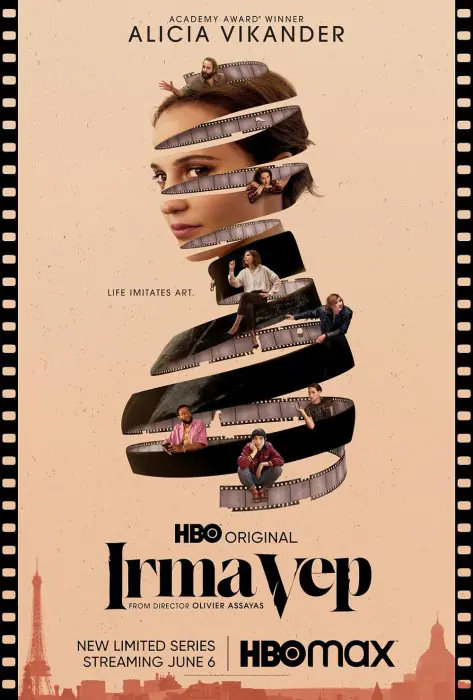
Irma Vep: The Meta-Liberation of a Woman Who Became a Ghost in the Skin of Desire
What is the color of a life where one returns home still wearing the face of another, even after the lights have dimmed on a silent set? We all live our lives clad in leather suits called “roles” assigned to us. Sometimes, those garments fit so tightly that we forget where our own skin truly begins.
Olivier Assayas’s Irma Vep (2022) transcends being a mere remake; it is an intellectual confession of an artist standing before a mirror, peering into the abyss where past and present, fiction and reality, collide. It traces the uncanny liberation of a woman who sheds the shell of a “star” preserved in the gaze of others, choosing instead to become a ghost capable of passing through walls.
🌿 Moments When This Series Deeply Resonates
- For those who have felt a sense of isolation in an empty hotel room behind the glamorous spotlight, feeling like a stranger to themselves.
- For those unable to escape the gravity of a love-hate relationship, still orbiting each other despite the bond having ended.
- For those sensing a crisis where their identity is being consumed by social roles or past reputation.
- For those who wish to indulge in the precarious boundary of whether art saves life or devours it.
- Because this review goes beyond a simple series guide to deeply analyze the power structures of relationships and the fusion of the self, forcing you to face the reality of the “roles” you cling to.
🎞 Note Before Viewing the Series
This work focuses on psychological tension and emotional affairs between characters rather than physical exposure or violence. It is an intellectual adult drama dealing with the gap between the Hollywood system and French arthouse cinema, and the complex power dynamics between women.
🎬 Series Information
- Title: Irma Vep (2022)
- Director: Olivier Assayas
- Screenplay: Olivier Assayas
- Original Work: The 1996 film of the same name, Irma Vep (Directed by Olivier Assayas)
- Country: USA, France
- Genre: Comedy, Drama, Meta-fiction
- Runtime: 8 episodes (Approx. 50 mins per episode)
- Platform: HBO / MAX (Wavve in South Korea, etc.)
- Cast: Alicia Vikander, Adria Arjona, Jeanne Balibar, Kristen Stewart
📖 The Cracks and Rebirth of a Star Hidden in a Leather Suit: Synopsis [No Spoilers]
Mira Harberg (Alicia Vikander), a top Hollywood star at the height of her career, becomes disillusioned with the consumable image of big-budget blockbusters and heads to Paris. Her chosen project is a TV series modernizing the 1915 crime thriller Les Vampires, which defined the silent film era. There, Mira takes on the role of the lethal villain, Irma Vep.
The set is chaos itself. The director, René Vidal, suffering from a nervous breakdown, walks a tightrope between his artistic vision and friction with the production company. Meanwhile, Mira experiences emotional exhaustion within her lingering, messy relationship with Laurie (Adria Arjona), her former lover and assistant.
As filming progresses, Mira realizes that the black leather suit she wears is not merely a costume. The spirit of the character “Irma Vep” begins to intrude upon Mira’s daily life, and she experiences supernatural phenomena—passing through walls like a ghost and prowling the rooftops of Paris at night. As the boundaries between acting and reality, past and present collapse, Mira enters a strange journey to find her true self.
🖤 The Boundary Between Leather and Skin: The Transference of Identity in Irma Vep
The core of this drama lies in illustrating the deconstruction of the self through the process of the actress Mira being consumed by the character Irma Vep. Mira feels fatigue from being treated as a typical Hollywood “commodity,” yet in Paris, she finds herself trapped in another frame: the director’s muse.
Here, the black leather suit acts as a powerful metaphor. It is simultaneously the image of Mira defined by others and an anonymous suit of armor that allows her to escape from reality’s constraints (her obsession with Laurie, the public eye). Mira’s act of passing through walls in costume is not a defiance of physical laws, but a psychological liberation that transcends the norms of social relationships that have oppressed her.
Ultimately, the interpretation of this work rests not on “who is playing whom,” but on “how acting saves a human being.” By playing a character onto whom others’ desires are projected, Mira instead releases her own suppressed desires, finally existing as an independent ghost—belonging to no star and no lover.
⛓ The Pendulum Between Laurie and Zoé: Relationship Structures of Power and Healing
The female narrative in Irma Vep is a struggle between the ghost of the past (Laurie) and the possibilities of the future (Zoé), centered around Mira. The relationship with Laurie is a classic product of power imbalance. Having controlled every aspect of Mira’s life as her assistant, Laurie continues to destabilize Mira’s ego after their breakup, inducing an emotional addiction. She is a “remnant of the past” that Mira must purge, an anchor mooring her to the swamp of reality.
In contrast, the newly introduced Zoé (Jeanne Balibar) strives to treat Mira as a whole individual rather than a star. She attempts to understand Mira’s complex inner world but maintains a distance of mutual respect that never intrudes. Mira’s transition from Laurie’s obsessive love to Zoé’s calm world symbolizes her growth as an independent female subject.
Interestingly, whenever Mira wavers between these two relationships, the “Irma Vep” leather suit slips into the cracks. This paradox—where a fictional character provides the absolute freedom that real-world love cannot—attests to the extreme exhaustion caused by relationships.
🔎 Conclusion: The Declaration of a Woman Who Chose to Remain a Ghost
The conclusion of Irma Vep gazes beyond the surface event of Mira finishing the shoot and leaving Paris. Mira ultimately returns to Hollywood having fully integrated the ghostly attributes of Irma Vep into her inner self. This marks the death of the fragile star who was swayed by past wounds (Laurie) and the birth of a new entity soaring across the gaze of others.
The detachment Mira displays in the finale signifies a total severance from Laurie. She refuses to be anyone’s possession any longer. What she has gained is “the way to become another without losing oneself,” and what she has lost is “the hypocritical self that acted in order to be loved by others.”
By destroying her real-world self through the power of fiction, Mira finally reclaims her absolute sovereignty.
❓ Issues in the Irma Vep Finale and Meta-Narrative
Q1. Can I understand the series without seeing the 1996 original film? The original contains the director’s private history (his relationship with Maggie Cheung), so knowing it adds depth, but it is not essential. Since the drama itself follows a meta-structure regarding the remake process, following the chaos experienced by director René Vidal is enough to immerse oneself. In fact, watching without prior information can help one empathize more with Mira’s confusion.
Q2. Is the scene where Mira passes through the wall fantasy or a hallucination? The work does not provide a definitive answer. This is a realm of magical realism where Mira’s psychological state is externalized. The importance lies not in whether it is “real,” but in the “sense of liberation” Mira feels in that moment. It is reasonable to interpret it as a visual manifestation of the trance-like state an actor feels when fully immersed in a role.
✨ Irma Vep, the Chilling Comfort Offered by the Ghost in the Mirror
This work is a sharp report on how the modern content industry consumes artists and how individuals protect their identity within that consumptive system. Mira Harberg’s journey asks us: When you strip away the “name” and “profession” that define you, who is the ghost that remains within?
To those of us accustomed to erasing ourselves for the sake of relationships, this drama suggests that sometimes we need the audacity to become ghosts and pass through the gaze of others. The only way to find the self may paradoxically begin with the courage to abandon oneself and become something entirely different.
Art is the most sophisticated form of necromancy, summoning the ghosts of the past to heal the pains of the present.
🌙 Is there a moment when your inner self needs the skin of ‘Irma Vep’?
Secret desires we wish to show no one sometimes make us the most free. What is the “mask” that makes you your most honest self?
📽 Violet Screen Curation: Other Abysses of Female Narratives
- May December (2023)
- Reason for Recommendation: It deals with the process of an actress’s identity blurring as she portrays a real-life person. While Irma Vep is fantastical, this film is chillingly realistic and cynical.
- Portrait of a Lady on Fire (2019)
- Reason for Recommendation: It explores the gaze and power between painter and model, observer and observed. It is a masterpiece that maximizes the beauty of the moment when a relationship between women is sublimated into art.
To provide a more stable publishing environment, multilingual content, and better communication with our readers, we have moved our official publication to Substack.
All new film reviews and critical essays will be published on our new platform. This website will be closing down soon, so we would greatly appreciate it if you subscribed to our new space.
TODAY'S QUESTION
If you could say one thing to someone today, what would it be?
Your answer isn't saved. Feel free to share it in the comments below.


You May Also Like
Abby Parker in The Deuce: Reclaiming Agency from the Streets of Desire

Reverse With Me (2025) Analysis: Love Beyond the Orbit of Time and the Aesthetics of Sublime Indebtedness