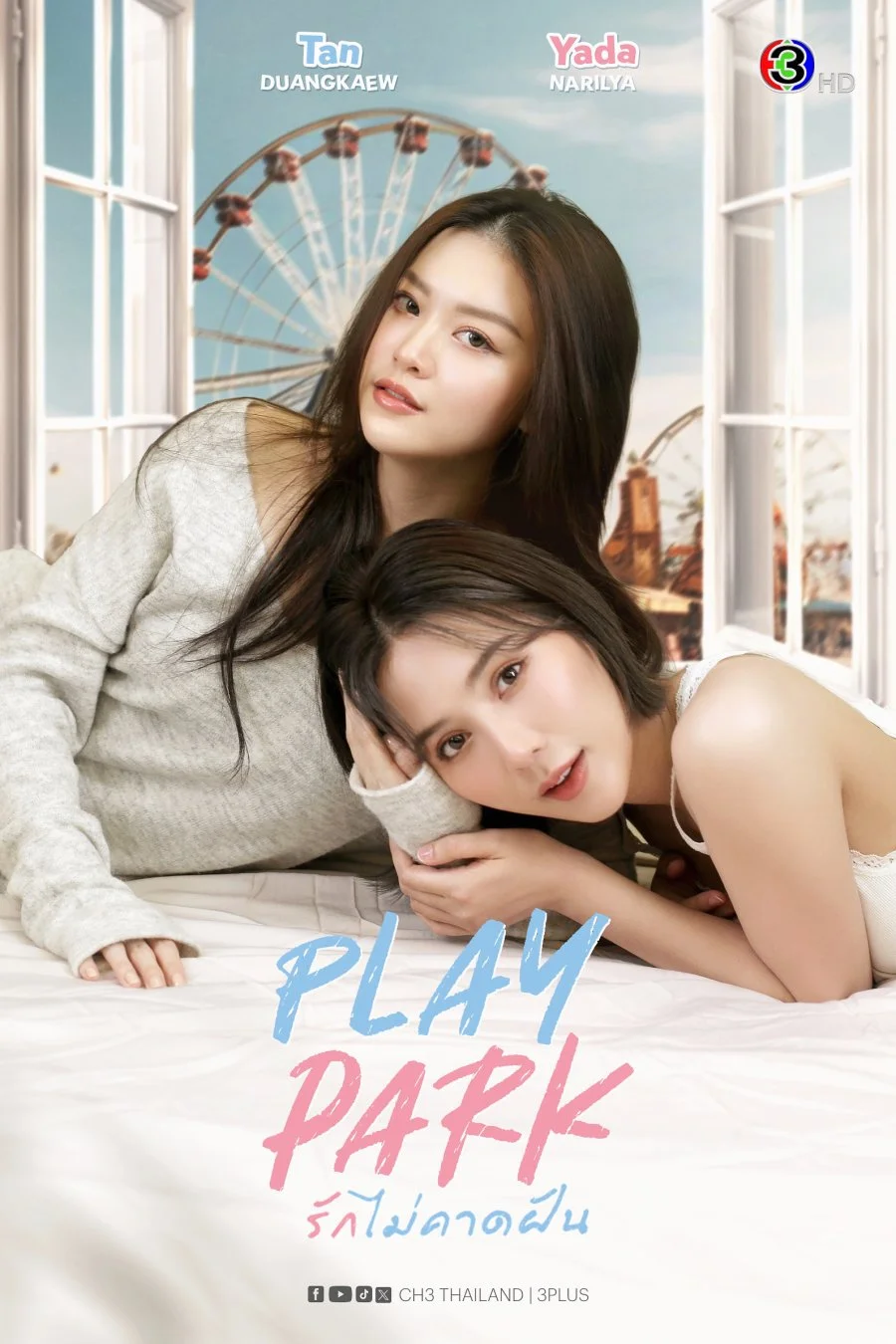
Play Park (2026) Review: The Gravity of Solidarity and Love Blooming in the Cold War of Capital
On the boundary between a scarred past and a cruel reality, the story of two women saving each other always resonates powerfully. The 8-episode Thai Channel 3 GL drama Play Park (2026) wears the outer shell of a simple romantic comedy, but beneath it breathes a fierce chronicle of two women standing against patriarchal oppression and the ruthlessness of capitalism. Through the lens of Violet Screen, we offer an in-depth analysis of the emotional trajectory left by this work.
🌿 Moments When This Drama Permeates Especially Deeply
- When defense mechanisms activate, forcing one to push away approaching sincerity due to past trauma
- When one discovers a reckless value worth protecting to the very end in a world that demands only efficiency
- When one longs for the warmth of the moment two people recognize each other’s deficiencies and hold hands in silence
- Therefore, the reason to read to the end is to clearly interpret the growth and structural liberation of two women reclaiming the sovereignty of their lives, moving beyond mere romance
🎞 Notes Before Watching
Rather than physical relations or provocative depictions, this drama focuses on the characters’ past wounds and the emotional communion through which they heal. While elements of emotional conflict exist, such as threats from a violent ex-husband, the core of the narrative centers on the process of trust and solidarity built between the two protagonists to overcome them.
🎬 Drama Information
- Title: Play Park (2026) / รักไม่คาดฝัน
- Director: Ampaiporn Jitmaingong
- Screenplay: Nuttiya Sirakornwilai
- Country: Thailand
- Genre: Romantic Comedy, Drama, GL
- Running Time: 8 episodes (approx. 60 minutes per episode)
- Platform: Channel 3, Netflix
- Cast: Yada Narilya Gulmongkolpech, Tan Duangkaew Piyaui
📖 Play Park, The Inevitable Clash Between the One Who Protects and the One Who Destroys [No Spoilers]
Yingying, the manager of the old, worn-out amusement park ‘Play Park,’ carries the trauma of a past forced marriage and abuse by her ex-husband, acting as the sole breadwinner responsible for her young son and younger brother. For her, this amusement park is more than just a workplace; it is the only sanctuary sustaining her scarred life and a space akin to family.
However, when the young CEO Lilin is dispatched to build a large academy on the site of the financially struggling amusement park, their two worlds collide. To Lilin, who seeks to prove her capabilities on behalf of her father and ascend to the position of chairperson, Yingying appears merely as a recklessly stubborn individual. Yet, as the number of visits to the park for negotiations increases, Lilin begins to notice Yingying’s devoted life and tender inner self, and the distance between them begins to be swept into an unexpected torrent of emotion.
🎢 The Deconstruction and Reconstruction of Space: The Class Conflict Depicted in Play Park (2026)
The ‘Play Park’ in this work is not merely an amusement park where rides are gathered. It is a sanctuary where childhood innocence and emotional solidarity are uniquely permitted in a cruel society that pursues only efficiency and capital profit. The large cram school that Lilin intends to promote is a space symbolizing infinite competition and class mobility; thus, Lilin’s appearance is akin to an invasion of capital seeking to destroy this sanctuary.
However, through her encounter with Yingying, Lilin realizes that the space she intended to demolish is actually the foundation of Yingying’s survival and her sole refuge. In this process, the drama closely tracks the subjective transformation of Lilin—who was armed with the logic of capital—as she re-evaluates the value of the space and modifies her own power structure.
🔗 The Symmetry of Wounds: Resonance Between Forced Silence and Suppressed Identity
A standout element in the character structure of Play Park is that despite the two protagonists occupying opposite social positions, they share a symmetry of wounds—both having their identities denied by patriarchal power in the past. While Yingying suffered extreme physical and mental abuse through a forced marriage and violence while having her sexual orientation denied, Lilin was raised to function solely as the perfect successor under the absolute authority of her father, with her identity and first love (a bakery teacher) castrated.
These internal deficiencies become a powerful gravity that allows them to recognize and be drawn to each other. Lilin’s active courtship of Yingying is a subjective declaration to reclaim her true essence, which her father had previously blocked. Conversely, the fear Yingying experiences is a self-defense mechanism, wishing for her life never to be destroyed again by an uncontrollable external force. Their love is not a mere heterosexual alternative, but the beginning of a solidarity that cracks the oppressive world of paternity.
🔎 Reinterpreting the Ending: The Victory of Female Solidarity and Liberation Proven by a Happy Ending
The latter half of this drama depicts the process in which Lilin resolves her misunderstandings regarding Yingying and dismantles the dual patriarchal barriers formed by her father’s schemes and the ex-husband’s threats. The ending, in which Lilin ascends to the position of chairperson, preserves the amusement park, and succeeds in a mutually beneficial business venture in the final episode, is not a mere repetition of a Cinderella story.
This conclusion declares that while women enter the capitalist narrative of success, they restructure the system through a grammar of coexistence and solidarity rather than the existing male-centered methods of destruction. Yingying steps out of her past victimhood to stand tall as an autonomous partner in life, while Lilin escapes the shadow of her oppressive father to attain a complete self. Their union transcends private romance; it is a declaration of structural liberation that puts an end to the oppressive structure of perpetration.
💬 Play Park Deep Dive FAQ: Interpreting Polarizing Points in Female Representation and Narrative
Q1. There are critical views regarding the fact that Yingying’s past (domestic violence, forced marriage) is handled somewhat heavily within the romantic comedy genre. How should we interpret this?
The criticism that the weight of life borne by Yingying is excessively tragic compared to the lively tone and manner of the first half is valid. However, this should be understood not as a mere melodramatic device, but as a mechanism that exposes without filter how patriarchal social structures in Thailand have violently suppressed women’s sexual identity. The drama does not stop at exhibiting this tragedy; it achieves an aesthetic accomplishment by punishing the perpetrator through solidarity with Lilin, an autonomous partner, and legal action, thereby simultaneously delivering genre pleasure and a sense of social liberation.
Q2. What is the structural analysis regarding the opinion that the breakup caused by a misunderstanding in the latter half and the uncomfortable travel sequence make for a somewhat frustrating development (so-called ‘sweet potato’ plot)?
The conflict arising from Yingying hiding her ex-husband’s threats from Lilin could easily be seen as a cliché of common romance dramas. Structurally, however, this realistically demonstrates the defense mechanism of Yingying, a ‘vulnerable individual and breadwinner’ who has had to bear and resolve her own pain by herself throughout her life. The process through which a person who never learned how to rely on others experiences the catastrophe of a misunderstanding, only then learning to expose her vulnerability raw and communicate, is an inevitable rite of passage that had to be undergone for true emotional growth. We invite you, the readers, to judge for yourselves whether you view this conflict as a simple frustrating development or as an inevitable device that adds three-dimensionality to the character.
✨ Play Park, When Wounded Tenderness Becomes Each Other’s Salvation
Play Park is a work that shows how two women, bruised by the ruthlessness of capital and patriarchal violence, recognize each other’s wounds and ultimately form a solidarity. The drama proves through the journey of Yingying and Lilin that love is not merely invading another person’s world, but a process of recognizing the value of the world they wish to protect and defending it together. True salvation does not stem from being rescued by someone, but from the power of solidarity, holding each other’s hands to break down the walls of oppression that imprisoned their respective lives.
🎡 What Does an Amusement Park Mean to You?
Sometimes, a reckless heart wishing to protect something is more valuable than the efficiency of the world. If a moment comes when you must compromise with harsh reality to protect a precious value, would you choose the adventure of changing the system like Lilin, or would you silently hold your ground like Yingying?
🎬 Violet Screen Recommended Curation
- Pluto (2024) Reason for Recommendation: A mystery romance where a woman intentionally approaches a visually impaired woman—who is her twin sister’s first love—to seek revenge for her sister who fell into a coma due to an accident, only to fall into an unbelievable love. It unfolds a narrative of solidarity, guilt, and salvation blooming upon the precarious space of deception with a sensory mise-en-scène.
- Petrichor (หยดฝนกลิ่นสนิม, 2024) Reason for Recommendation: A thriller romance following a rookie police officer in the criminal investigation division and a forensic pathologist at the National Institute of Forensic Science as they track a serial murder case. It boldly shatters the sweet romance formulas of the mainstream, delivering a sharp and deep narrative of solidarity between two women who are the only ones to notice each other’s wounds amidst a harsh scene filled with blood and scent.
TODAY'S QUESTION
Which ending has stayed with you the longest?
Your answer isn't saved. Feel free to share it in the comments below.


You May Also Like
Show Me Love The Series: A Structural Review of Solidarity and Love Blossoming Behind a Glamorous Beauty Pageant

Marienhof 2009: Kerstin and Juliette, a Release of Desire More Intense Than Chocolate