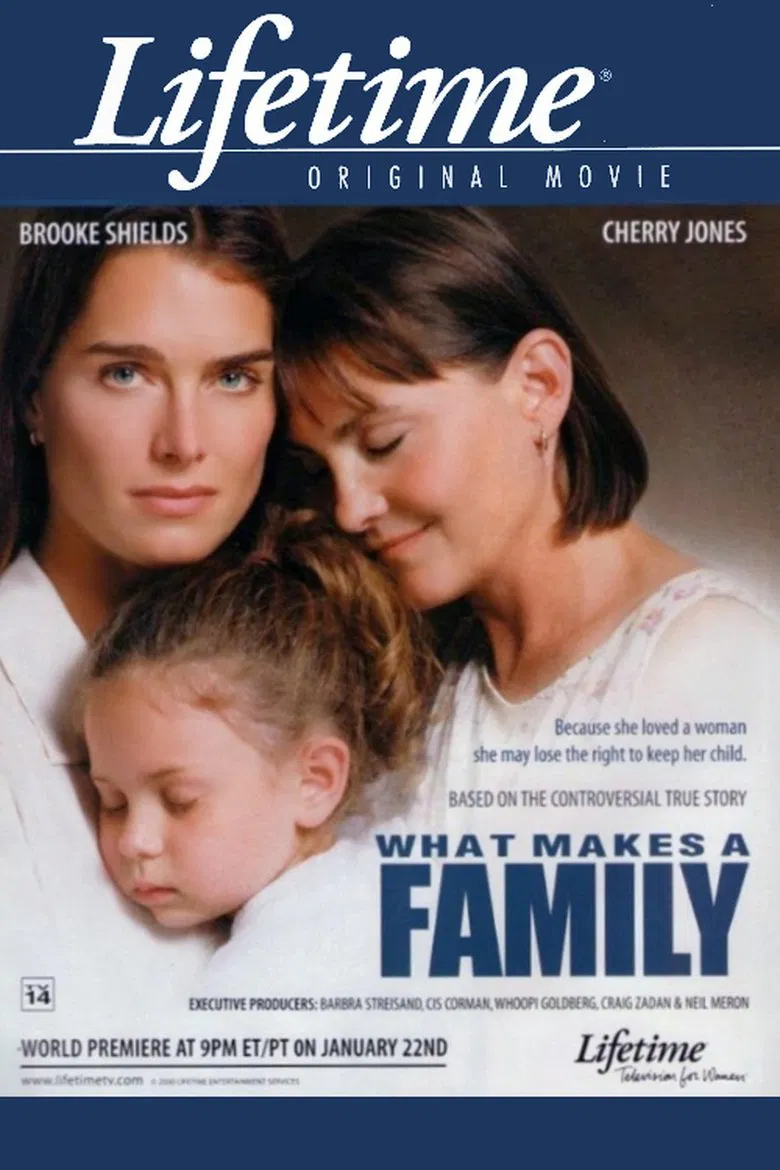
What Makes a Family: Love Beyond Blood, Questioning the Definition of Family
Love sometimes loses its way before the boundaries of the law. Is the name “family”—which we take for granted—truly completed by a combination of genes, or is it proven by the layered accumulation of everyday moments?
What Makes a Family explores the depth of human dignity and love when the most private relationships collide with public systems. We follow the record of this struggle, observing how those blocked by the sturdy fortress of blood relations go on to build a true community.
🌿 Moments That Resonate Deeply
- Janine’s empty daily life after Sandy’s death, when she is forcibly separated from her child solely because she lacks legal rights.
- Facing the cold system of an era when the word “mother” in a courtroom was bound strictly to biological relation.
- The journey of proving the reality of parenthood, transcending simple partnership to endure societal prejudice out of a sole sense of responsibility toward the child.
- The weight of the ending, which reconfirms the tangible value of love ignored by a consanguineous society, forcing us to ponder what a true family really is.
🎞️ Before Watching the Film
This work deals with the legal blind spots of the early 2000s, when the parental rights of same-sex couples were not recognized. Rather than relying on a sensational narrative, it focuses on the attachment between characters and the emotional bonds revealed during the legal battle. It is a human drama centered on the grief of losing a loved one and the struggle to protect a child.
🎬 Film Information
- Title: What Makes a Family (2001)
- Director: Maggie Greenwald
- Screenplay: Lisa Maria Peterson
- Country: United States
- Genre: Drama
- Running Time: 90 minutes
- Platform: Lifetime (Original Broadcast)
- Cast:
- Brooke Shields – Janine Nielsen
- Cherry Jones – Sandy Cataldi
- Whoopi Goldberg – Terry Harrison
📖 What Makes a Family Synopsis: The Reality of Love Transcending the Wall of Blood [No Spoilers]
In a peaceful Florida town, long-time partners Janine (Brooke Shields) and Sandy (Cherry Jones) consider each other lifelong companions and welcome their daughter, Heather, through artificial insemination. With Sandy as the biological mother and Janine dedicated as the co-parent, the three build a happy household that anyone would envy.
However, tragedy strikes on the day of Heather’s christening when Sandy collapses from lupus. Despite Janine’s devoted care, Sandy ultimately passes away. Before the grief can even settle, Sandy’s parents, Frank and Evelyn, file a custody lawsuit for Heather against Janine, who lacks legal parental rights.
Treated merely as “the mother’s roommate” and forcibly separated from her child, Janine, with the help of lawyer Terry (Whoopi Goldberg), begins an intimate yet fierce courtroom battle against a rigid legal system and societal prejudices that emphasize blood relations above all else.
⚖️ Proving Motherhood Beyond Institutional Norms: The Essential Question Asked by What Makes a Family
What exactly is the standard that defines the structure of a family? Through the everyday scenes of Janine and Sandy welcoming and raising their child in the first half of the film, the work demonstrates that motherhood is not merely the product of biological cause and effect. Instead, it is the accumulation of deeply concrete devotion—changing diapers and monitoring the child’s breathing night after night.
Because Florida law at the time fundamentally denied adoption and partnerships for same-sex couples, Janine’s existence is thoroughly marginalized within the territory of the law. This work intimately traces the scale of grief an individual must bear when legally guaranteed rights are absent, sharply exposing how institutional voids deny and strip away a person’s sublime motherhood.
💔 A Society Where Even Mourning Loss is Denied: Marginalization and Existential Struggle in the Courtroom
The courtroom Janine faces after Sandy’s death is not simply a space to contest custody; it transforms into a violent arena where her entire life and identity are denied. The consanguinity and traditional family values championed by the maternal grandparents attempt to erase the seven years Janine and Heather built together in a single stroke.
Here, the film does not exaggerate Janine’s endurance and sorrow, but quietly captures them, prompting the audience to question the limits of institutional justice. Janine’s struggle goes beyond a simple fight to reclaim her child; it takes on the character of a solemn declaration to prove that their love existed, standing against the exclusion perpetrated in the name of the law.
🔎 Reinterpreting the Ending of What Makes a Family: Truth Restored by Videotape and the Completion of Relationship
Sandy’s videotaped message, found near the end of the film, performs an aesthetic function that goes beyond mere legal evidence. It serves as a spiritual surrogate that transcends the physical disruption of death, officially engraving the “legitimacy as a mother” that Sandy bestowed upon Janine into the social space.
The final scene, where the court ultimately recognizes Janine’s substantive parental status and permits her reunion with Heather, eschews a dramatic courtroom victory. Instead, it is filled with a quiet, serene embrace between the two. This ending shows that the practice of love, which transcends the authority of blood, has finally redefined the rigid boundaries of the law.
Where legal contracts and biological determinism fail, only mutual devotion and responsibility remain as the sole substantive truths that sustain the community called family.
💬 On the Ending and Representation of Family in What Makes a Family
Q. Considering the limitations of the era, are there any shortcomings or divisive elements in how this work represents the relationship of a female same-sex couple?
Some critics argue that because this piece was produced within the framework of a mainstream TV movie (produced by Lifetime), it safely confined the characters’ sexual and queer identities within the non-threatening, universal frames of “maternal love” and “devoted guardian,” rather than directly and powerfully asserting them through social activism.
However, this moderate approach can be re-evaluated within its structural context as an aesthetic and strategic choice. It allowed the film to reach the conservative American public of the time without resistance, effectively persuading them of the system’s absurdity and broadening social empathy for the parental rights of same-sex couples.
Q. Can the custody lawsuit filed by the grandparents, Frank and Evelyn, be viewed merely as the malicious interference of simple antagonists?
The depth of this work lies in the fact that it does not depict the grandparents as flat, absolute villains. They, too, are parents grieving the loss of their child, limited by their era, believing that protecting their granddaughter within the “traditional family values” and “blood ties”—the only values they know—is the best course of action.
The film portrays their confrontation not as a simple battle of good versus evil, but as a “clash of beliefs defining family” in a rapidly changing era, prompting the audience to reflect more deeply on the rigidity of institutions.
✨ What Makes a Family: A Definition of Family Written in Devotion Redder than Blood
Even after more than twenty years, this work continues to ask an unchanging question. It is a reflection on how many forms of love and motherhood are still marginalized within the narrow doorway of family defined by law and institutions. To a modern society wandering between relationships, identity, and legal boundaries, this film eloquently argues that the emotional choice to endure daily life together is far more sublime than the biological accident of blood relations.
Family is not something one is born into; it is a sanctuary newly invented every day through endless responsibility and tender promises toward one another.
✉️ What Must We Protect at the End of Loss?
To take full responsibility for someone is to willingly offer up one’s own universe. Watching Janine’s choice to keep her promise to her child amidst the storm of loss and prejudice, I want to ask: what do you believe is the core bonding force that makes a “true family”? Is it the certainty of shared blood, or is it the weight of trust forged by enduring time together?
🎞️ Other Narratives of Connection Recommended by Violet Screen
《If These Walls Could Talk 2》 (2000)
- Reason for Recommendation: Highlighting the social barriers and chronicles of love experienced by lesbian couples from the 1960s to the 2000s in an anthology format, it offers historical insights that align closely with What Makes a Family.
《The Watermelon Woman》 (1996)
- Reason for Recommendation: Tracing the identities and histories of Black lesbian women erased from history with a witty yet sharp gaze, it brings to light the importance of solidarity among women and the power of archiving.
To provide a more stable publishing environment, multilingual content, and better communication with our readers, we have moved our official publication to Substack.
All new film reviews and critical essays will be published on our new platform. This website will be closing down soon, so we would greatly appreciate it if you subscribed to our new space.
TODAY'S QUESTION
What genre or mood do you always reach for when you're alone?
Your answer isn't saved. Feel free to share it in the comments below.


You May Also Like

Who’ll Stop the Rain: An In-Depth Analysis of Two Women’s Inner Revolution and Queer Narrative Born of an Oppressive Era
The Secret Diaries of Miss Anne Lister: Records of an Isolated Soul Decoding the Cipher of Desire