Saving Face: A Record of Women’s True Desires and Solidarity Hidden Behind the Gaze of Others
We spend our entire lives refining our own form while looking into the mirror of others’ gazes. Especially within the rigid fence of family and the norms of a community, revealing one’s complete truth is sometimes akin to confronting the fear of having one’s very existence denied.
The film Saving Face is a work that captures the deficits and longings of two generations of women hidden behind that very barrier of “face” with the warmest yet sharpest perspective.
🌿 Moments When This Film Permeates Particularly Deeply
- When the weight of a life that always had to be the perfect daughter and doctor feels suffocating
- When you have hesitated in a crowd, unable to hold the hand of the person you love
- When you finally confront the “desire as a woman” possessed by the entity known as mother
- When you want to break out of the prison called the gaze of others and stand as your whole self
Therefore, the reason you must read until the end is that, moving beyond the simple happy ending of a queer romance, it flawlessly analyzes the structural narrative of how two generations of women become each other’s mirrors, dismantle the face of a patriarchal community, and acquire autonomous dignity.
🎞 Note Before Watching the Film
This work deals with the love and solidarity blooming amidst the conservative gaze of an East Asian immigrant society. Instead of provocative or sensational depictions, it is a deeply psychological drama that focuses on the characters’ minute glances, high-density exchange of emotions, and the essential shifts within relationships.
🎬 Film Information
- Title: Saving Face (2004)
- Director: Alice Wu
- Screenplay: Alice Wu
- Country: United States
- Genre: Romance, Comedy, Drama, Queer
- Running Time: 91 minutes
- Platform: DVD · VOD
- Cast: Michelle Krusiec, Lynn Chen, Joan Chen
📖 Saving Face, a Liberation Chronicle of a Mother and Daughter Lost Between Face and Truth [No Spoilers]
Wil (Michelle Krusiec), a capable surgeon in Manhattan, New York, lives hiding her identity as a lesbian in front of a conservative Chinese immigrant community, in stark contrast to her flawless career. Her mother, Hwei-Lan (Joan Chen), pretends not to know her daughter’s secret and constantly arranges blind dates, while Wil meets and falls in love with the confident and charming contemporary dancer Vivian (Lynn Chen) but remains busy hiding the relationship out of fear of the community’s gaze.
Then one day, the 48-year-old widow mother Hwei-Lan becomes pregnant by an unidentified man, is banished from the family clan, and arrives at Wil’s apartment, bringing a fracture to their peaceful life. As the scandal of the mother, who lifelong emphasized face, and the daughter’s secret romance collide in a single space, the two women confront a massive conflict structure between family expectations and individual happiness.
🎭 The Exquisite Shackle Named Face and the Collision of Queer Identity
The title and core keyword of the film, Saving Face, is the most powerful norm governing Chinese immigrant society and an invisible prison that constrains the characters’ actions. Despite holding the successful social status of a surgeon, Wil thoroughly pushes her love with Vivian into the shadows to avoid becoming the subject of community gossip.
This defense mechanism of Wil manifests as a refusal to even hold hands in public spaces, which causes deep conflict in the relationship structure with Vivian, who proudly displays her identity. Ultimately, through the grammar of queer narrative, it is sharply analyzed that the “face” Wil sought to protect was a false peace that could only be maintained by denying her own essence.
🤰 Mother and Daughter, a Chronicle of a Mirror-Pairing Solidarity Breaking the Intergenerational Transmission of Oppression
Hwei-Lan’s unexpected pregnancy is the most fascinating point of contact and narrative turning point in this film. This is because the mother, who spent her life conforming to the rules of the patriarchal community and enforcing heteronormative marriage upon her daughter, becomes the very entity that violates the norms most severely and enters the daughter’s world.
Within the confined space of Wil’s apartment, the mother and daughter become mirrors looking at each other while harboring their respective secrets (Hwei-Lan’s hidden love and Wil’s same-sex romance). In this process, Wil realizes that her mother is also an autonomous woman whose own desires were castrated while trapped in the shackle of face, and the relationship between the two expands beyond simple mother and daughter into solidarity against an oppressive social system.
🔎 Hesitation at the Airport and Dancing in the Plaza, a Chronicle of Growth Left by the Reinterpretation of the Ending
The latter half of Saving Face moves beyond the antics of a traditional romantic comedy toward a structural narrative that declares the internal liberation of the character. Wil’s failure at the airport, where she tried to catch Vivian but hesitated at the demand to proclaim her love in front of the public, is a point that illustrates an immature ego still unable to overcome the weight of face.
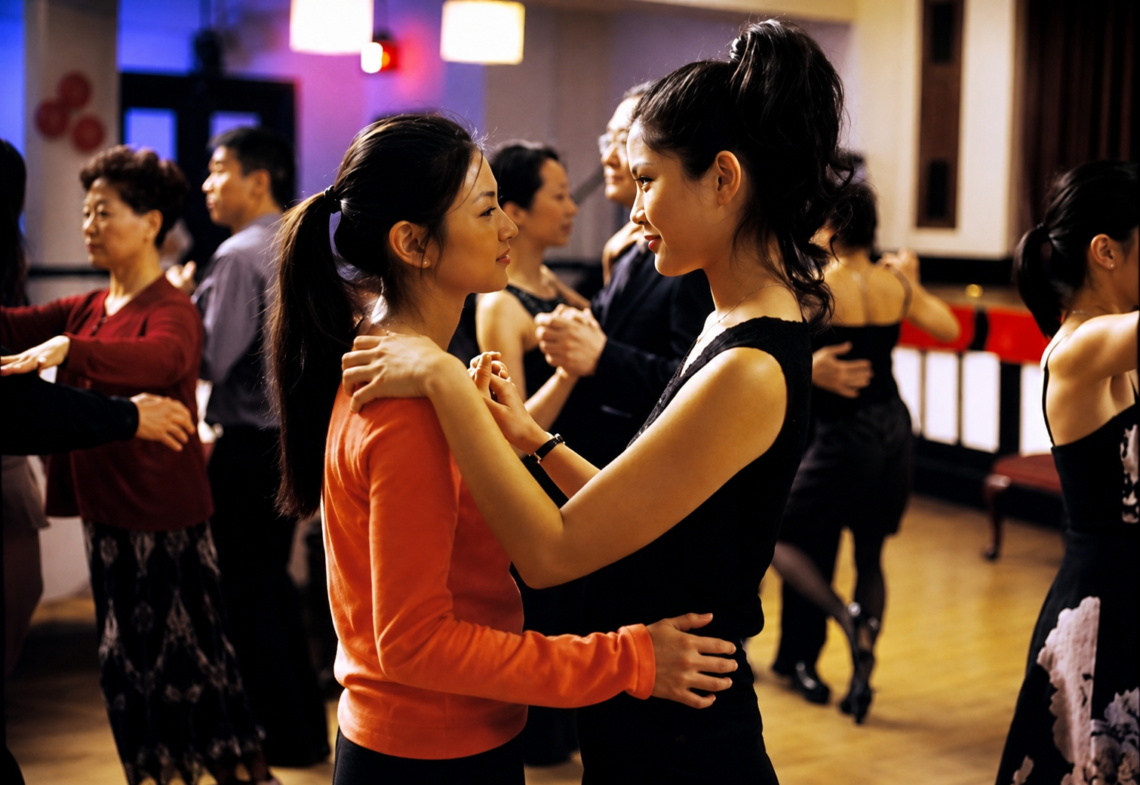
However, a few months later, at the community’s year-end gathering—the most heavily guarded “plaza of face”—the ending where Wil approaches Vivian and asks for a dance signifies the complete acquisition of subjectivity. This conclusion is a dignified declaration to refuse compliance with the massive world of others’ gazes and to face the world with one’s own authentic face. What Wil and Hwei-Lan gained by choosing their respective loves is not the false security of the community, but the complete freedom and internal growth to control their own lives.
💬 On the Interpretation and Modern Representation of Saving Face
Q. How do you evaluate the criticism that the film excessively caricatured or compromisingly depicted the conservatism of immigrant society?
The criticism that the work somewhat softly portrayed the deep-rooted oppression of patriarchal immigrant society by adopting the form of a wedding commotion or a comical blind-date farce in the latter half is valid. However, this should be interpreted as the director’s aesthetic strategy of choosing public communication rather than a sharp indictment. In that it opened a pathway for the queer narrative to softly permeate the interior of the community through a pleasant subversion instead of a tragic severance, the points of divergence in preference for this work function instead as a strength that broadens modern inclusivity.
Q. Despite being a work from the early 2000s, why does the film’s method of representing women remain valid to this day?
Unlike typical Western-centric queer films, it tightly weaves the contexts of “filial piety” and the “family community”—which are specific traits of the East Asian cultural sphere—into the narrative. In contrast to how white-centric narratives frequently treat homosexuality solely as a matter of individual liberation, this work fiercely contemplates how one can acquire subjectivity without severing the link to the family. Therefore, it poses deep humanistic questions to current audiences rather than remaining a simple romance relay.
✨ A Final Question That Saving Face Poses to Us in Modern Society
The ending of this film does not stop at merely celebrating the reunion of two lovers, but poses a question that remains valid to us now, some 20 years later. This is because we are still trapped in a modern version of “face”—such as the number of likes on social media or social reputation—living while censoring the desires we truly want.
Ultimately, true liberation does not stem from breaking down the wall that blocks me, but from the attitude of proudly taking responsibility for the person by my side even in front of that wall. Only those who choose internal truth over the rules of normalcy defined by the world can finally possess their own authentic face.
💃 Concerning the Distance Between ‘Hiding’ and ‘Revealing’ in Relationships
Silence born of fearing the gaze of others sometimes results in erasing not only oneself but also the very existence of the person one loves.
Do you tend to step forward proudly before the world to protect a precious relationship, or do you tend to cultivate the density of the relationship within a safe silence? Please share your thoughts on which choice protects your dignity more firmly.
🔮 Violet Screen Curation: Recommended Women’s Narratives to Watch Together
- Show Me Love (Fucking Åmål, 1998)
- Reason for Recommendation: A masterpiece Swedish coming-of-age drama set in a conservative small town, where two female students transparently find their feelings for each other against the surrounding gazes and prejudices.
- Shiva Baby (2020)
- Reason for Recommendation: A black comedy depicting the suffocating day of a protagonist who simultaneously confronts her family’s nagging, her ex-girlfriend, and her sugar daddy in the confined space of a traditional Jewish funeral (shiva).
TODAY'S QUESTION
What's your favorite line from a WLW movie or show?
Your answer isn't saved. Feel free to share it in the comments below.


You May Also Like

Thai GL Film Yes or No: The Aesthetics of Identity and Liberation Offered by a Queer Classic

Bandaged (2009) Analysis: Tearing Through Suppressed Oppression Hidden Beneath Bandages—Two Women’s Destructive Indulgence and Its Ultimate Conclusion