First Kill: Desire Carved Between Instinct and Taboo
Is yearning for another’s warmth in an isolated world an instinct for survival, or a choice toward destruction? At times, we discover our most authentic mirror in the very being we are forbidden to love. This paradoxical narrative—where the act of inflicting a wound becomes a testament to love and the hunt serves as a courtship—touches upon the primal deficiencies hidden within us.
🌿 Moments When This Drama Resonates Deeply
- On nights when you feel powerless before the towering wall of fate, yet cannot stop your footsteps toward one another.
- When the sublime devotion known as “family” begins to feel like a sharp snare tightening around the individual self.
- When you wish to witness the collapse of the predator-prey binary and see a new emotional order bloom within the cracks.
- Ultimately, one must read this record to the end to discover the true meaning of the “first kill” these two girls face at the intersection of fierce hatred and fascination.
🎞 Notes Before Viewing
This work features physical conflict and blood-soaked depictions inherent to the antagonistic structure of vampires and hunters. However, these elements function not as mere horror, but as cinematic devices to visualize the fatal attraction and tension between characters. Above all, it is a relationship-driven narrative focused on the transference of emotion.
🎬 Drama Information
- Title: First Kill (2022)
- Director: Jet Wilkinson et al.
- Screenplay: Victoria Schwab, Felicia D. Henderson
- Original Work: Based on the short story of the same name by Victoria Schwab
- Country: USA
- Genre: Supernatural Young Adult Drama, Romance
- Running Time: Season 1 (8 Episodes)
- Platform: Netflix
- Cast: Sarah Catherine Hook (Juliette Fairmont), Imani Lewis (Calliope Burns)
📖 First Kill: A Vortex of Fate Where Hunter and Prey are Reversed [No Spoilers]
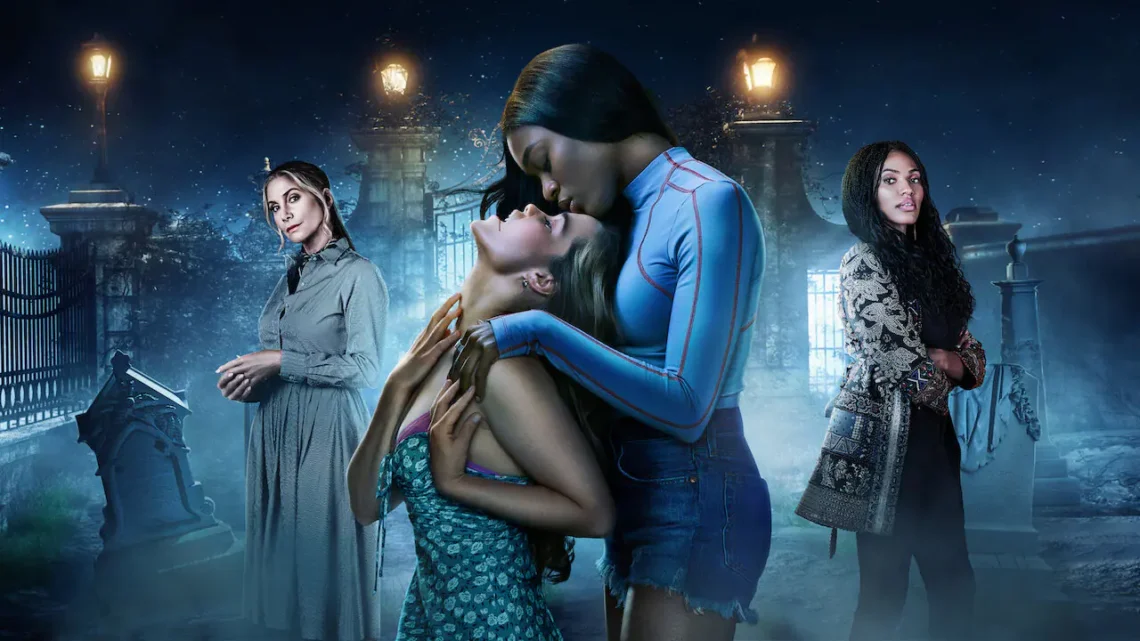
Approaching her rite of passage, Juliette Fairmont, a legacy vampire, faces immense pressure to complete her first kill according to family tradition. However, possessing a naturally kind disposition, she feels an aversion to taking a life and endures a torturous thirst. Amidst this, she experiences an intense fascination with Calliope Burns, a mysterious girl who has newly transferred to her school.
Conversely, Calliope, hailing from a family that has hunted monsters for generations, is filled with the desire to succeed in her first hunt and be recognized as an official hunter. The two girls, having marked each other as their first prey, encounter one another in a dark corner of a party. There, in the space where murderous intent should reside, an unfamiliar longing begins to take root. As ancestral destiny clashes with personal desire, their relationship begins to oscillate precariously between irrevocable catastrophe and revolution.
🩸 Variations on Fate: An Aria of Dominance and Submission in First Kill
While the work adopts the classical framework of Romeo and Juliet, the energy filling that space is far more subversive. The relationship between Juliette and Calliope extends beyond simple romance; it acts as an act of destruction against the moral codes of their respective closed communities. While the vampire family defines “preservation of pure blood” as justice and the hunter family defines “absolute eradication” as the same, the two protagonists realize through each other how hypocritical that justice truly is.
Specifically, the thirst Juliette experiences is both a physical hunger and an expression of emotional liberation—a desire to escape the society that defines her as a “monster.” Her choice of Calliope is not merely due to attraction, but because she feels most vividly alive only in the presence of the one being capable of killing her.
🏹 Mirror Identity: Finding the Other Self at the End of the Hunt
The recurring imagery of the “hunt” throughout the drama serves as a key device symbolizing the growth of the two girls. For Calliope, hunting was a means to gain parental approval, but upon meeting Juliette, it transforms into a painful process of understanding the “Other.” The transition from a hand attempting to drive a stake through a heart to a hand reaching out to hold the other signifies a psychological leap—recognizing the other not as an object of conquest, but as an object of coexistence.
Furthermore, the contrast between the two families suggests an interesting social context. The tension between the vampire family, disguised as a wealthy, sophisticated professional class, and the hunter family, characterized by a working-class ethos moving under military discipline, can be read as a variation on class conflict. Within this, the two girls construct their identities as independent subjects rather than as assets or tools of their families.
🔎 Reinterpreting the Ending — The Eternal Fracture Hidden Behind Complete Union
In the finale of Season 1, Juliette’s act of turning Theo into a vampire leaves a deep resonance as a tragedy born of good intentions. In effect, she has dealt him a shame worse than death, ultimately creating an irreparable fracture in the couple’s relationship. This paradox—where an act intended to save out of love becomes the cruelest curse to the recipient—poignantly demonstrates that the essence of a relationship is grounded in selfish desire.
Calliope’s rage and Juliette’s guilt have now become barriers as formidable as their affection for one another. This conclusion declares that the two have moved beyond the stage of simply overcoming family interference and have entered a stage of maturity where they must live with the scars they have inflicted upon each other. Love is sometimes completed not through salvation, but by the destruction of each other’s worlds.
🧐 First Kill Ending Analysis: Is Coexistence Truly Impossible for Hunter and Vampire?
Q1. Was Juliette’s choice to turn Theo into a vampire truly a selfish desire?
Some viewers criticize Juliette for transforming Theo to ease her own guilt while ignoring Calliope’s pain. However, one must consider the racial characteristics of being a “legacy vampire” and Juliette’s sense of alienation within her family. To Juliette, death is an absolute end, while transformation was the beginning of “another life.” She attempted to save Theo in the best way she knew, but it remains a tragedy caused by that aesthetic attempt clashing with the ethics of a hunter. Ultimately, this should be viewed not as a matter of good and evil, but as a collision of differing worldviews.
Q2. Was Calliope’s vow of revenge as she left Juliette at the end a breakdown of the narrative?
While many were bewildered by the abrupt shift in attitude, it is an inevitable result of Calliope’s “family-centered narrative.” To her, Theo was not just a brother, but the embodiment of her pride as a hunter. When Juliette violated that value, love was instantaneously displaced by the fuel of hatred. This point serves as a device that breaks away from the typical tropes of YA romance to remind the audience of the gravity of relationships, posing a heavy question: can love take precedence over all other values?
✨ First Kill: Human Dignity Proven Through Wounds
This drama questions the “wounds” that inevitably accompany human relationships. To love someone deeply is to expose one’s most vulnerable parts and, simultaneously, to possess the power to dismantle the other’s world. The tragedy faced by Juliette and Calliope is the price of growth, suggesting that true solidarity begins not by removing each other’s differences, but by gazing steadily at the wounds those differences have made.
True growth begins the moment one realizes their own instinct can become violence to another and resolves to endure the weight of that responsibility.
🌹 Two Truths Encountered at the Edge of a Relationship
If you had to choose to make someone the very being they loathe most in order to save them, would you call that “love”? Or would you call it “selfishness” that interrupted a noble death?
- Option 1: The tether of obsession that clings to a loved one’s breath, even if they must become a monster.
- Option 2: The etiquette of silence that respects the values they upheld and willingly lets go at the most tragic moment.
🎬 Another Perspective from Violet Screen: Recommended Women-Led Narratives
- Warrior Nun (2020): A sensory fantasy action series depicting the solidarity and struggle of women who reject a holy calling to choose their own paths.
- Motherland: Fort Salem (2020): An alternate history work where witches become the nation’s military, exploring the complex power structures and emotional bonds among women in depth.
To provide a more stable publishing environment, multilingual content, and better communication with our readers, we have moved our official publication to Substack.
All new film reviews and critical essays will be published on our new platform. This website will be closing down soon, so we would greatly appreciate it if you subscribed to our new space.
TODAY'S QUESTION
What genre or mood do you always reach for when you're alone?
Your answer isn't saved. Feel free to share it in the comments below.


You May Also Like
Interpreting Euphoria: The Catastrophic Aesthetics of Addictive Illusions and the Obsession with Salvation

Xeque Mate Review: A Precarious Solidarity Blossoming on the Chessboard of Desire