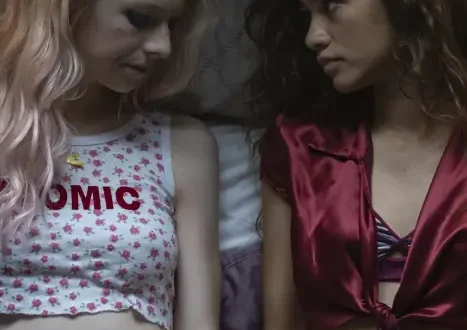
Yellowjackets (2021) Analysis: Trajectories of Twisted Desire Buried Beneath the Hunger for Survival
In an isolated wilderness, the first thing humans lose may not be the etiquette of civilization, but the capacity for empathy—the ability to sense the pain of others. Hunger devours morality, and survival distorts the very form of love into something grotesque. Yellowjackets is more than a mere chronicle of the atrocities suffered by stranded girls; it is a chilling mirror that forces us to confront the face of the primal ‘predator’ hidden behind the masks of social achievement and reason.
🌿 The moments this series deeply permeates
- To those who have felt an internal ‘Other’ that even you cannot control.
- If you have memories of a passionate first love ending with the coldest betrayal.
- For adults living with rotting secrets beneath the fortified walls of social success.
- The reason to read until the end: Because a hair-raising catharsis begins the moment you realize Taissa’s dual personality is not a simple ailment, but the ‘monster of survival instinct’ that dwells within us all.
🎞 Note before viewing
This work deals with psychological fissures and suppressed desires between characters arising from extreme isolation. While it includes physical mutilation and horrifying depictions, it is essentially a psychological thriller focused on complex, subtle solidarity and destructive relationships among women.
🎬 Drama Information
- Title: Yellowjackets (2021)
- Director: Ashley Lyle, Bart Nickerson
- Writer: Ashley Lyle, Bart Nickerson, et al.
- Country: USA
- Genre: Survival, Psychological Thriller, Mystery
- Running Time: 4 Seasons (Approx. 60 min. per episode)
- Platform: TVING (Paramount+), Netflix (Varies by season)
- Cast: Tawny Cypress (as Taissa Turner), Jasmin Savoy Brown (as young Taissa), Melanie Lynskey, Christina Ricci, Juliette Lewis, Sophie Nélisse, Liv Hewson (as young Van), Lauren Ambrose (as adult Van)
📖 Yellowjackets, a Dirge of Ruin Created by the Collision of Past Savagery and Present Hypocrisy [No Spoilers]
In 1996, members of the promising ‘Yellowjackets’ high school girls’ soccer team board a plane for a national tournament, only to crash in the heart of the Canadian wilderness. For nineteen long months, they survive not by the laws of civilization but by the rules of the forest, making terrible choices that they dare not speak of.
Taissa, who exercises realistic leadership, and her lover Van sustain each other amidst the terror of survival, becoming each other’s sole sanctuary. However, twenty-five years after their rescue, shadows of the past reappear before the adult Taissa, now a senatorial candidate with a seemingly perfect family. Her other persona, ‘Dark Taissa,’ awakened alongside her sleepwalking, begins to shatter the peaceful life she has built. Forgotten symbols of the forest reappear, leading her back to Van—her past lover and the sharer of her secrets.
🌒 The Orbit of Taissa and Van: An Interpretation of Salvation in the Name of Love and Predatory Obsession
The relationship between Taissa and Van in Yellowjackets takes a unique form, blending survival and madness beyond simple romance. In the forest of 1996, Van was the only person who witnessed the darkest part of Taissa—’Dark Taissa’—and was not afraid. If it was Taissa’s devotion that saved Van from the brink of death after a wolf attack, it was Van’s sacrificial love that protected the uncontrollable Taissa by tethering them together every night.
However, their relationship is shattered by Taissa’s choice of ‘Respectability’ following their rescue. To ensure her success, Taissa pushes away Van—the symbol of her past savagery—and hides within the realm of ‘normalcy’ by marrying Simone. Yet, that which is suppressed inevitably returns. Adult Taissa’s acts of threatening her family and creating grotesque altars while sleepwalking prove that the forest instincts she tried to discard never truly vanished. Ultimately, the reunion of the two is not a recovery of lost love, but a tragic flare that reawakens the monsters lurking within their respective interiors.
🌳 Dark Taissa and ‘The Man with No Eyes’: A Cruel Interpretation Designed by the Suppressed Unconscious
Taissa’s dual personality, the so-called ‘Other Tai,’ is the grandest mystery and psychological mechanism permeating the entire work. ‘The Man with No Eyes,’ seen at her grandmother’s deathbed during childhood, instilled in her a trauma associated with death and supernatural terror. For Taissa, who aspires to an extremely rational and controlled life, ‘Dark Taissa’ becomes a conduit for discharging raw desires and survival instincts that are socially unacceptable.
The actions performed by this ‘other persona’ are intriguing. Sacrificing a pet dog’s head on an altar and performing grotesque rituals are, by common standards, mad crimes; yet, as a result, Taissa wins the senatorial election. This implies that the energy of the forest, or perhaps her unconscious, chose ‘sacrifice’ for the sake of victory. Dark Taissa serves as the predatory ego that executes the ‘foul gambit’ Taissa’s rational self could never dare to commit.
🔎 Reinterpretation of the Ending — The Forest Never Lets Go of a Human
The truth revealed as the seasons progress is that although they escaped the woods, the rules of the forest still flow through their veins. The adult Taissa eventually seeking out Van and destroying her own family in the process follows the savage logic that ‘there is no achievement without sacrifice.’ The fact that Van is battling illness and the tragic omens surrounding her demonstrate how the unpaid price of survival in the past eventually strips away the precious things of the present.
The conclusion Taissa faces is ultimately the total fragmentation and isolation of the self. She craves love but hurts the one she loves; she desires success, but the foundation of that success is steeped in blood and soil. The brilliant political achievement she has built is, in fact, nothing more than a precarious fortress traded for a dog’s head hidden in the basement. Taissa’s fragmentation is a specimen of structural collapse, showing that the beast hidden beneath the thin skin of civilization can overpower human will.
❓ Yellowjackets Deep FAQ: On the Ambiguity of the Ending and Narrative
Q. Is the supernatural element not too strong to view Taissa’s behavior as simple mental illness?
A. Correct. From a critical perspective, one could argue the work consumes mental illness too much as a horror trope. However, the creators maintain an ‘aesthetic of ambiguity’ by not defining it clearly. While Taissa’s symptoms could be medically explained as Dissociative Identity Disorder, her subconscious discovery of secret forest locations and her prophetic actions make it impossible to exclude the intervention of ‘supernatural forces’ within the work. Ultimately, this serves as a device asking the audience what to believe in—reason or madness—when faced with a grand destiny beyond human control.
Q. Were the cruel power structures and depictions of cannibalism among women necessary?
A. The value of this work lies in shattering the illusion of ‘unconditional solidarity’ often expected in female-centric narratives. It unflinchingly reveals that in extreme situations, women can become predators just like men, establishing hierarchies and sacrificing comrades for survival. This is interpreted as an essential device to break the frame of ‘moral purity’ previously assigned to female characters and to establish them as more human (and simultaneously diabolical) subjects of desire.
✨ Yellowjackets: A Question Posed to Human Hypocrisy, Which Only Becomes Truthful in the Dark
Yellowjackets coolly observes how past trauma colonizes the present and how easily the emotion we call ‘love’ is eclipsed by the monster of ‘survival.’ Taissa’s sleepwalking is not a mere sleeping habit, but perhaps a struggle for truth intended to tear down a life built on lies. The more perfect the roles we play in society, the larger the hole ‘The Man with No Eyes’ drills as he watches us.
We all live harboring a forest of our own, and the things done there will inevitably one day knock on the door of the present.
💬 What secrets are buried in your forest?
Are there ‘fragments of your most innocent days’ that you had to give up or ignore for social success? If the shadows of the past were to threaten your perfect present, would you, like Taissa, sacrifice them to move forward, or would you lay everything down and kneel before the truth of the forest?
💜 Violet Screen’s Recommended Curation: The Pinnacle of Suppressed Desire and Female Narrative
- The Wilds (2020): Dealing with the psychology and growth of girls isolated on an island after a plane crash, this series focuses slightly more on high-school narrative while maintaining sharp relationship depictions similar to Yellowjackets.
- Dead Ringers (2023): A work dealing with the twisted symbiosis and desire of twin obstetrician sisters. Recommended if you found Taissa’s self-fragmentation intriguing.
To provide a more stable publishing environment, multilingual content, and better communication with our readers, we have moved our official publication to Substack.
All new film reviews and critical essays will be published on our new platform. This website will be closing down soon, so we would greatly appreciate it if you subscribed to our new space.
TODAY'S QUESTION
Which ending has stayed with you the longest?
Your answer isn't saved. Feel free to share it in the comments below.


You May Also Like
Gypsy (2017) Netflix Psychological Thriller Review: A Mirror of Twisted Desire Crafted by Deficiency
Conversations with Friends: The Aesthetics of the ‘Fissure’ Born from the Collision of Isolated Interiors and the Worlds of Others