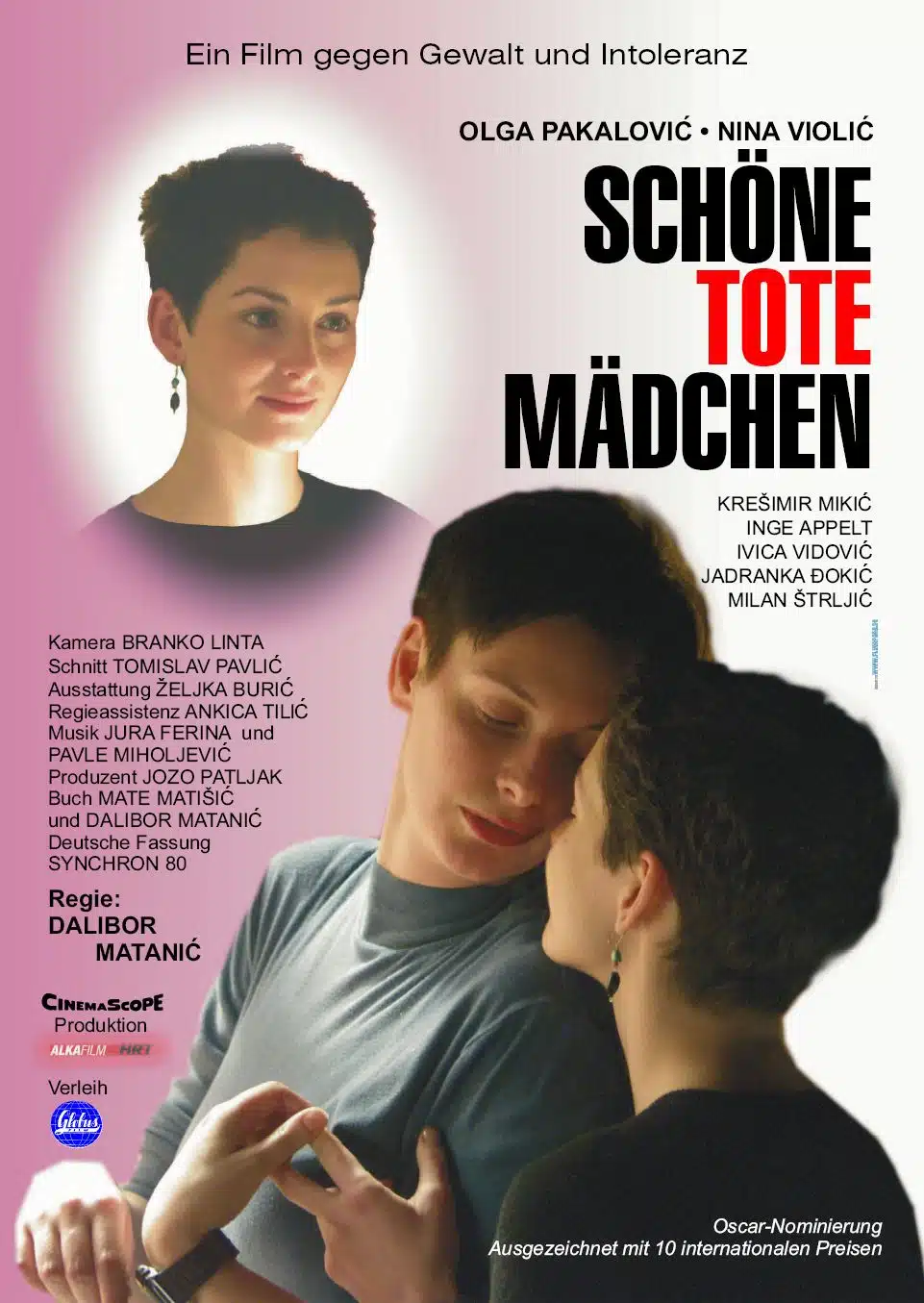
Fine Dead Girls (Fine mrtve djevojke): An Apartment of Hatred and the Cruelty of Isolated Desire
There are spaces where one’s very existence poses a threat—places where the gaze of others becomes a blade and difference is branded a sin. The 2002 film Fine Dead Girls, which shook Croatia upon its release, moves beyond the tragic romance of two women to dissect the social madness and the ugly reality of patriarchy hidden in the wake of war.
The film poses a harrowing question: Could the home we believe to be a sanctuary actually be the ultimate prison? It is a visceral record of how far a human can be destroyed when the desires of others trample upon one’s dignity, and how one continues to live atop those shattered ruins.
🌿 Moments when this film resonates deeply:
- When you desperately seek a perfect sanctuary for two, fleeing from the eyes of the world.
- When you wish to witness the structural violence of how the silence of the majority gradually suffocates the lives of the minority.
- When you are prepared to endure the discordant notes struck when love, the purest of values, collides with social mania.
The reason to read this piece to the end is to understand the price paid by the one who ultimately survived amidst destroyed relationships, and the true nature of the revenge hidden within.
🎞 Note Before Viewing
This work contains intense and shocking depictions of homophobia, sexual violence, and mob lynching. These are not mere devices for provocation; they function as narrative tools to indict the maladies of Croatian society at the time and deeply explore the destruction of human connections.
🎬 Movie Information
- Title: Fine Dead Girls (Fine mrtve djevojke, 2002)
- Director: Dalibor Matanić
- Screenplay: Mate Matišić, Dalibor Matanić
- Country: Croatia
- Genre: Drama, Thriller, Crime
- Running Time: 77 minutes
- Platform: MUBI (varies by region), International VOD services
- Cast: Olga Pakalović, Nina Violić, Inge Appelt, Ivica Vidović
📖 Fine Dead Girls: The Process of a Mundane Sanctuary Turning into the Entrance to Hell [No Spoilers]
Iva, a medical student, and her lover Marija move into an old apartment on the outskirts of Zagreb. Though they are a lesbian couple deeply in love, they attempt to live quietly, concealing their relationship from neighbors in consciousness of the conservative social atmosphere. However, the apartment they choose serves as a microcosm of a Croatian society rife with the scars of war and hypocrisy.
The landlady Olga, who rules with an iron fist, her violent son Daniel, and neighbors harboring their own ugly secrets initially approach with masks of neighborly kindness. Yet, the moment the couple’s sexual identity is accidentally discovered, the apartment instantly transforms into a massive interrogation room and an execution ground. The collective madness, fueled by hatred, brutally dismantles the two women’s daily lives and begins a headlong rush toward an irreversible catastrophe.
🏚️ Monsters Behind Closed Doors: Interpreting the Space Dissected by Fine Dead Girls
The apartment in the film is not a mere backdrop but functions as an organism where patriarchy and totalitarianism converge. Through these narrow corridors and worn walls, the director maps the psychological state of a nation suffering from the aftereffects of war.
The residents of each floor symbolize social ills: a doctor who wanders in a blood-stained gown performing abortions, an elderly man hiding his wife’s corpse to collect her pension, and a war veteran exerting violence while steeped in PTSD. While they turn a blind eye to their own immorality, they become harsh judges only toward the “difference” of the two women. This moral double standard is the most chilling reality of the horror that dominates the film.
⚠️ Enforced Normality and the Chain of Hatred: Structural Analysis of Character Relations
The landlady Olga is the architect of this hellscape. By inciting her son Daniel to “claim” Iva, she reduces the female body to family property or a tool for preserving bloodlines. The resulting sexual violence is not an individual deviation but carries the character of a social punishment used by the collective to domesticate the minority.
The act of Marija’s father hiring a prostitute to “correct” his daughter also blatantly exposes the violence hidden behind the names of religion and familism. Ultimately, the conflict in this film focuses not on the internal fissures between the two women, but on how a massive external system of hatred compresses and destroys them.
🔎 Reinterpretation of the Ending — Fractured Peace and the Curse of Bloodline
The film’s framing structure presents a cruel truth to the audience. In the present timeline, Iva has lost her past lover Marija and lives raising a son—the byproduct of the violence that violated her. Her appearance as a woman married to a man leading an ordinary life signifies not a victory, but a surrender for the sake of survival and a complete loss of self.
In the finale, the act of the once-impotent husband Blaž executing his wife Olga may seem like belated justice, but it is effectively just another violent manifestation of patriarchy. Iva has reclaimed her child, but that child is the bloodline of the perpetrator who destroyed her and the physical embodiment of a memory she wishes to erase.
This conclusion suggests that despite physical revenge being carried out, the victim’s interiority can never be healed. The life of the survivor is imprisoned in an abyss deeper than the memory of the dead. This completes a structural tragedy, meaning the history of violence has not ended but has seen the seeds of that tragedy transferred to the next generation (the son).
❔ In-depth FAQ on the Ending and Narrative Devices of Fine Dead Girls
Q1. The ending feels overly contrived or like a sudden “deus ex machina.” Is this a limitation of the work?
The revenge scenes in the latter half certainly tend toward symbolic condemnation rather than narrative causality. However, this should not be interpreted as the director providing catharsis for the audience. Rather, it must be seen as an aesthetic choice to emphasize a desperate social structure where the situation can only be terminated by the most powerless figure exerting violence. While the point of criticism is clear, the urgency itself represents the magnitude of social resentment felt by the Croatian film industry at the time.
Q2. How do you view the criticism that the two women are depicted as passive victims rather than proactive agents?
From a modern perspective, Iva and Marija may appear as weak characters swayed by their environment. However, considering the extreme homophobic sentiments of Eastern Europe in the early 2000s, their very existence was already a monumental resistance. The film adopts a strategy of establishing them as ordinary humans rather than heroizing them, thereby maximizing the demonstration of how easily an average person can be crushed by a system.
✨ Fine Dead Girls: Precarious Survival Built Upon the Ruins of Hatred
This film deals with the “internal war” that persists among us even after the war has ended. The gunfire may have ceased, but the hypocrisy of patriarchy and the hatred of minorities still wander the apartment corridors, searching for new victims. Iva’s final gaze warns us: as long as the violence of the majority to “correct” the abnormal into the normal does not stop, true peace cannot exist.
Survival conceived through violence is not salvation, but a deferment of pain that will last forever.
💬 Is your sanctuary safe?
Have you ever witnessed a moment where the silence of the majority turns into violence in an isolated space? Between the bystanders of the majority and the resistance of the minority, would you have the courage to open that apartment door and walk out?
📽️ Violet Screen Curation: Other Narratives of Relationships
- Blue Jean (2022)
- Reason for Recommendation: Set in 1980s Britain under ‘Section 28,’ it deals with the isolation and growth of Jean, a teacher who must hide her identity. While Fine Dead Girls focuses on external violence, this work delicately captures how an oppressive social atmosphere erodes an individual’s interior.
- Women Talking (2022)
- Reason for Recommendation: Following a series of mass sexual assaults within an isolated community, it shows the power of dialogue as women gather to discuss whether to “stay or leave.” It provides a deep sense of liberation through the process of confronting patriarchal violence not with physical conflict, but with logical solidarity and resolve.
To provide a more stable publishing environment, multilingual content, and better communication with our readers, we have moved our official publication to Substack.
All new film reviews and critical essays will be published on our new platform. This website will be closing down soon, so we would greatly appreciate it if you subscribed to our new space.
TODAY'S QUESTION
Which ending has stayed with you the longest?
Your answer isn't saved. Feel free to share it in the comments below.


You May Also Like

Lucky, Apartment: The Psychology of Space and Memories of Odor Captured by a Female-Centric Film

Viola di mare Review: A Monumental Queer Film That Shattered Patriarchal Barriers
