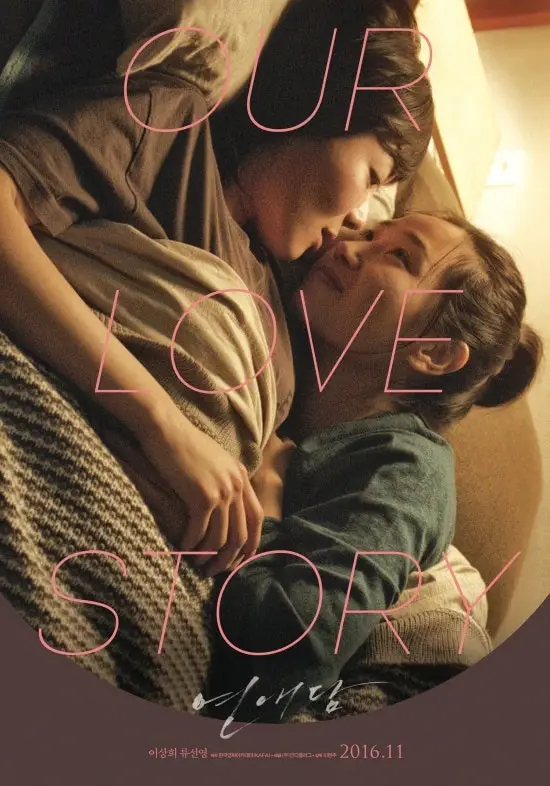
Our Love Story: A Perspective on the Temperature of Clumsy Hearts and Realistic Rifts
The emotion of love sometimes shakes the very foundation of a human life, but the weight of reality that follows relentlessly tests the expiration date of that feeling. Through love, we may discover new facets of ourselves, yet we also acutely confront our own deficiencies and limits.
Without flamboyant packaging, the film Our Love Story calmly yet sharply captures the process of two individuals becoming imbued with each other and the delicate textures of emotions wounded within the subtle cracks of reality.
🌿 Moments When This Film Resonates Deeply
- For those who remember losing the balance of daily life after falling irresistibly for someone for the first time
- For those who understand the loneliness of pragmatic compromise and silence over the heat of passion
- For those who prefer narratives focused on emotional connection and subtle shifts in temperature between characters
- For those who wish to look back on themselves as having grown a step further after passing through memories of awkward first love
- For those who desire to deeply understand the essence of relationships through the structural process of love beginning and dissolving
🎞 Notes Before Viewing
This work avoids provocative or excessive direction regarding physical touch or emotional expression, focusing instead on emotional communion and subtle relational shifts between the characters. It is an emotion-driven romantic drama that depicts love between women through a thoroughly ordinary and realistic lens.
🎬 Film Information
- Title: Our Love Story (연애담, 2016)
- Director: Hyun-ju Lee
- Screenplay: Hyun-ju Lee
- Country: 🇰🇷 South Korea
- Genre: Romance / Drama
- Running Time: 99 minutes
- Platforms: Watcha, Wavve, TVING, Naver Series On
- Cast: Sang-hee Lee – as Yoon-ju, Eun-yeong Ryu (Ryu Abel) – as Ji-soo
📖 Our Love Story: The Flutter of Clumsy First Love and the Unfolding of Realistic Cracks [No Spoilers]
Facing her fine arts graduate school thesis exhibition, thirty-year-old Yoon-ju, whose sense of self and vitality remain ambiguous, randomly encounters the bold and free-spirited Ji-soo at a junk shop and a convenience store. Yoon-ju feels a powerful attraction to Ji-soo’s subtle charm, while Ji-soo takes a liking to Yoon-ju’s unsophisticated demeanor, leading the two to naturally become lovers. Yoon-ju’s life becomes entirely consumed by Ji-soo, causing her graduation work to fall by the wayside.
Meanwhile, Ji-soo begins to experience conflict between her father’s marriage pressure and pragmatic compromises. The physical and psychological distance between Samcheok and Seoul creates a deep fracture between the two. Amid Ji-soo’s cold demeanor, Yoon-ju faces trials in both her art and her relationship, encountering a major emotional turning point.
🎨 Yoon-ju and Ji-soo: The Attraction of Deficiency and Emotional Imbalance
For Yoon-ju, Ji-soo was a powerful sensory stimulus entering a stagnant daily life. Conversely, for Ji-soo, Yoon-ju was a safe sanctuary to temporarily retreat from the exhaustion and pressures of reality. The temperature difference in their emotions—present from the starting line—becomes increasingly clear as the relationship deepens.
Yoon-ju submerges herself to the point of setting aside her daily routine and artwork for Ji-soo, whereas Ji-soo cannot fully break away from the conventional framework demanded by patriarchal society. This substantial difference in temperature ultimately serves as the central axis of the narrative, acting as the primary cause that shakes their relationship.
🌫 Spatial Mise-en-scène: The Confinement of the Studio Apartment and the Cold Distance of Samcheok
In this film, space functions as a vital device representing the psychological states of the characters. Yoon-ju’s studio apartment acts as a protective space safeguarding an intimate and warm world belonging solely to the two of them, yet it simultaneously serves as an isolated island cut off from external reality.
In contrast, Samcheok—the space where Ji-soo’s father resides—is a place governed by a thoroughly realistic and patriarchal order. The cold attitude Ji-soo displays when Yoon-ju visits Samcheok clearly demonstrates how easily emotions constructed within an enclosed personal space can collapse in the face of social space’s reality.
🔍 Reinterpreting the Ending: Traces of Dignity and Growth Left by a Calm Farewell
The coldness Yoon-ju displays toward Ji-soo when she returns after everything has crumbled is not mere resentment. It is a declaration of dignity that she will not entrust her life entirely to another person, and a resolve to no longer remain an auxiliary presence.
While this conclusion signifies that a permanent fracture in their relationship has been completed, it also demonstrates that Yoon-ju has emerged from the emotional whirlpool to finally stand upright in her own life and work. Yoon-ju lost love, but gained a sense of self and agency that is no longer swayed by others. This calm farewell is not emotional bankruptcy, but a structural renewal through which the protagonist reclaims her dignity.
❓ Our Love Story: Ethical Controversies Surrounding the Work and Limits of Artistic Reception
Q. Our Love Story received high praise as a queer narrative featuring women, but generated significant controversy due to the director’s sexual assault incident. How should we view this work?
One must first acknowledge the critical points and ethical dilemmas. The fact that the director, as a creator, was sentenced to a prison term for sexual assault creates immense aesthetic and ethical ambiguity alongside the delicate female narrative and solidarity values contained within the film. Despite the outstanding craft and emotional resonance within the text itself, the moral discomfort that audiences inevitably feel during the viewing experience is a natural response.
Therefore, viewing this work must not end at simply praising cinematic aesthetics. It requires an active, subjective stance from the reader—either strictly separating the value of the text from the creator’s ethical crime, or critically recognizing the gap itself while reading the work.
✨ Our Love Story: Existential Questions Posed by Past Love
The film Our Love Story does not merely sing of the beauty inherent in love; it honestly contemplates human clumsiness and limits as they crumble before the wall of reality. Just as Yoon-ju establishes her own life through the dissolution of love, the end of a relationship sometimes becomes the most potent catalyst compelling one to face oneself.
The failure of love is not the destruction of existence, but a painful transition back to oneself.
💬 Where Does Your Choice Lie Within a Relationship?
The moment love ends, we stop living a life dragged around by another and finally reclaim ourselves.
Have you ever had the experience of leaving your loving heart behind out of necessity due to walls of reality or differences in emotional temperature, or were you the type to struggle until the end to mend those cracks?
💜 Violet Screen’s Pick: Recommended Female-Centric Narratives
- Moonlit Winter (윤희에게, 2019)
- Reason for Recommendation: An emotional melodrama about healing deep-seated deficiencies and recovering one’s sense of self through a journey in search of lost first love memories.
- The Handmaiden (아가씨, 2016)
- Reason for Recommendation: A major classic work that unpacks the intense solidarity and love between two women surpassing status and schemes through exquisite mise-en-scène and a meticulous narrative structure.
TODAY'S QUESTION
What changed the most for you after coming out?
Your answer isn't saved. Feel free to share it in the comments below.


You May Also Like
La Graine (2023) Review: Love and the Conditions of Family Beyond the Boundaries of Normativity

Bye Bye Blondie, An Eternal Trajectory Between Punk Resistance and Bourgeois Compromise