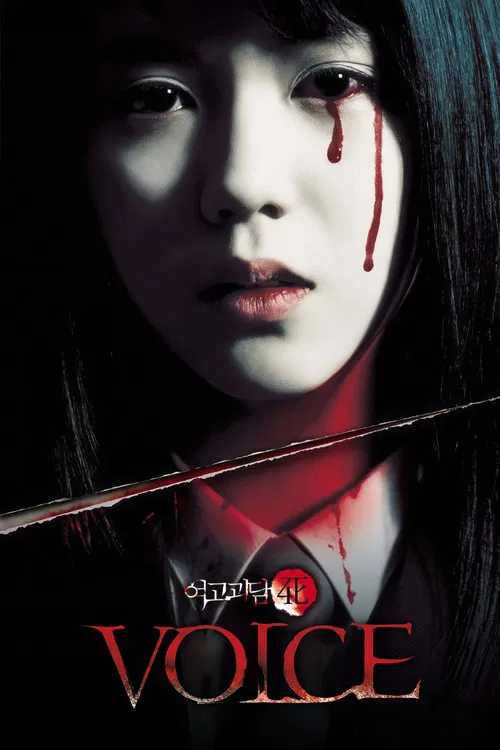
Whispering Corridors 4: Voice — A Chilling Sonic Tragedy Born of Lack and Possessiveness
Human beings live with an intense desire to have their existence validated. Within the narrow boundaries of relationships where one’s presence is proven only through the gaze and voice of others, the longing for recognition often curdles into a chilling madness.
The film Whispering Corridors 4: Voice is a cruel yet beautiful emotional tragedy that delves deep into the precarious psychology of characters experiencing obsession, isolation, and loss of identity within the claustrophobic space of a girls’ high school.
🌿 Moments When This Film Penetrates Deeply
- For those who have felt the primal fear of being utterly forgotten by someone: The film three-dimensionally and sensorially embodies the emotion of extinction—of being erased from another’s memory.
- For those fascinated by dense relationships where love and obsession, admiration and jealousy intertwine by a paper-thin margin: It deeply dissects the precarious emotional power dynamic underlying teacher-student and peer relationships.
- For those seeking a humanistic mystery centered on emotion and narrative beyond simple jump-scare horror: It offers a deep, lingering resonance completed through auditory symbolism and mise-en-scène.
The reason to read until the very end, therefore, is that it anatomizes the structure of lack hidden behind surface-level screams, illuminating the boundary between true dignity and cruelty implied by the characters’ shocking choices in the resolution.
🎞 Note Before Watching
Rather than physical mutilation or visual dopamine dripping with blood, this work is a psychological horror emotional drama focused on interpersonal relationships, lack, and the auditory mise-en-scène of the voice. While maintaining an appropriate level of expression suitable for a 15-and-over rating, it quietly and heavily stirs emotional anxiety.
🎬 Film Information
- Title: Whispering Corridors 4: Voice (여고괴담 4: 목소리, 2005)
- Director: Choi Ik-hwan
- Screenplay: Choi Ik-hwan
- Country: 🇰🇷 South Korea
- Genre: Horror / Mystery / Occult
- Running Time: Approx. 100 minutes
- Platforms: Watcha, TVING, Wavve, Series On
- Cast: Kim Ok-bin (as Young-eon), Seo Ji-hye (as Seon-min), Cha Ye-ryun (as Cho-ah), Kim Seo-hyung (as Hee-yeon), Lim Hyun-kyung (as Hyo-jung)
📖 Whispering Corridors 4: Voice Synopsis — The Girl Left Only as a Voice and the Truth of Entangled Memories [No Spoilers]
At Seongwon Girls’ High School, Young-eon, a student with exceptional vocal talent, meets a tragic death accompanied by a mysterious vocal harmony while practicing late at night in the music room. However, immediately after her death, Young-eon wanders the school as a disembodied voice without realizing she has died, approaching her closest friend, Seon-min, who is the only person capable of hearing her voice.
As Seon-min sets out to find Young-eon’s body and the cause of her death, a strange rift develops when Cho-ah, a student with a mystical aura, appears and warns her not to unconditionally trust Young-eon’s voice and memories.
With the suicide of the music teacher Hee-yeon, past tragedies surface, revealing a complex web of emotional ties among Young-eon, Hee-yeon, and Hyo-jung—a former student who once sought to monopolize Hee-yeon’s affection. Deepened jealousy and anxiety, triggered as Hee-yeon’s focus shifted from Hyo-jung to Young-eon with her fresh voice, ultimately brought about an irreversible catastrophe.
As the pursuit continues, Young-eon confronts the truth that she was not merely a innocent victim, but was selectively remembering only what she wanted to see within distorted memories, bringing the narrative to a shocking turning point.
🎼 Projection of Lack: Pathological Attachment and Power Dynamics Between Teacher and Student Mediated by Voice
The relationship among the three characters in the film—Young-eon, Hyo-jung, and Hee-yeon—far exceeds the boundaries of a pure teacher-student dynamic. Hee-yeon, a music teacher who lost her voice in a past accident and saw her dream as a vocalist shattered, harbors a desire to compensate for her lost self and inner lack through her students’ brilliant voices.
To Hyo-jung, Hee-yeon was the only warmth in the world that validated her existence and a salvation that would fill her loss; however, when Hee-yeon turns her attention to a new talent, Young-eon, Hyo-jung experiences a sense of existential erasure.
Young-eon likewise carried a psychological emptiness due to guilt over her mother’s death and her own solitude, making Hee-yeon’s special validation her sole sanctuary. Ultimately, Hee-yeon’s unstable affection served as fertile ground breeding rivalry between Hyo-jung and Young-eon, and this pathological structure of mutual dependence—where one can survive only through another’s recognition—culminated in a tragic collapse.
🩸 Distortion of Memory and Fracturing of Subjectivity: Interpreting Young-eon as Both Victim and Perpetrator
The most chilling aspect of Whispering Corridors 4: Voice is the fact that the dead protagonist Young-eon’s memories are by no means pure or objective. Young-eon frames herself as an wrongfully murdered victim, appealing to Seon-min’s sympathy; however, Cho-ah’s intervention and the emergence of the truth expose the selfishness and obsession latent within Young-eon. Young-eon sought to monopolize Hee-yeon’s affection while ignoring the sense of loss and pain Hyo-jung felt, restructuring her own memories to conceal her guilt.
This narrative twist sharply illuminates how human beings selectively edit memories to justify themselves in relationships with others. Young-eon is reborn not as a pure victim, but as an agent of desire who wishes to sustain her own existence even at the cost of invading another person’s life.
🔍 Reinterpreting the Ending: Invasion of the Other and Complete Subjugation Driven by Longing for Existence
In the film’s final scene, Young-eon rejects the path of an ordinary vengeful spirit departing the living world. Young-eon’s desire degrades from “uncovering the secret of her death” to “living again even if it means stealing another’s body.” Disregarding Seon-min’s wariness and plea for her to leave, Young-eon eliminates Cho-ah and finally possesses the body of her best friend, Seon-min, fully stepping back into daily life.
What this ending leaves behind in their relationship is not the fulfillment of a bond, but an everlasting violence and catastrophe that completely swallows the subjectivity of the Other. Young-eon achieved her ends of survival and proof of existence, but lost her human dignity and genuine connection; Seon-min had her life and soul usurped as the price for her pure affection toward Young-eon.
Young-eon’s possession is not a salvation of the soul, but a cruel invasion and the completion of destruction by a self attempting to fill its own lack by erasing the life of another.
🗣️ On the Ending and Narrative Structure of Whispering Corridors 4: Voice
🙋♀️ Regarding criticism that Young-eon’s character transformation between the first and second halves is overly extreme
The abrupt shift from the position of a victim in the early part of the film to a subject who steals another’s life in the latter half may draw mixed reactions regarding narrative plausibility.
However, this is the exploded result of Young-eon’s guilt over her mother’s death and her fundamental fear of being erased without being remembered by anyone.
The director aimed to dissolve the boundary between victim and perpetrator, dramatically staging the harrowing survival drive and selfishness hidden deep within human nature.
✨ Whispering Corridors 4: Voice — The Solitude of an Existence Present Only in Others’ Memories
Whispering Corridors 4: Voice does not remain merely a ghost story haunting high school hallways; it is a work that precisely dissects the “desire for recognition” and “fear of extinction” harbored by all of us living in modern society. We constantly long to be heard by someone, perceiving being forgotten as a terror worse than death. Through the immaterial symbol of the voice, the film chillingly demonstrates that human desire, when stripped of subjectivity, can become a weapon that destroys others.
An existence validated solely through the recognition of others ultimately culminates in a tragedy that consumes even oneself.
🎧 What kind of voice does your solitude carry?
Have you ever experienced a moment when the desire to be fully understood by someone ended up breaking the relationship instead? Do you view Young-eon’s final choice as a desperate plea for life, or as a selfish invasion? Please feel free to leave your thoughts in the comments.
💜 Violet Screen Curation: 2 Recommended Works Featuring Delicate Psychological Narratives Between Women
- Moonlit Winter (윤희에게, 2019)
- Reason for Recommendation: Unlike Whispering Corridors 4, which is fraught with obsession and tragedy, this classic melodrama unfolds the long-buried longing and solid solidarity between women against a neat, beautiful snowy landscape. It serves as a perfect variation when you wish to feel emotional healing and growth.
- House of Hummingbird (벌새, 2019)
- Reason for Recommendation: A masterpiece drama that calmly captures the anxiety of relationships, lack, and the special connection with a teacher experienced during female adolescence through the life of middle schooler Eun-hee in 1994, viewed through a calm and humanistic lens.
TODAY'S QUESTION
When did you first feel fully accepted for who you are?
Your answer isn't saved. Feel free to share it in the comments below.


You May Also Like
Nude Area: An Interpretation of Sensory Liberation Painted by the Gaze of Desire and Isolated Skin

Chloe (2009) Analysis and Ending: The Aesthetics of a Twisted Mirror Crafted by Desire