Friendly Rivalry Review: A Brutal Salvation Narrative of Girls Shaped by Deficit and Obsession
At some point in life, everyone harbors a blind desire to be completely captured by another. Especially within the living hell of college entrance examinations, where every direction leads to a cliff, the existence of a single person who comes to save you becomes akin to a religious faith.
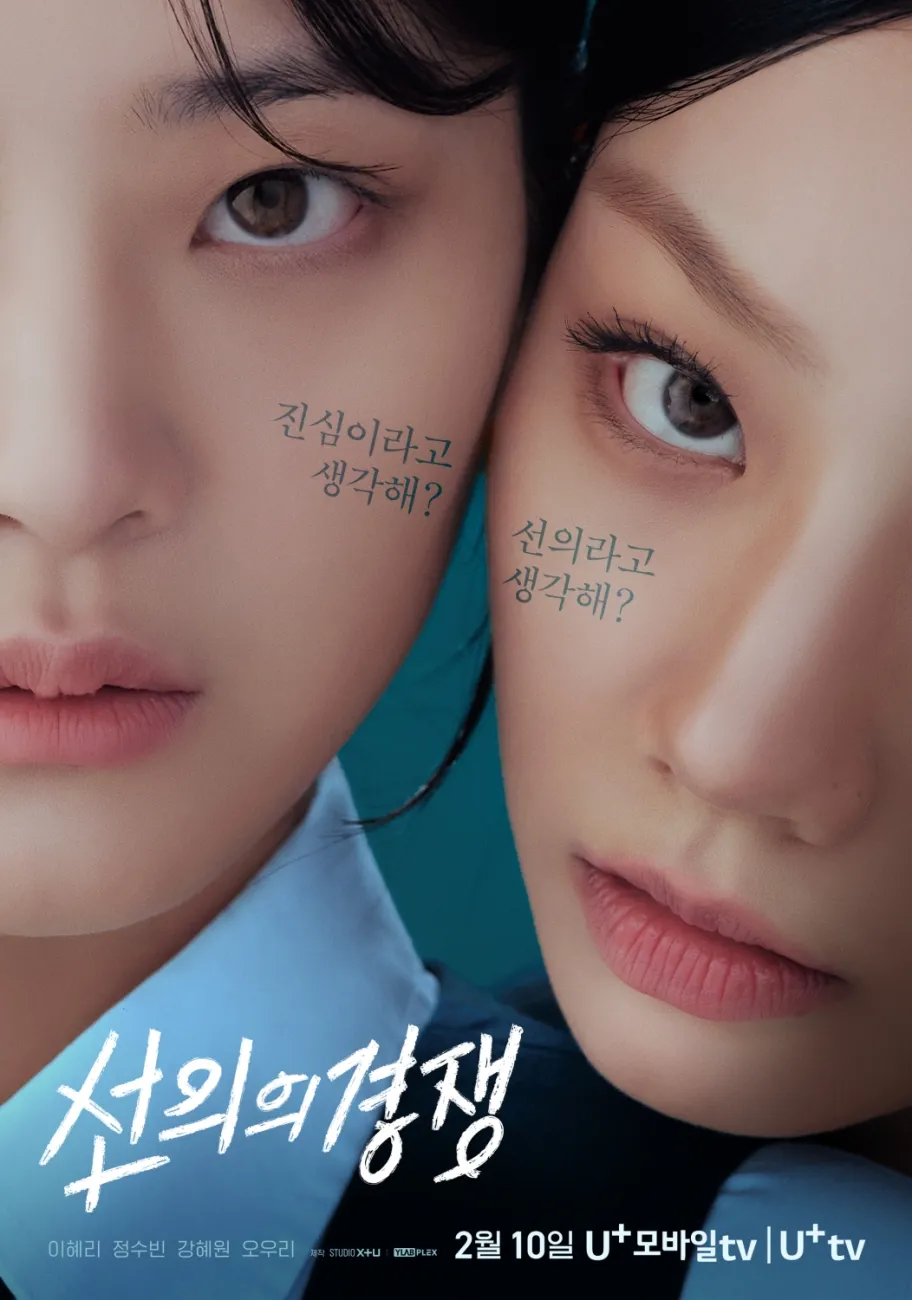
The drama Friendly Rivalry (2025) deals with the precarious world of two girls who meet during that most vulnerable and passionate period of their lives. Moving beyond a simple school mystery, this work tenaciously tracks how these girls, facing each other in profound isolation as if to consume one another, become each other’s destroyers and saviors.
🌿 Moments When This Drama Deeply Permeates
- When you feel that, under the suffocating pressure of competition, the only means to prove yourself is through the validation of others
- The moment when the boundaries between friendship and obsession, admiration and jealousy blur, making you want to become the other person
- When you witness the fatal vulnerability hidden behind the cold mask of someone who appears flawless
- The reason to read to the end is to fully comprehend the exclusive and poignant psychological relationship structure of the two protagonists and the aesthetic essence of the ending, both hidden beneath the grammar of a superficial school thriller.
🎞 Note Before Watching the Drama
This work densely depicts the extreme psychological warfare and obsession among characters unfolding within the closed space of a high school. While it includes certain provocative incidents and a cool GL (Girls Love) sentimental subtext, these function not for the sake of provocation itself, but as core devices to express the deep emotional deficits and the very essence of the relationships between the characters.
🎬 Drama Information
- Title: Friendly Rivalry (선의의 경쟁, 2025)
- Director: Kim Tae-hee
- Screenplay: Kim Tae-hee
- Original Work: Naver Webtoon Friendly Rivalry (Song Chae-yoon, Sim Jae-young)
- Country: South Korea
- Genre: Mystery, School, Psychological, Drama
- Running Time: Approximately 30 minutes per episode (16 episodes total)
- Platform: U+Mobile TV, TVING, WATCHA, Netflix
- Cast: Jung Su-bin (as Woo Seulgi), Lee Hye-ri (as Yoo Jei), Kang Hye-won (as Joo Yaeri), Oh Woo-ri (as Choi Kyung)
📖 Friendly Rivalry, A Precarious Accompaniment Created by Class Isolation and a Mysterious Hand [No Spoilers]
Woo Seulgi, who grew up in a rural orphanage, transfers to Chaehwa Girls’ High School—a gathering place for South Korea’s top 1% elite—following the sudden and mysterious death of her father, a member of the CSAT test-setting committee. Amidst extreme class disparity and a chilling competitive atmosphere, Seulgi is instantly isolated and faces the threat of ostracization. At this moment, Yoo Jei, the absolute authority and flawless transcendent of the school, reaches out to Seulgi first.
Under Jei’s exclusive attention and protection, the two rapidly become best friends. However, as dark mysteries surrounding the school and the pressure of entrance exams close in, their friendship gradually begins to morph into an abnormal obsession and madness. As Seulgi inches closer to the truth behind her father’s death, the relationship between the two girls sheds its mask of good intentions and plunges into an uncontrollable vortex of passion.
👁🗨 Analyzing the Captivity of Perfection and the Attraction of Deficit’s Magnet
In Friendly Rivalry, the relationship structure between Yoo Jei and Woo Seulgi is thoroughly asymmetrical yet complementary. Yoo Jei is a perfect individual possessing a wealthy family, transcendent intelligence, and flawless appearance; yet, in reality, she is nothing more than a prisoner trapped in a massive cage of control and pressure constructed by her father. Conversely, Woo Seulgi is an outsider from an orphanage with absolutely nothing, yet she possesses a “raw vitality” and authenticity that Jei lacks.
The reason Jei becomes emotionally submerged in Seulgi is not out of mere condescending pity. Seulgi is the only breathing hole through which Jei can strip away the mask she has been forced to wear her entire life and entirely expose her own vulnerability. Jei exhibits a deceptive pattern of placing Seulgi in danger only to dramatically rescue her—such as manipulating class president elections or directly resolving bullying incidents—which is a manifestation of an abnormal developmental background where she could confirm her own safety only by controlling others. The deficits of the two girls become magnets that powerfully attract each other, expanding beyond simple admiration into an addictive relationship where neither can maintain their ego without the existence of the other.
🔗 The Power Structure of the Gaze and the Symbolic Interpretation of the Red Thread
Within the work, the mise-en-scène and direction visually partition the power dynamic between the two clearly. Inside the classroom, Jei always looks down on Seulgi from a higher position or dominates the center of the screen, becoming the ruler of the gaze. However, the moment they enter a confined space where they face each other alone, the camera angles equalize horizontally, generating a taut emotional tension.
In particular, the directorial intent behind the deepening GL subtext and the kiss scenes after the midpoint is not the simple fulfillment of a romantic fantasy. It is closer to a desperate struggle to press their flesh together and verify each other’s souls under extreme pressure where verbal communication has become impossible.
While cleverly inheriting the thriller-like tension of the original webtoon, the drama deepens the depth of the trauma shared by the characters through visual metaphors. The invisible chain Jei fastens around Seulgi is, paradoxically, the very lifeline that sustains Jei herself.
🔎 Reinterpretation of the Ending: Subjective Liberation Through Destructive Acceptance
Many offer varying interpretations regarding the open ending presented by the finale of Friendly Rivalry. In the latter half, to break free from the shadow of her oppressive father and entirely protect Seulgi, Yoo Jei makes the sacrificial choice to relinquish the pinnacle of vested interest—a perfect score on the CSAT. This is not a simple escape, but a narrative of liberation that finally attains subjectivity by destroying the very system that bound her.
The scene in the final episode where Seulgi confirms Jei’s survival and freedom through a courier package containing a photograph of the sea and shoes proves that their relationship has crossed an eternal fracture to finally reach a complete resonance. Jei lost the crown of success dictated by society but gained the subjectivity to save her own soul, while Seulgi broke free from dependence and suspicion, achieving growth by subjectively embracing the pain of another.
The mad obsession shared by the two girls was ultimately not a poison that destroyed one another, but the sole survival strategy to separate and protect themselves from a contaminated world. The implication of their reunion is not a mere deferral of a happy ending, but an aesthetic of lingering resonance that blesses the beginning of a new life for those who rejected the rules of the world.
💬 Interpretations on Why Solidarity Among Girls Turns Brutal in Modern Society
Q. Can Yoo Jei’s obsession and mad methods of control within the work be justified?
A. Viewed through a critical lens, the way Jei treats Seulgi clearly straddles the boundaries of gaslighting and emotional abuse. Leaving Seulgi abandoned in dangerous situations only to dramatically rescue her and become a hero stems from a pathological desire for control. However, the intent of the work does not stop at morally condemning this behavior. This abnormal form of relating is a structural monster birthed by a sadistic entrance examination system that demands only first place and tolerates no failure, coupled with an abusive domestic environment. Rather than defending Jei’s misdeeds, the work presents the aesthetic context of how utterly a girl clad in the veneer of perfection was collapsing, throwing a heavy question to the audience that goes beyond mere preference.
Q. What are the achievements of the drama’s adaptation choices compared to the original webtoon?
A. While the original focused on the suffocating psychological warfare and provocative thriller elements between the girls, director Kim Tae-hee’s drama version strengthened the mystery surrounding the death of Seulgi’s father, thereby building a sturdier genre backbone for the narrative. Simultaneously, it widened the emotional amplitude felt by the characters, raising the psychological resolution. The desires of surrounding characters such as Joo Yaeri and Choi Kyung were also designed to reflect their respective class deficits rather than leaving them as simple villains, thereby securing a degree of completion as a mirror reflecting the ills of modern South Korean society.
✨ Friendly Rivalry, Souls That Consumed Each Other to Avoid Becoming Monsters
The ending of this drama presses a sharp blade against the cruelty of infinite competition dominating our society today. The perfection that the system demands of an individual is ultimately nothing but a mirage that can only be reached by obliterating one’s own humanity. The work chillingly demonstrates how the purest values of love and identity can be distorted into the monster of obsession under extreme pressure. Nevertheless, the choice of the girls, who ultimately never let go of each other’s hands, is the most passionate rebellion against the massive proposition of a world stating that one must trample others to survive.
True victory does not mean standing at the apex of the system, but possessing the courage to willingly walk out of that system for the sake of the one you love.
💬 Where Lies Your Distance of ‘Obsession’ That Shook Your Soul?
Under the guise of wanting to save someone, we sometimes attempt to control their entire world. Between Yoo Jei’s mad protection and Woo Seulgi’s precarious dependence, what do you consider the true form of ‘solidarity’? Imagining the color of the sea the two girls would face after the ending, please leave your interpretations in the comments.
🎬 Violet Screen’s Curation Recommendations
- (ClaireBell, 2025): A raw psychological thriller that unfolds when ‘Bell,’ an innocent girl falsely accused and locked in a women’s prison, falls under the protection of ‘Claire,’ the coldest and most feared inmate in solitary confinement. Excluding simple romantic fantasies, it densely depicts how hostility in an isolated space transforms into an abnormal and intuitive obsession and solidarity for survival. It is a work that inherits the sentiment of the power structures and asymmetrical attraction seen in Friendly Rivalry with a rougher, heavier tone.
- (Like a Palette, 2026): A mysterious, emotional drama that begins when ‘Jane,’ a freshman dreaming of a peaceful college life, is captured by the gaze of ‘Dai,’ the finest genius and star of the art school. It captures the possessiveness toward an artistic muse and the subtle psychological curve of a character slowly being submerged under that gaze through a sensuous mise-en-scène. It offers a perfect psychological variation for viewers who prefer tight tension between the controller and the shaken.
To provide a more stable publishing environment, multilingual content, and better communication with our readers, we have moved our official publication to Substack.
All new film reviews and critical essays will be published on our new platform. This website will be closing down soon, so we would greatly appreciate it if you subscribed to our new space.
TODAY'S QUESTION
Which couple, on screen or in real life, are you rooting for right now?
Your answer isn't saved. Feel free to share it in the comments below.


You May Also Like

Wentworth Ending Explained and the Redemption of Franky & Bridget: A Narrative of Liberation for Isolated Souls
Verbotene Liebe Carla & Susanne Review: The Flawed Legacy of Institutional Union and Deep Interpretation